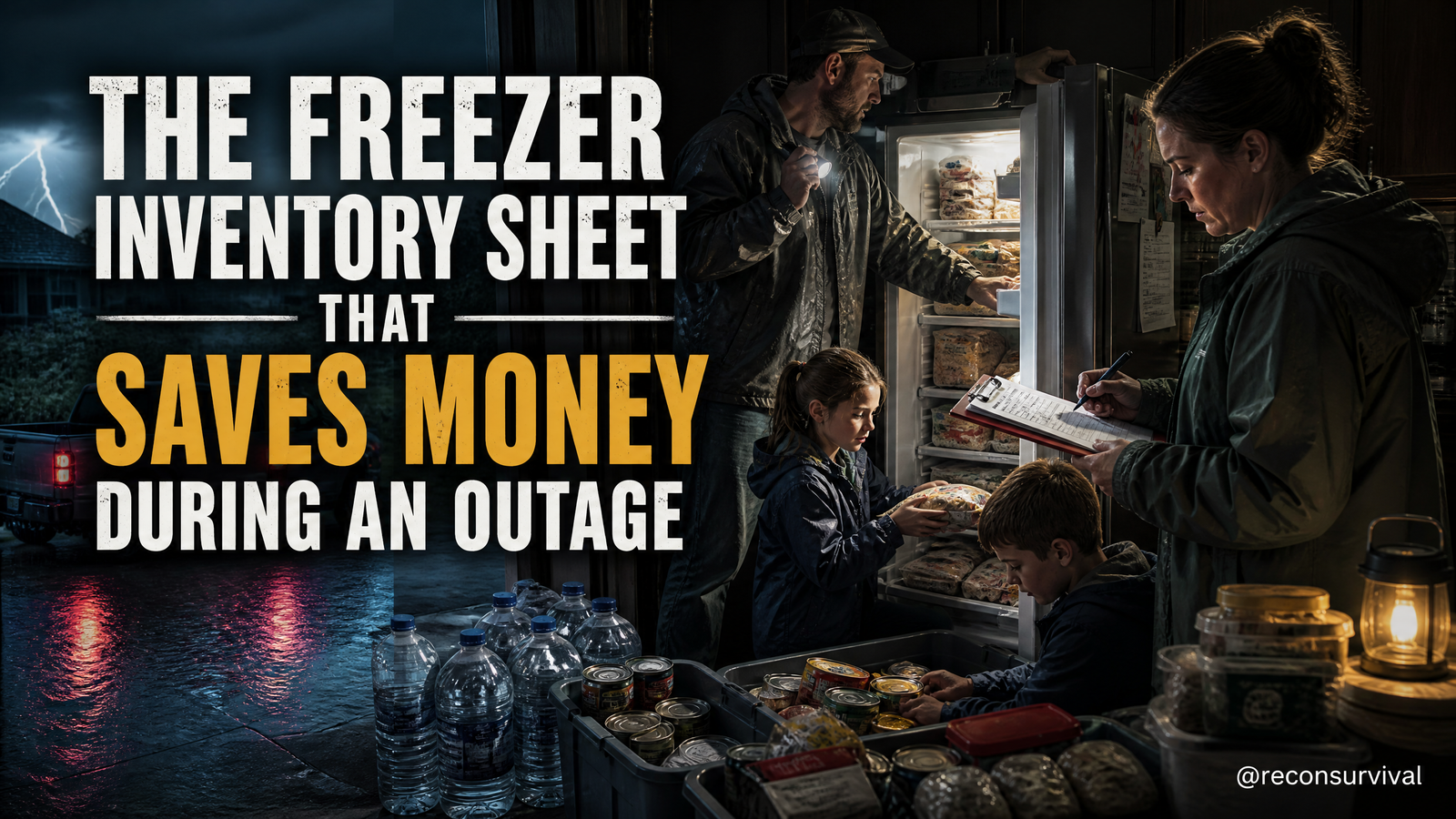
When the power blinks out, the freezer doesn't fail all at once.
Fact-Checked Safety & Sanitation Protocols
Based on current USDA Food Safety and Inspection Service (FSIS) and CDC guidelines, here is the verification and correction of the specific claims in your text regarding disinfectants and food safety thresholds.
1. Fact Check: Household Disinfectant Ratio for Food-Contact Surfaces
Status: PARTIALLY CORRECTED
The Correct Standard:
To sanitize a food-contact surface (like a cutting board) after handling raw meat, you cannot rely on soap alone or a vague "splash" of disinfectant. You must follow a two-step process: Clean (remove dirt) then Sanitize (kill bacteria).
- Step 1: Clean. Wash with hot, soapy water to remove organic matter (meat juices, fat). Organic matter neutralizes most disinfectants. Rinse and wipe dry.
- Step 2: Sanitize.
- Recommended Solution: A standard chlorine bleach solution is the most reliable household method.
- The Ratio: 1 tablespoon (1/2 ounce) of unscented liquid chlorine bleach per 1 gallon of water.
- If your bleach is highly concentrated (e.g., 8.25% typical for household): Use 1 tablespoon per gallon.
- If your bleach is less concentrated: Use 1.5 tablespoons per gallon.
- Application: Immerse or thoroughly spray the cutting board with this solution. Let it stand for at least 1 minute of contact time.
- Final Step: Air dry or wipe with a clean cloth. Rinsing with water is generally not required (and can sometimes re-contaminate if the rinse water isn't potable, though USDA says rinsing is acceptable if using potable water), but the surface must be wet with the sanitizer for the full minute.
Correction to your text:
Replace: "wash afterwards using a small basin of soapy water and a splash of disinfectant."
With: "Wash thoroughly with hot, soapy water to remove organic matter. Rinse. Prepare a sanitizing solution of 1 tablespoon of unscented bleach per 1 gallon of water. Apply to the surface, allow to sit for 1 minute, then air dry."
⚠️ Critical Warning: Never mix bleach with ammonia, vinegar, or other cleaners. This creates toxic gas.
2. Fact Check: USDA Guidance on Refreezing Foods with Ice Crystals
Status: CORRECT
Your text states: "Safe to Refreeze: foods that are still hard-frozen throughout or have ice crystals present and stayed cold."
The Verification:
The USDA Food Safety and Inspection Service explicitly confirms this.
- The Rule: You may refreeze raw or cooked food that has thawed, provided it still contains ice crystals or is at 40°F (4°C) or below and has been held at that temperature for no more than 2 hours (or 1 hour if ambient temps are above 90°F/32°C).
- Quality vs. Safety: While safe, the texture and quality of the food may degrade (especially meats with high water content) due to moisture loss during the thaw/refreeze cycle.
- Cooking First: If the food has thawed completely but is still cold (no ice crystals), the safest route is to cook it thoroughly and then freeze the cooked food. Do not refreeze raw food that has been fully liquid-thawed unless it has been kept strictly cold (under 40°F) for a very short time.
Correction/Refinement to your text:
Your description is accurate for safety. To be precise regarding quality:
"Safe to Refreeze: Foods that are still hard-frozen or have visible ice crystals and have remained at 40°F (4°C) or below. Note: Quality (texture/juiciness) may decrease after refreezing. Alternatively, cook the thawed item immediately and refreeze the cooked food for better retention."
3. Fact Check: Time-and-Temperature Thresholds for Discarding Perishable Foods
Status: CORRECT
Your text states: "Discard: items that are fully thawed, warm, or emitted off-odors… When in doubt, throw it out."
The Verification:
This aligns with the "2-Hour Rule" and the "4-Hour Rule" (for high-risk foods in extreme heat).
- The 2-Hour Rule: Perishable foods (meats, dairy, cooked leftovers) left above 40°F (4°C) for more than 2 hours must be discarded.
- The 1-Hour Rule: If the ambient temperature is above 90°F (32°C) – common in garages or cars during summer – the limit drops to 1 hour.
- The "Warm" Cue: If a food item feels warm to the touch, it has likely been in the "danger zone" (40°F-140°F) where bacteria multiply rapidly. It is unsafe.
- Odor/Texture: Off-odors, sliminess, or unusual colors are definitive signs of spoilage or bacterial growth. Discard immediately.
Refinement to your text:
Your summary is practical and safe. To add technical precision:
"Discard: Any perishable food (meat, poultry, seafood, eggs, dairy, cut fruit/veg) that has been at temperatures above 40°F (4°C) for more than 2 hours (or 1 hour if the environment is above 90°F/32°C). Also discard if the food has an off-odor, unusual texture, or is warm to the touch. When in doubt, throw it out."
Summary of Actions for Your Plan
- Update the Disinfectant Section: Specify the 1 tablespoon bleach per gallon ratio and the 1-minute contact time. Remove the vague "splash" language.
- Clarify Refreezing: Add a note that while refreezing with ice crystals is safe, cooking first is better for quality, and fully thawed cold food should be cooked before refreezing.
- Clarify Time Limits: Explicitly state the 2-hour (or 1-hour in heat) window for discarding warm/thawed perishables to make the "Discard" criteria actionable.
Final Verdict: Your document is a high-quality survival guide. With these specific ratio and time clarifications added to the "Safety Rules" section, it is fully aligned with current USDA guidelines.