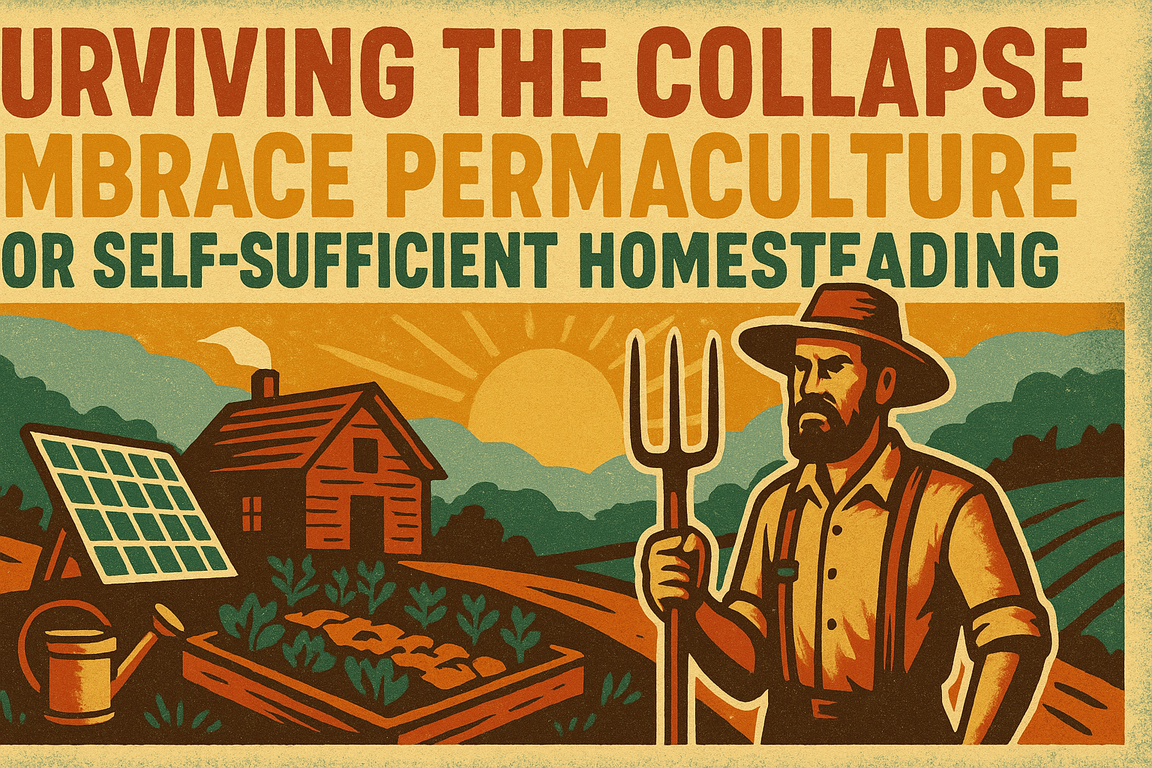
Alright, let’s get down to brass tacks. If you’re reading this, chances are you’ve got a gut feeling that the world’s going sideways faster than a greased pig on a slip ‘n slide. You’re not alone. High-yield homesteading isn’t just some hipster trend—it’s a lifeline in a world that’s hanging by a thread. And if that thread snaps? You’ll thank your lucky stars for every bit of know-how you’ve stuffed in your skull about permaculture and self-sufficiency.
Listen up. Permaculture isn’t just for tree-huggers—it’s the backbone of post-collapse survival. It’s about working with Mother Nature, not against her. It’s about building a system that’ll keep feeding you when the trucks stop rolling and the supermarket shelves are as bare as Old Mother Hubbard’s cupboard.
Self-sufficiency and resilience? Non-negotiable. It’s about not just surviving but thriving when the grid goes down and the rest of the world is scrambling. It’s about knowing that no matter what hits the fan, you’re not just a survivor—you’re a damn conqueror.
Now, let’s dig into the nitty-gritty.
Permaculture isn’t just a set of gardening tips—it’s a philosophy. It’s got ethics like caring for the earth and sharing the surplus. It’s about observing natural patterns and processes and using them to your advantage. Think of nature as your co-conspirator in the game of survival.
When you’re carving out your homestead, you’ve got to think like a general planning a battlefield. Zones and sector analysis are your terrain maps. They help you use your land to its fullest potential, putting everything from the herb garden to the chicken coop right where it should be—max productivity with minimal fuss.
Building healthy soil is like loading your magazine with the best ammo. You can’t grow jack without it. Good dirt is full of life, and you want it on your side. Composting isn’t just about tossing your scraps in a pile—it’s about harnessing decay and turning it into growth.
You ever heard of hugelkultur or mycorrhizal associations? They’re the special ops of soil fertility. We’re talking mounds of wood and soil that store water like a camel and fungal networks that turn your plants into nutrient-siphoning powerhouses.
Water is life. Period. A smart survivalist knows how to catch every drop of rain that falls from the sky and use it again and again. Earthworks are like contour trenches in a firefight—they direct the flow right where you need it. And don’t even get me started on grey and blackwater—if you’re not recycling that, you’re basically throwing away liquid gold.
Diversity in planting is like having a well-rounded squad. You need every type of plant pulling its weight. Forest gardens are the elite teams—plants working together like a Navy SEAL unit. Companion planting? That’s your buddy system. And let’s not forget perennials and uncommon edibles—they’re the unsung heroes, coming back year after year and growing stronger while everyone else is struggling.
Livestock isn’t just for fresh eggs and meat. These critters are part of your team. Rotational grazing keeps your land fresh and fertile, kinda like rotating your defensive positions. And animal tractors? That’s a movable feast, friends. Aquaculture and bees? That’s your aquatic and aerial support.
You’re gonna need energy. Solar, wind, hydro—if it’s renewable, it’s your friend. And if you’re not making biochar yet, you’re missing out on a powerful ally in the soil fertility war. Waste on a homestead isn’t waste—it’s resource. Recycling and upcycling aren’t just good for the environment; they’re essential for survival.
Innovative permaculture techniques like keyline design and syntropic agriculture are the next level of homesteading—like upgrading from a knife to a Swiss Army knife. And agroforestry, with alley cropping, is like planting a supermarket in your backyard. We’re talking maximum yield in minimal space.
Now, listen. The permaculture game is always changing. As the world shifts, so must your tactics. Education doesn’t stop when you leave the classroom—it’s lifelong, especially in permaculture. Building a community? That’s your mutual aid group, your backup when you need it most.
The legacy we leave isn’t just for ourselves; it’s for the generations that follow. It’s about passing on the torch of self-sufficiency through permaculture—teaching them not just to survive but to thrive in a world that’s doing its damn best to chew you up and spit you out.
Remember, the key to surviving the chaos is staying one step ahead. Stay ready. Stay dangerous.