A practical way to compare backup power roles without treating any system as a magic solution, but most advice is either too generic, too gear-focused, or too late.
Mid-May is a critical window for reviewing your energy resilience. The days are lengthening and the ambient temperatures are rising, putting the electrical grid under increasing strain. For most households, the power grid functions as an invisible utility that is assumed to be on when the switch is flipped. However, when grid reliability drops, your ability to maintain safety, communicate with family, and preserve food depends entirely on the backup systems you have planned and prepared. This article addresses the confusion around selecting backup power by providing a practical framework to compare the roles of solar generators and gas generators without relying on fear or hype.
Why Testing Systems Matters Before Summer Heat Peaks
As we move into mid-May, the seasonal context shifts from spring variability to the anticipation of summer heat stress. The most common mistake people make with this topic is treating any backup power system as a "magic solution." Readers often seek a single piece of equipment that will solve all their energy problems during an outage. In reality, there is no single magic switch. Solar generators and gas generators serve fundamentally different roles in a resilience plan, and expecting one to handle the other's job leads to unsafe situations or wasted money.
Treating a generator as a universal fix ignores the specific constraints of fuel supply, starting reliability, and load capacity. During the first few days of a long outage, which is the most difficult period for households, a solar generator might provide light and charging for devices, while a gas generator might be required to run a refrigerator or air conditioner. Understanding this distinction is vital for safety. If a household relies solely on battery storage for high-load appliances like air conditioners without a clear understanding of the battery depletion rate, they risk running out of power in the middle of the night or being unable to power their home once the batteries are drained.
The Most Common Planning Mistake
The primary error in backup power planning is the assumption that a larger battery bank can replace the need for a combustion engine entirely. While battery capacity is excellent for managing daily fluctuations and low-draw devices, it is not a substitute for a gas generator when high-wattage loads are needed. Another common mistake is ignoring the time-to-charge or time-to-fuel variables.
Consider a scenario where the grid goes down for 48 hours. A solar generator with a limited battery bank can run a refrigerator for a few hours if the sun is out, but once the sun sets and the sun returns the next day, the load must be managed carefully. If the homeowner tries to power a heat pump or a large air conditioner with batteries alone, the system will deplete rapidly, leaving the house cold and unsafe. Conversely, relying on a gas generator without a plan for fuel storage or maintenance can result in a machine that fails to start or runs poorly due to old or contaminated fuel.
The Recon Survival Practical System for Role Comparison
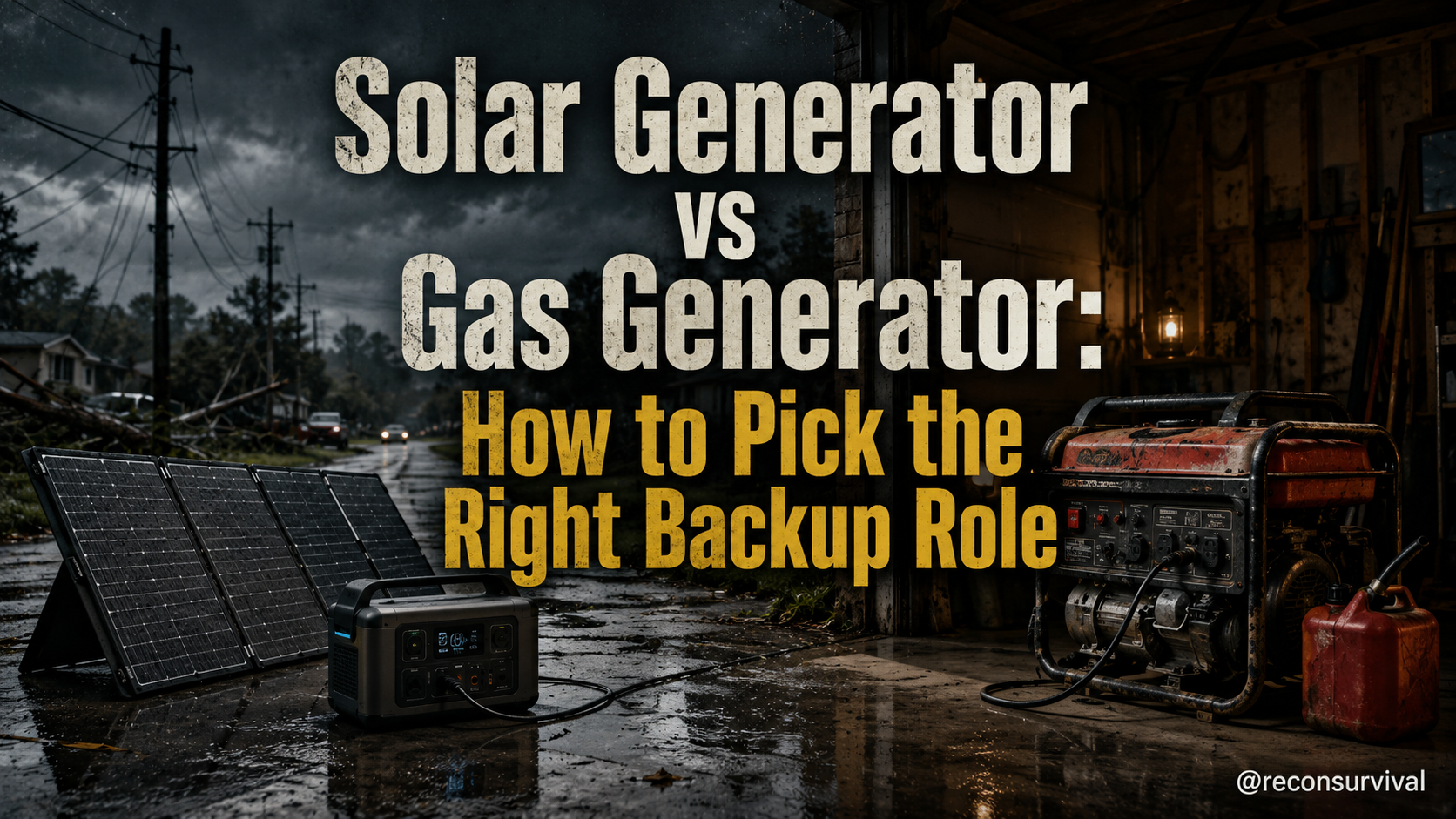
By answering these questions, a household can assign a specific job to each system. For example, a solar generator might be assigned the role of "Essentials Keeper," responsible for lighting, communication devices, and small electronics. A gas generator might be assigned the role of "Thermal Support," responsible for running refrigeration or heating during peak load times. This approach prevents the paralysis of choosing between two perceived "best" options and instead focuses on creating a hybrid capability that addresses real-world needs.
Step-by-Step Guide to Comparing Power Roles
Breaking this system into clear steps allows a normal household to implement it immediately without specialized knowledge.
- List High-Priority Loads: Identify the appliances that are critical for safety and health, such as a refrigerator, freezer, medical devices, or ventilation fans. These will define your baseline power requirements.
- Categorize Low-Priority Loads: Identify secondary needs like television, internet router, and lights. These can often be managed by smaller systems or manual solutions during an extended outage.
- Assign Fuel Sources: Determine which loads must run continuously for 24+ hours. These are likely candidates for the gas generator or a larger solar setup with significant battery storage.
- Define System Boundaries: Establish where the solar generator ends and the gas generator begins. For instance, if the solar generator runs out of charge at 8 PM, the gas generator must be ready to take over for the night.
- Calculate Runtime Needs: Use the wattage of the assigned loads and the capacity of the generator's fuel tank or battery bank to calculate how long the system can sustain the role.
- Plan for Transition: Ensure there is a clear method to switch between systems if one fails or requires maintenance. This includes having spare cables, extension cords, and fuel transfer containers ready.
Defining the Minimum Viable System
Before discussing upgrades or adding complexity, it is essential to define the minimum viable system. This baseline ensures that a household can survive the first 72 hours of a power outage, which is the standard safety window for emergency responders to assist if they have to wait for grid restoration.
For the essentials role, the minimum system includes a 1000W inverter with a lithium battery bank capable of powering a laptop, phone charger, LED lights, and a small radio for at least 8 hours. This allows for communication and basic illumination. For the thermal support role, the minimum is a portable gas generator capable of starting the refrigerator compressor, which is one of the most energy-intensive household tasks.
Upgrades should only be considered once this baseline is solid. Adding more solar panels or a larger gas tank does not help if the inverter cannot handle the load or if the fuel delivery system is blocked. A robust minimum viable system is safer than an oversized system that is poorly managed.
Safety Limits, Maintenance, and Failure Points
Every power system has specific safety limits and realistic failure points that must be understood before deployment. Gas generators, in particular, require strict adherence to ventilation rules to prevent carbon monoxide poisoning. They must always be operated outdoors in well-ventilated areas, never inside a garage, basement, or near a window. Fuel storage is another critical safety factor; gasoline should be stored in approved containers and used within a month to prevent varnish formation in the tank. Older fuel will gum up carburetors and fuel injectors, leading to failure when it is needed most.
Battery systems have their own failure points, primarily thermal runaway and degradation. Lithium-ion batteries degrade over time and should be monitored for swelling or unusual heat. If a battery bank is charged to 100% in a hot summer environment, the risk of failure increases. Manufacturers recommend keeping batteries cool and avoiding deep discharge cycles that shorten their lifespan. Regular maintenance includes checking battery terminals for corrosion, ensuring fans are clear of debris, and verifying that the transfer switches and extension cords are in good condition.
Realistic failure points also include the human element. A system can be perfect on paper, but if the owner does not know how to reset a breaker or refuel the tank, the system is useless. Training the whole family on how to operate the generator and interpret battery status lights is a non-negotiable part of safety.
Recon Survival Principle: Prioritize Safety Over Capacity
In off-grid scenarios, the ability to power a specific appliance for a short period is less valuable than the ability to do so safely and reliably. Do not assume that a system works because it is rated for a higher wattage. Always test your equipment under load before a disaster occurs. A generator that runs at half capacity with a safe voltage output is better than one that trips breakers or overheats when run at full capacity.
This principle applies to both solar and gas systems. A solar generator that trips its built-in breaker because of a voltage surge is a safety hazard. A gas generator that lacks a carbon monoxide alarm nearby is a fatal risk. Always verify that your equipment meets manufacturer instructions and local fire department guidance. When comparing systems, always ask: "Is this safe to operate in my location under these conditions?"
Recon Survival Action Plan
The following checklist helps you compare backup power roles without treating any system as a magic solution. Use this guide to audit your current setup and plan your next steps.
- Inventory your loads: Write down every appliance you want to run during an outage, noting its wattage. Distinguish between essential loads (fridge, medical) and non-essential loads (TV, AC).
- Audit your fuel: Check the age of your gas generator's fuel. If the fuel is older than 30 days, drain it or treat it with a fuel stabilizer. Replace old fuel with fresh gasoline or diesel stored in approved containers.
- Inspect battery health: Check the voltage of your solar generator batteries. Look for signs of swelling, corrosion on terminals, or loose connections. Clean terminals and tighten bolts.
- Test the transfer switch: If you have a switch to move between grid and backup power, run a test to ensure it operates smoothly. Replace any worn extension cords or switches.
- Verify ventilation: Ensure your gas generator is positioned at least 20 feet from windows and doors to prevent carbon monoxide from entering the house. Check that the exhaust pipe is not clogged with leaves or debris.
- Practice the load test: Run your gas generator at a medium load to verify it starts and runs smoothly. Run your solar generator with a device connected to ensure the inverter and battery manage power correctly.
- Document your plan: Write down the steps for operating each system. Include instructions on how to reset breakers, refuel the tank, and manage battery discharge. Keep this document in a waterproof container where all family members can access it.
Do Today
- Walk the main system named in the brief and write down the first weak point.
- Assign one person to own that fix before the day ends.
- Check the related supplies, tools, batteries, labels, or documents by hand.
- Put the next review date on a calendar instead of relying on memory.
- Move one critical item to the place where it will actually be used.
- Tell the household what changed and where the updated item now lives.
- Repeat the check after the next outage, storm warning, trip, or schedule change.