A practical way to rank water pumps, animal needs, fans, refrigeration, fencing, and tool charging by priority, but most advice is either too generic, too gear-focused, or too late.
As an Amazon Associate, I earn from qualifying purchases.
When a main power line fails, the first decision you must make isn't whether you can survive the outage, but which essential systems you can afford to keep running with limited fuel or battery capacity. This is the reality every homesteader faces when the grid goes down. You need a clear, logical method to decide what to run first, what to run last, and what to let go when the generator or inverter runs low. Most advice online focuses on the gear itself – the size of your inverter, the brand of your battery, or the wattage of your solar array. While that gear matters, it does not solve the immediate problem of resource scarcity during an event. This article provides a practical framework for ranking your most critical loads: water pumps, animal needs, fans, refrigeration, fencing, and tool charging.
Why Power Priorities Matter Before Summer Heat Arrives
Mid-May represents a transition point where the weather begins to shift toward the hot conditions that dominate the summer grid stress season. You do not need to fearmonger about total societal collapse, but you must acknowledge that summer heat places unprecedented demand on the electrical grid. When temperatures rise, residential usage spikes due to air conditioning needs, and the likelihood of rolling brownouts or extended outages increases. If you wait until the first 100-degree day to think about power priorities, you are working in a high-stress environment where fatigue and confusion can lead to poor decisions.
Testing and refining your power plan now, while the weather is mild, allows you to simulate outages without the physical discomfort of extreme heat. The reason this matters is simple: fuel and battery storage are finite resources. In a standard scenario, you may have a limited number of gallons of gasoline or a specific amount of usable battery discharge. Every watt you divert to a non-essential load reduces the time available for your life-critical systems. Establishing a priority list now ensures that when the event occurs, your actions are deliberate and effective rather than reactive and desperate.
The Most Common Mistake With Backup Power Planning
The single most common mistake people make regarding backup power is assuming that all loads are created equal or that they can afford to run everything until the fuel runs out. Many households treat their backup generator or inverter as a safety net where they can simply plug in their favorite appliances and wait for the outage to end. This mindset leads to rapid depletion of fuel or battery capacity. Without a strict prioritization system, a single error – like running a high-draw appliance while the well pump needs power for livestock hydration – can compromise your ability to function for hours or days.
Another frequent error is waiting for a crisis to define your plan. When the power actually goes out, adrenaline and heat impair judgment. You are less likely to think clearly about water conservation or load shedding when you are exhausted from the heat and worried about your pets. This article addresses that gap by providing a static system you can review in a calm environment. You define your rules now, so your brain does not have to invent a solution when the lights go out.
The Recon Survival Priority System for Essential Loads
To manage resources effectively, we need a method that separates needs into distinct categories. The Recon Survival system for ranking loads relies on four criteria: safety, biology, preservation, and utility. You will apply this logic to specific items like water pumps, animal needs, fans, refrigeration, fencing, and tool charging.
Water pumps and animal needs fall into the safety and biology categories. Animals cannot regulate their body temperature or stay hydrated indefinitely without water. Water pumps often require significant power, making them a primary contention point. Fans and refrigeration fall into the preservation and comfort categories. Fans provide passive cooling for humans and livestock, which is safer and less fuel-intensive than active air conditioning. Refrigeration preserves food safety, but it is not life-saving in the short term unless you are relying on it for medication. Tool charging and general lighting fall into the utility category. These are important for daily work but can be paused without immediate physical harm.
We will break this down further in the next section to give you a step-by-step way to apply this logic.
Step-by-Step Load Ranking for Your Household
You can apply this system by following three specific steps: Assess, Categorize, and Schedule.
First, Assess the Draw. Determine the wattage or amperage requirement for each device. A water pump might draw 500 watts, while a fan draws 75 watts. Knowing the cost in fuel or battery capacity is vital. Second, Categorize the Need. Assign each item to one of the four categories mentioned above: Safety/Biology, Preservation, Comfort, or Utility. Safety and Biology always take precedence. Third, Schedule the Run Time. Decide how long each category needs to run and how you will rotate them. For example, you might run the water pump for two hours in the morning and two hours in the evening to ensure water security without draining your generator.
This process turns a chaotic situation into a manageable routine. You can write this plan on paper and tape it to your control panel. When the power goes out, you do not need to think; you follow the list.
Applying the System to a Small Backyard Homestead
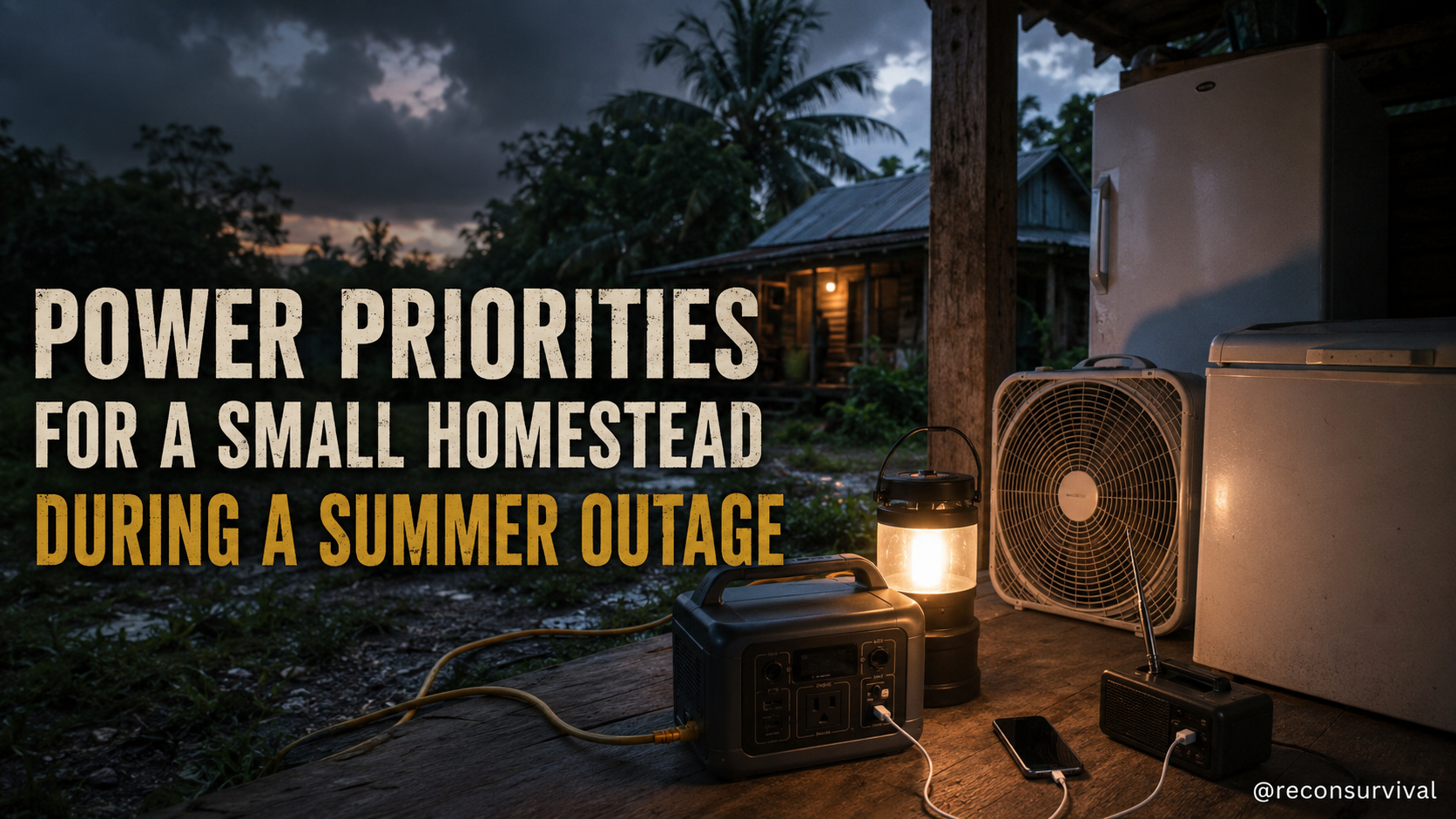
Consider a small backyard setup with a well pump, a few goats or chickens, and a refrigerator. The water pump is your first priority because it fills water troughs and keeps livestock safe. Animals have a biological need for hydration that cannot be delayed. If the pump fails, you risk dehydration within a day or two depending on ambient temperatures. The refrigerator is your second priority to prevent food spoilage, but you can accept a loss of fresh goods if necessary to save power for the pump and fans.
Fans become your third priority. In a small homestead, fans help cool the environment for both people and animals. A portable fan drawing 75 watts can circulate air effectively if placed correctly. If you have limited power, you might use a fan only when you are in the house or when the animals are in a shelter. Tool charging is low priority. You can charge a single flashlight battery or a radio battery during the peak of your water pump cycle. This approach ensures you never sacrifice animal welfare or immediate hydration for the sake of convenience.
Low-Cost Options and Durable Upgrade Paths
You do not need expensive gear to implement this system, though upgrading offers long-term benefits. For low-cost options, a standard gasoline generator with a basic automatic transfer switch or manual cord management suffices. You can use a timer to run the water pump only when necessary. For more durable upgrades, consider an inverter generator that runs quieter and cleaner, or a propane generator that is less prone to running out of fuel if you have stored supplies. You can also invest in a larger battery bank for a grid-tied system that allows for more flexibility in managing loads. Regardless of the gear, the priority logic remains the same: safety first, preservation second, comfort third. A battery monitor helps you track exactly how much capacity is left, giving you a precise metric for when to switch off non-essential loads.
Recon Survival Principle
Safety and Biology Always Trump Convenience. When resources are constrained, the physical needs of living beings – hydration, temperature regulation, and food safety – must come before tool functionality or comfort. This principle guides every decision you make about load shedding.
Do Today
You can begin implementing this system immediately with a few concrete actions. Follow this checklist to organize your current setup before the next heatwave arrives.
- Write down the estimated wattage or fuel cost for your water pump, fridge, fans, and any other critical devices.
- Rank your devices into the four categories: Safety/Biology, Preservation, Comfort, or Utility.
- Create a physical priority list on paper that ranks water pumps and animal needs at the top.
- Identify one fan you can use for passive cooling and note its power consumption.
- Check your fuel storage levels and ensure you have enough for your top two priority loads.
- Test your current generator or inverter setup by running your water pump for a short duration while the main power is on to verify operation.
- Review your current power plan and adjust it based on the seasonal context of approaching summer heat.
By following these steps, you transform uncertainty into a clear plan. You prepare your homestead for the inevitable stresses of the season, ensuring that when the power goes out, you are ready to act calmly and effectively.