A practical way to organize storm supplies by use case, household role, and outage phase, but most advice is either too generic, too gear-focused, or too late.
As an Amazon Associate, I earn from qualifying purchases.
Why a Dark Storm Tote Fails Before the Lights Go Out
The last full week of May is the final window to complete your hurricane supplies before the season officially begins. Most households assume that if they have water and snacks, they are ready. They are wrong. The real problem starts when the power grid goes down and the clock ticks past twelve hours. That is when a disorganized supply bag transforms into a scavenger hunt. You reach into the dark, feeling around for batteries that do not fit your flashlight or water that has been exposed to damp heat. This article solves a specific, high-stakes household failure mode: the inability to locate critical supplies during a prolonged outage. We are not talking about fear or fantasy; we are talking about the simple mechanics of accessing your gear when your eyes cannot see it.
The Utility of a Organized Hurricane Ready Kit
Organizing a storm tote by use case and outage phase is not about fearmongering. It is about operational continuity for your household. When the power fails, the normal flow of decision-making breaks down. Your brain enters a state of stress response, narrowing your focus to immediate threats like darkness and hunger. If your supplies are not categorized, you waste precious energy searching for items. In a survival scenario, that wasted energy is calories and decision-making capacity you do not have. A properly organized kit allows you to maintain order while chaos brews outside. It ensures that the person who needs a medical item can find it without asking, and the person who needs light can find it without panic. This is the difference between surviving an event and recovering from one. The hurricane season ready kit is most useful when it functions as a calm command center, not a chaotic pile of purchased items.
The Common Mistake: Sorting by Container, Not Function
The most common mistake people make with storm kits is organizing by where the item is, rather than what the item does. You see this when you reach into a backpack and find a box of batteries sitting next to a first aid kit that is half-empty. You also see it when supplies are grouped by brand or purchase date. If a storm hits in late May or June, and you have a bag full of items sorted by brand, you will likely spend the first hour of an outage looking for the specific type of fuel cell for your stove. You are sorting by container, not function. This failure point happens because we treat our survival supplies like groceries. We assume we will have time to rummage. We do not. The first hour of a major outage is often the most critical. If you cannot locate your flashlight within thirty seconds of the lights going out, you have lost that critical window. The mistake is believing that "having" the supplies is enough. You must also have the system to access them.
The Recon Survival Three-Axis Organization System
To fix this, Recon Survival recommends a practical system that organizes supplies by three axes: use case, household role, and outage phase. This system forces a logical structure onto your gear before you pack the bag.
Use Case Axis: This is the function of the item. Does it provide light? Does it provide hydration? Does it provide medical care? Does it preserve food? Every item must have a single, clear function assigned to it. If an item serves multiple purposes, it must be clearly labeled for its primary function.
Household Role Axis: This groups supplies by the person who is responsible for using them. Children need different access points than adults. People with mobility issues or specific medical conditions need their items placed in the most accessible location. In a multi-generational home, separating items by age or responsibility prevents confusion. A child looking for candy will not be distracted by the first aid kit. An adult looking for a radio will not be confused by the water filtration system.
Outage Phase Axis: This is the timeline of the emergency. Phase one is the immediate need: the first four to six hours. Phase two is the extended need: twenty-four hours to three days. Phase three is the transition to external aid or recovery. Supplies should be grouped by when they are needed most. High-calorie, low-prep food goes in phase one. Water purification systems go in phase one. Fuel for a stove goes in phase one. Items like games, books, or long-term food reserves belong in phase two or three.
Step-by-Step Guide to Building Your System
You can build this system using any durable tote bag or rolling luggage. Follow these steps to organize your storm supplies.
Step 1: Define Your Roles. Before packing, list every person in the household. Note any specific needs. Write these names on a piece of tape or a card inside the tote. This creates the "Household Role" anchor.
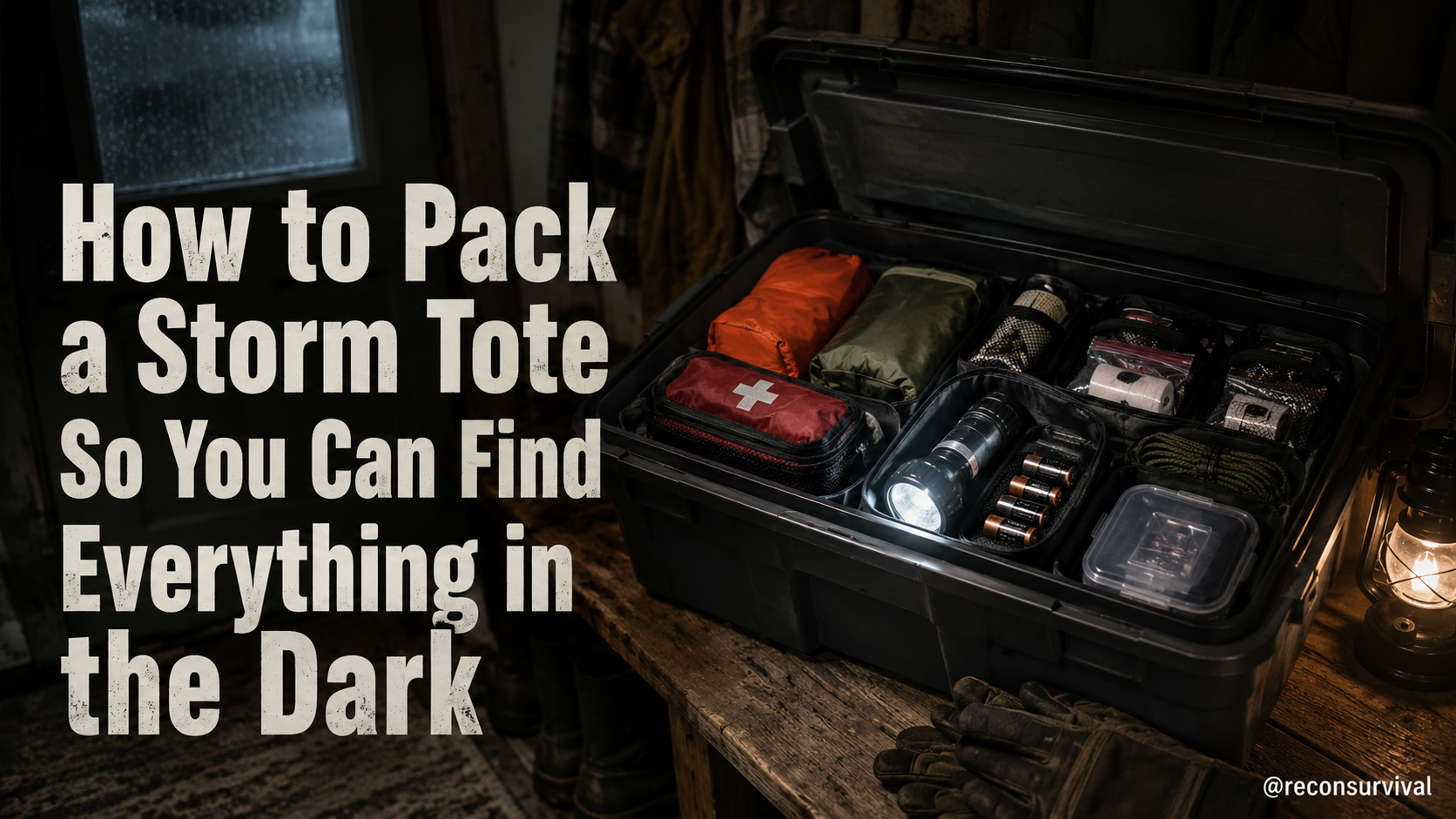
Step 2: Categorize by Function. Separate your supplies into their core functions. Create distinct zones for "Light," "Water," "Nutrition," "Medical," and "Comfort." Label each zone clearly with permanent markers. Avoid writing on the outside of the container if the tote is reusable, but ensure the internal labels are legible in low light.
Step 3: Sort by Phase. Within each function zone, sort items by urgency. Place the critical items needed for the first night in a separate, easily accessible pouch or compartment. Place the secondary items in a secondary pouch. Place the tertiary items, which might be used for comfort or longer-term needs, in a compartment that is accessible but not the primary first grab zone.
Step 4: Cross-Reference. Create a small laminated card or waterproof notepad that maps the physical location of every item to its function. For example, "Water: Top Left Pouch, Phase One." This card should be visible even in total darkness if you have a glow-in-the-dark sticker on it.
Step 5: Test the Reach. Stand the tote on the floor. Close your eyes. Try to retrieve the primary light source. Try to retrieve a water pouch. Try to retrieve a specific medical item. If you stumble or hesitate, your organization is flawed. Adjust the placement until the items are intuitive to your hand.
A Safe Beginner Practice Drill
You need to practice this system before the storm hits. Do not wait until the lights go out to test your bag. You will be too stressed to simulate the process, and you will learn nothing. Instead, perform a dark drill once a month, ideally in May or June.
- Dim the room in your house. Turn off all lamps.
- Place the closed storm tote on the floor in a central room, away from walls.
- Pick a role, such as "parent." Without using your eyes, you must locate a water bottle and a flashlight within ten seconds.
- Repeat this with other roles in the family, including children if they are old enough to understand the drill.
- Time yourself. Note how long it takes to find items.
- If you fail to locate an item quickly, open the tote and reorganize it. Move the item to a more accessible location.
This drill simulates the cognitive load of an emergency. It trains your muscle memory to access supplies without visual cues. It is safe, requires no special equipment, and takes only five minutes.
Measuring Improvement in Your Readiness
How do you know if you are improving? You measure it by speed and accuracy. The goal is to reduce the time it takes to locate a specific item by half every month. Start by timing yourself. If it takes thirty seconds to find a flashlight in the dark, your goal for the next month is fifteen seconds. Accuracy is also key. You should be able to find the correct item every time. If you grab the wrong flashlight, or if you grab batteries that do not fit, your organization has failed. Keep a simple log of your drill times. When your time drops below your threshold, you know your skill is improving. You are no longer relying on luck or panic; you are relying on a trained system.
Recon Survival Principle
Principle: Order is a Defensive Asset.
In any survival scenario, the first casualty is often the ability to make clear decisions. A disorganized kit forces you to make decisions under stress about where items are. An organized kit eliminates that variable. By sorting supplies by use case, role, and phase, you remove the burden of decision-making from your mind. This allows you to conserve mental energy for actual threats. This principle applies to any survival kit, from a car emergency pack to a long-term storage cache. The goal is always to create a system where the right tool is in the right place, without needing to think about it.
Do Today
You can implement this system today. Here are seven concrete actions to get your storm tote ready.
- Take your storm tote out and place it in the center of a room.
- Empty the tote completely onto a clean surface.
- Sort every single item into its functional category: Light, Water, Medical, Food, Communication.
- Group items by the person in the household who is responsible for them.
- Place the most critical items, needed for the first six hours, into a top-tier pouch or accessible location.
- Place secondary items into a secondary pouch.
- Label every pouch or compartment with a waterproof marker.