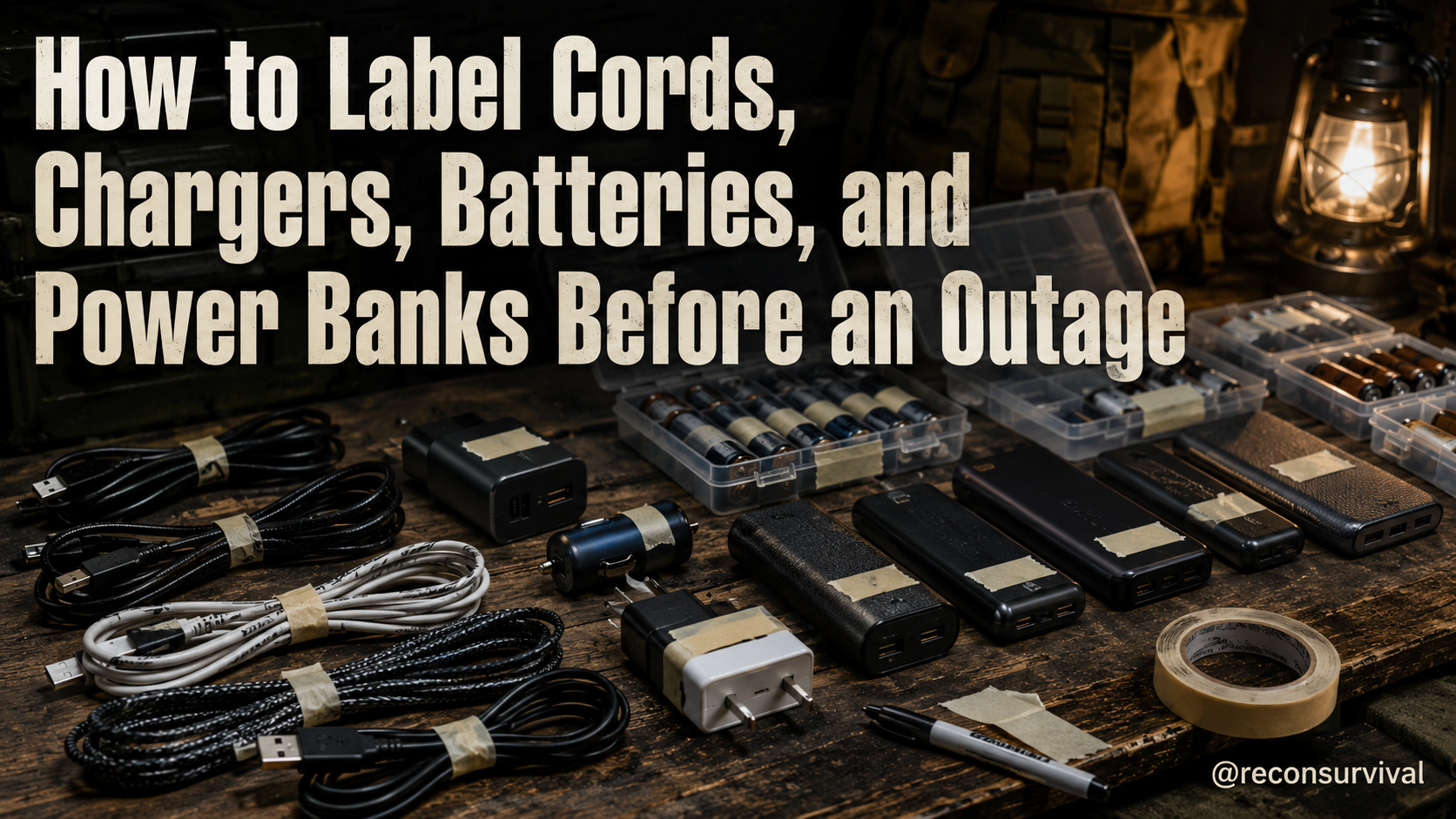
A practical way to organize small power gear so anyone in the household can use it under stress, but most advice is either too generic, too gear-focused, or too late.
As an Amazon Associate, I earn from qualifying purchases.
The Chaos of the Blackout Cabinet
When the grid flickers or goes dark, the first thing most families do is reach for the backup gear. But in the minutes that follow, confusion sets in. One family member hunts for the generator fuel while another frantically tries to locate a specific battery bank charger. The result isn't a smooth transition to survival mode; it is a panic scramble where valuable seconds are lost simply identifying which tools are needed.
This disorganization is the silent enemy of household readiness. The problem isn't just that you lack a generator or extra batteries. It is that your backup power gear is not immediately usable by everyone in the home. If the primary user is incapacitated or overwhelmed, and the secondary person cannot identify which cord charges the medical device, which battery starts the vehicle, or where the portable heater plugs in, the family fails before the event even fully unfolds.
Organizing small power gear is a critical survival skill that goes beyond simply buying equipment. It is about creating a system where function is decoupled from memory.
Why Labeling Matters Before Summer Heat
As the calendar turns toward mid-May, the regional power grid begins to feel the strain of increasing seasonal demand. We are entering a period where high temperatures drive air conditioning usage, often pushing older grid infrastructure to its limits. In a scenario where the utility fails to manage this surge, a blackout becomes more than a nuisance; it becomes a logistical challenge that requires immediate, clear decision-making.
Without pre-summer preparation, the risk is not just losing power. It is losing time. When power fails during the peak heat of late spring or early summer, cooling systems shut down, refrigeration fails, and lighting goes out. Families need to move from reliance to immediate self-sufficiency. A labeled and organized kit allows you to address these needs instantly. You don't need to think about which cable goes to which port. The system tells you what to do.
This is not about predicting a specific failure date. It is about reducing the cognitive load required to survive a power event. When you are calm and your gear is organized, you can focus on safety and preservation. If you are confused and your gear is a jumble, you focus on finding things in the dark, which increases the risk of error and injury.
The Common Mistake: Functional Amnesia
The most common mistake people make with backup power gear is assuming that because they know where the items are, their household members know too. This is a dangerous assumption.
Many families store chargers in a pile near a router or a laptop charging station, believing that the item's location defines its identity. However, in a stress event, the brain's ability to process complex information diminishes. You cannot rely on a spouse or a child to identify a specific multi-pin connector or a proprietary battery pack if they have never used it or seen it organized specifically for an emergency.
Furthermore, many people buy a "surplus" of gear and throw it all into a single closet or basement bin. They think, "I have a generator, so I don't need to worry about a battery pack." Or they buy five different brands of power banks but do not label them or categorize them. This leads to "functional amnesia." The gear is there, but its specific function is not accessible without a search. Searching for gear under stress wastes critical resources like time and fuel.
The Recon Survival Small Power System
To solve this, we use the Recon Survival Practical System for Small Power Organization. This method treats every cord, battery, and charger not as random objects, but as data points that must be indexed. The goal is to make the gear's function visible without requiring you to think about it.
This system relies on three pillars: Visual Indexing, Functional Grouping, and Redundancy Clarity. Visual indexing means the function is written on the item. Functional grouping means items that work together are stored in the same container. Redundancy clarity means you know exactly what alternative exists if the primary method fails.
By applying this system, you transform a cluttered storage space into a command center. You ensure that if one family member cannot operate a specific device, another person can instantly pick up the right tool because the labeling system guides them. This ensures that the family's ability to function does not depend on a single person's memory or physical capability.
Step-by-Step Implementation for Households
Implementing this system does not require expensive hardware or industrial labeling machines. It requires standard household items and a willingness to organize. Follow these steps to build your system:
- Inventory and Clean: Remove all unused gear from your emergency storage. Check for corrosion on battery terminals and wear on charger cables. Discard any broken or unreliable items. A functional system requires working components.
- Categorize by Function: Sort your gear into clear groups. Examples include "Vehicle Start Power," "Medical Device Charging," "Communications," "Lighting," and "Heating." Do not mix categories.
- Apply Durable Labels: Use a label maker or a permanent marker with waterproof tape for items that cannot be labeled directly. Write the function clearly on every cord and battery. For example, write "solar charger A" on a specific cable, or "Charger for Medical Pump" on a specific brick.
- Standardize Connection Points: Ensure that you know which outlets in your home or vehicle correspond to specific backup devices. If you have a portable battery station, label the input port with the type of generator or solar input required.
- Create Storage Zones: Use sturdy bins or shelves. Assign one bin per category. Place a label on the bin and a corresponding list inside the lid. Ensure the bin is located in a safe, accessible area that is not blocked by furniture.
- Document the System: Create a simple sheet of paper or a digital file that lists the gear in each bin, its capacity, and its status. Keep a copy with the gear itself.
- Review with All Members: Walk through the system with every adult in the household. Point out what each item does. Ensure everyone understands the logic of the labeling.
Practice Drill: The Blind Pick
To verify that your system works, you must run a drill. Do not just assume that the labels will be seen. Run a "Blind Pick" drill.
Have one family member remove a battery from a bin, place it in a dark or covered area (simulating a power outage environment), and ask another family member to identify the battery's function and capacity without looking at the original label or list. If they cannot identify the gear, you have found a gap in your system.
Next, simulate a scenario where the primary label is worn off. Cover the main label with tape or ask the person to ignore it. Can they still identify the gear by shape, connector type, or a secondary label? This teaches you to build redundancy into your organization.
This drill is safe and low-stress. It uses simple household items like tape, markers, and batteries. It takes only ten to fifteen minutes. Running this drill quarterly ensures that your system remains robust and that all household members are familiar with the backup power assets.
Measuring Improvement
How do you know if your skill is actually improving? You do not measure success by how many batteries you own, but by how quickly and accurately your household can locate and identify the necessary gear.
Set a baseline. Time how long it takes a non-practitioner to find the correct charger for a specific device. Document this. Then, after implementing the labeling system and running the drill, time the new process. You should see a significant reduction in time and a drop in errors.
Track the condition of your gear as well. Record how many items you replaced or discarded during an inventory. A healthy system should show zero or minimal corrosion on connectors and batteries. If you are constantly breaking cables because they are tangled or stored poorly, your organization system needs adjustment.
Success is defined by the ability to make a decision under stress without hesitation. If a family member asks, "Where is the solar input for the battery bank?", and the answer is immediately visible or accessible, the skill has improved.
Recon Survival Principle
Readiness is not about having everything; it is about knowing exactly how to use what you have.
In survival, hesitation is a liability. The difference between a safe night and a dangerous one often comes down to the speed of your response. Organized gear removes hesitation. When every tool is labeled and grouped by function, you can act immediately. Do not rely on memory alone; rely on a system that works regardless of who is leading the response.
Do Today
To begin organizing your small power gear today, follow this checklist. These actions are practical and require minimal time:
- Gather Materials: Find a box of permanent marker labels, tape, and a small trash bag for discarded items.
- Inspect Your Gear: Take every cord, charger, and battery out of their storage location. Check for frayed wires, loose connections, or damaged casings.
- Create Categories: Decide on three to five main categories for your small power gear (e.g., Charging, Lighting, Starting, Medical, General).
- Label the Items: Write the specific function and capacity on every item. If an item has multiple uses, write the primary use first.
- Store in Bins: Place the gear into sturdy, labeled bins. Ensure the bins are on the floor or a low shelf that does not require heavy lifting to retrieve.
- Run a Quick Drill: Have one family member point to a bin and ask another to identify the contents. Adjust the labels if confusion occurs.
- Secure the List: Place a simple index list inside the lid of the main storage bin so the contents are clear even if bins are stacked.
- Review with Family: Walk through the system with your family and confirm that everyone knows what each item is used for.
- Plan Your Next Drill: Schedule your first "Blind Pick" drill for next month.
Follow these steps to build a system that transforms a pile of cords and batteries into a reliable, organized command center. By the time summer arrives and power demand peaks, you will be ready to transition instantly to self-sufficiency.
FAQ
What if I don't have a label maker?
- Use a Permanent Marker and Tape: If you do not have a label maker, use a permanent marker (such as a Sharpie) and a piece of clear tape or a small sticker to protect the ink. Write the function and capacity clearly. Secure the label with tape to prevent it from wearing off or peeling.
What if my family members don't know the function of an item?
- Conduct a Training Session: Organize a short training session where you explain the function of each item in the kit. Walk through the labeling system. Ensure everyone understands the categorization. If confusion persists, simplify the categories or add more labels.
How often should I review the gear?
- Review Every 6 Months: You should perform a full review every six months. During this review, check for corrosion, replace expired batteries, and reconfirm the labeling. If the labels become worn, replace them immediately.
Conclusion
Organizing small power gear is a critical survival skill that requires more than just a generator or extra batteries. It is about creating a system where function is decopled from memory. When power fails and you need to find a specific cord in the dark, a well-organized, labeled system ensures that confusion does not set in. By following the steps outlined in this guide, you can transform your cluttered storage into a reliable command center, ensuring your family's safety and self-sufficiency.