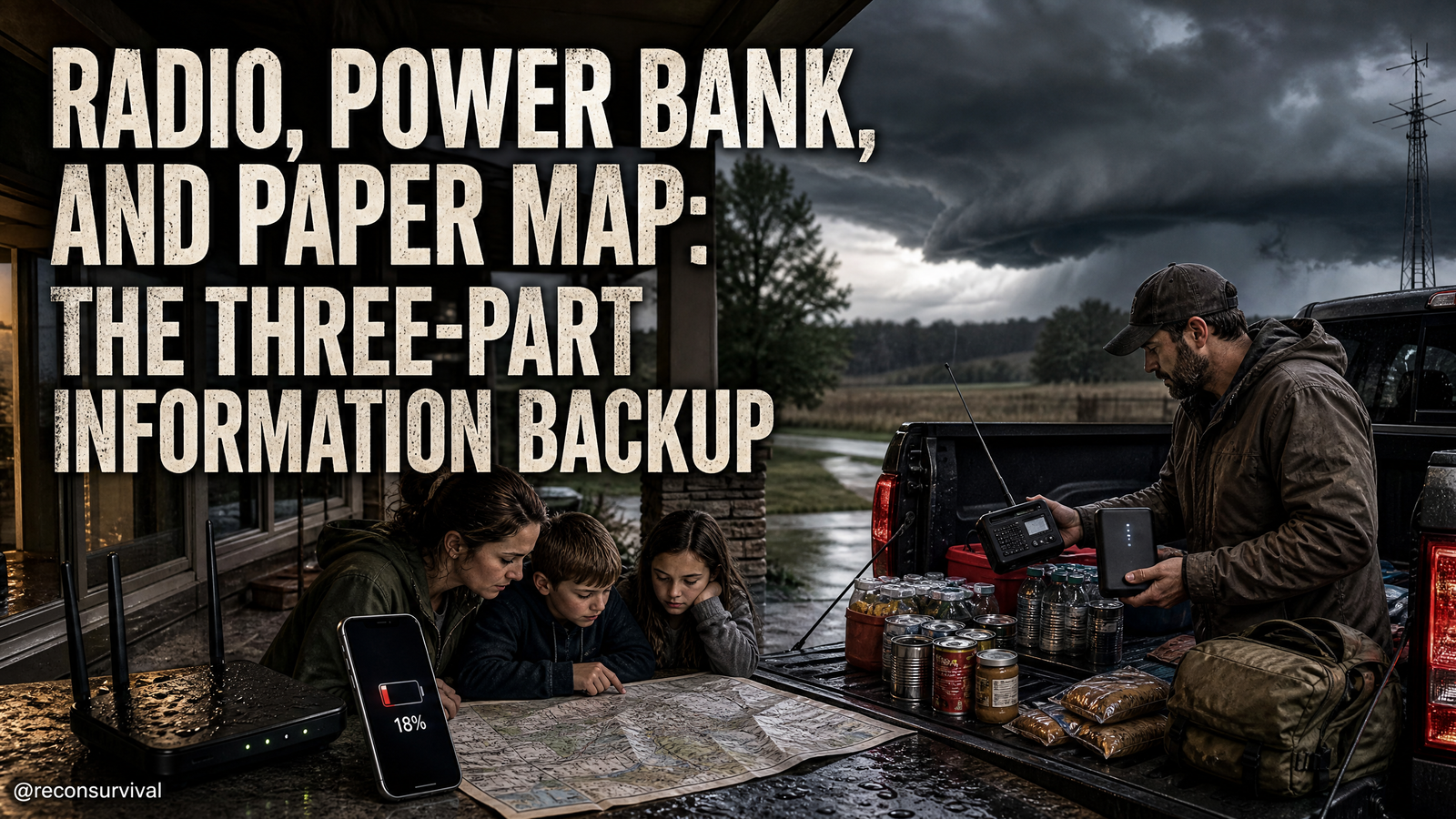
Water on the countertops, phones at 18%, router lights dead, and the group text stalling out. That's the moment a simple three-part backup matters: a radio to hear what's happening, a power bank to keep at least one phone alive, and a paper map so you can move without the internet arguing with you. Mid-summer storms and road miles expose how fragile your "all-in-one" phone plan really is. Build this redundancy into your house by location and it works under stress.
As an Amazon Associate, I earn from qualifying purchases.
Entryway Shelf: The Grab-Now Information Kit
Put the core kit where hands naturally go when you leave. A shallow bin on the entryway shelf or a labeled tote in the hall closet keeps the three-part backup together and visible.
What to stage, labeled and ready:
- Radio: Compact NOAA/AM/FM with speaker and headphone jack. Examples include any weather-capable portable that takes AA/aaa batteries. Hand-crank models are a backup, not your primary power plan.
- Power bank: 10,000 to 20,000 mAh, with at least two outputs. Pair it with a short USB-C and a Lightning cable in a zip bag. Add a micro-USB adapter if you own legacy lights or radios. – Paper map: One state map plus a printed 20-mile radius street map centered on your home. Slip both into a 1-gallon zip bag with a fine-tip Sharpie, a pencil, and a small compass.
Field work:
- Weigh the bin so you know it's grab-friendly. Under 4 lb is realistic for most people.
- Tape a small index card to the bin: "Radio, Bank, Map checked on: ____." Fill the date every 30 days. – Pre-set the radio: extend the antenna, find your local NOAA weather channel, and preset your two strongest AM news stations. Write those frequencies on blue painter's tape stuck to the radio's back.
Decision trigger: If the power dies for more than 10 minutes and your phone can't load a page, move the kit to the coffee table. If an evacuation watch is issued, the kit rides by the front door next to the go-bags.
Living Room: Radio Setup and Use That Actually Works
The living room shelf is where people gather and where you can hear updates without everyone crowding a hallway. Your radio lives here, plugged in if it supports AC, with fresh batteries already loaded.
Practical checks:
- Open the battery door and confirm the battery type and count. Write "3xAA" or "2xAAA" on a label. Keep one full spare set rubber-banded to the radio.
- Test volume and clarity on both AM and FM. AM is your friend when the grid's shaky. Rotate the radio a quarter turn if reception is poor; AM ferrite antennas are directional. – Post a small card under the radio with:
- NOAA channel number(s) that come in clearly. – Two AM news stations and one FM local station. – The county names around you for weather alerts.
Operating rhythm:
- Storm watch: extend antenna, set radio to NOAA, volume low but audible from the kitchen.
- Outage: scan AM for emergency info every 30 minutes. Note shelter locations, road closures, and boil-water alerts with a pen on your paper map margins. – Overnight: move the radio to a central hallway outlet with volume low if it supports alert mode per the manufacturer's instructions. If not, keep it in the living room and run a scheduled top-of-hour check.
Battery rotation: date the fresh batteries with a Sharpie. Rotate every 6 months into remotes or toys so the radio always gets newest cells.
Kitchen Counter: The One-Device Trap and How to Fix It
Most households fail by betting everything on one phone and a giant battery. When the tower is down or jammed, you've got a bright rectangle and no plan. The fix is a small, boring system you can maintain while the coffee brews.
Stand-up routine on the kitchen counter:
- Count your cables. You need at least one working cable for each critical device you intend to power. Put them in a zip bag labeled "Kitchen Cables," tossed in the utensil drawer front corner.
- Enable offline maps on at least one phone today. Download your city and the two nearest cities. Write "Offline maps: ON" with the date on a sticky note inside a cabinet door. – Print a one-page contact sheet: household names, two out-of-town contacts, pediatrician, vet, school, work, and a note: "Text first, then call." Tape a copy inside the pantry door and slide a spare into the paper map bag.
Why this matters: phones are still the best camera, note taker, and text device. The power bank keeps that utility alive. The radio tells you which direction is safe, and the paper map gets you there when GPS lies. Together they cut the noise and put you back in control.
Bedroom Nightstands: The Minimum Loadout for Sleep Hours
Night is when bad weather and bad timing collide. A small nightstand kit stops the midnight scramble. Keep it in the top drawer or on a tray next to the lamp.
Minimum viable kit per occupied bedroom:
- One small flashlight with fresh AA/AAA batteries or a clipped headlamp on the lamp base.
- One 10,000 mAh power bank charged to at least 80%, rubber-banded to a short charging cable for the occupant's phone. – A wallet-size contact card: household emergency numbers, home address, and the agreed meet spot.
Assign roles with paper:
- On a sticky note under the lamp: "If outage: A wakes radio, B grabs entryway kit." Write names. That prevents two people doing the same thing while the kids wait.
- If you have kids, write "Kid bag under bed: grab shoes + hoodie + card." Stage a small drawstring bag with those items.
Check cadence:
- First Saturday monthly: pick up the bank, press its indicator button, and top it off. Date a small label on its back. Test the flashlight for 3 seconds, then click it off.
Home Office Binder: Paper Maps and Contact Sheets That Survive Stress
Maps are your analog GPS. They don't need towers, accounts, or updates to show the road that's actually open. Build a slim binder or folder that lives on the office shelf within arm's reach of the desk chair.
Assemble the paper stack:
- One state highway map and one city street atlas, or high-resolution prints covering a 20-mile radius around home and along two likely evacuation corridors. Highlight three routes out of town in different directions.
- Print a 2-page "Local Operations" insert:
- Addresses for hospitals, urgent care, fire stations, police, and animal shelters. [FACT CHECK REQUIRED: verify shelter policies and locations with local emergency management]
- Utility outage numbers and your account numbers. – Frequencies: your primary NOAA channel number, the AM/FM stations you rely on, and channel notes for any family radios you own. – Slip sheets into page protectors. Add two pencils, a fine-tip waterproof pen, and a small notepad in the folder pocket.
Distribution:
- Make two additional packets: one folded map and one contact sheet in a zip bag for the entryway kit and one for the vehicle glove box.
- Write your last name and phone number on the lower-right corner of each map page in pencil. If it gets separated from you, it can find its way back.
Garage Shelf: Power Banks, Charging, and Solar Without the Myths
Your charging bench belongs on a waist-high garage shelf or utility room cart where outlets are free and cords aren't tripping hazards. The goal is steady, boring power for small devices.
Layout:
- One labeled bin: "Power Banks" holding 2 to 4 units totaling 20,000 to 40,000 mAh for a family of four. That's about 2 to 4 full phone charges per person.
- One small 10- or 20-watt USB wall charger and a multi-cable (USB-C, Lightning) dedicated to topping banks weekly. – Optional upgrade: a 10 to 21-watt folding USB solar charger for multi-day outages. Clip a note to it: "Expect 5-10 Wh/hr in good sun; one 10,000 mAh bank may take a full sunny day to recharge."
Care and safety:
- Heat kills lithium. Do not store power banks in hot cars or on a sunny windowsill. Keep them between 50 and 80°F when possible.
- Date each bank with painter's tape. Recharge to 80 to 100% every 60 to 90 days. If a bank swells, smells, or runs hot, stop using it and follow local disposal guidance. – Test under load: once a quarter, plug a phone or small lantern into a bank for 30 minutes. Confirm steady output.
Car charging:
- Put a 12V car charger with dual USB outputs in the glove box. Label it with your vehicle's fuse rating so you don't exceed it. Only idle a car outdoors with the tailpipe clear. Use carbon monoxide alarms at home when running any engine nearby.
Vehicle Glove Box: Mobile Redundancy for Evacuation
Your vehicle is the second house. If you leave in a hurry, it carries your information system without thinking.
Glove box loadout:
- Paper map packet in a zip bag, plus the spare contact sheet.
- Car charger and a short cable set wrapped with a rubber band. – One slim 5,000 to 10,000 mAh power bank. Date it and top it off at every oil change. – Pocket-sized AM/FM radio with a single AAA or a coin cell, plus one spare battery taped to it. – Mini-clipboard with a pencil. You will need to write a mile marker, detour, or frequency while buckled in.
Center console additions:
- Two laminated family contact cards. Hand them to kids or passengers at the start of a long drive if cell service looks sketchy.
- A small compass and a pair of foam earplugs. Sirens and wind noise make it hard to hear radio updates; earplugs help a driver focus.
Departure trigger:
- If a civil alert, wildfire smoke, or rising water threatens your route, move the car kit to the passenger seat cupholder and preload your radio and phone. Put the paper map on the dash pocket open to your first route.
Utility Closet: Safety Limits, Maintenance, and Failure Points
Even simple systems have edges. Name them now, tape the reminders where you'll see them, and nothing here will surprise you later.
Known limits:
- Hand-crank radios are fine for a quick minute of news, not continuous play. Cranking for 10 minutes might buy a few minutes of audio. Rely on batteries and power banks first.
- Cheap power banks over-report capacity and can fail under heat. Expect roughly 60 to 70% of stated mAh as usable phone charging, due to conversion losses. – Maps go stale. Construction, closures, and one-way changes happen. Reprint local pages after major moves, new subdivisions, or every 2 years. – Cables fail more than banks. Replace frayed or intermittent cords immediately. Keep spares in the entryway kit and the vehicle.
Maintenance board on the inside of the utility closet door:
- Monthly: test radio reception, top off two power banks, verify cables, check nightstand kits, update the contact sheet if someone changed numbers.
- Quarterly: solar panel test in full sun, car charger test with an actual phone, glove box bank top-off, re-highlight detour options on the paper map. – Annually: replace alkaline batteries in radios and flashlights if they haven't been used. Inspect for corrosion. Clean battery contacts with a pencil eraser if needed.
Safety notes:
- Follow manufacturer instructions for charging. Avoid cheap multi-outlet adapters that overheat. Uncoil long cables so they don't act like heaters under rugs.
- Never run engines in garages. Keep carbon monoxide alarms with fresh batteries on each sleeping level. – Store maps and paper away from water heaters and sump pumps. A damp, curled map is hard to read on a dashboard.
Hallway Walk-Through: The 8-Minute Circuit
Do one fast circuit to prove the system works. Start at the front door and move clockwise.
Order of stops:
- Entryway shelf: open the kit, extend the radio antenna, power it on, and confirm a strong weather channel. Check the date on the kit card and update it.
- Living room: switch to AM, find your primary news station, and adjust the radio placement for best reception. Write the frequency on the card if it changed. – Kitchen counter: open the cable bag, match each cord to a device in the room, and plug the power bank in for a 10-minute top-off. Check the offline maps download. – Bedrooms: press each nightstand bank's indicator, swap in fresh if under two dots, click each flashlight, and re-stick the roles note if it's peeling. – Home office: confirm the binder is reachable from the chair. Pull the map, trace your three highlighted routes with your finger, and reinsert. Print a fresh contact sheet if anything changed. – Garage shelf: touch each power bank label date, plug in one if it's at or past 90 days since last charge. Unfold the solar panel once and verify both USB ports light your tester or a small lamp. – Vehicle: open the glove box, confirm the map packet is sealed, the bank has charge, and the car charger is present. Put the spare contact card back in the console.
Eight minutes, real confidence. That's your weekly family drill during storm season or after any neighborhood outage reminds you why this matters.
Recon Survival Principle
Information, not speculation, drives good decisions. Build redundancy across three modes that don't share the same failure point: a broadcast radio that doesn't need a tower, stored power that doesn't assume the grid, and a paper map that doesn't argue with a dead GPS. Stage them where you live, sleep, and drive so you don't have to think when it's loud, dark, and wet. Keep it boring, labeled, and tested. That's not gear worship. It's disciplined access to signals when everything else is noise.
Do Today
- Put a small bin on your entryway shelf and label it "Radio + Bank + Map." Move your radio, one charged bank, and a paper map into it. Write today's date on an index card inside.
- Program or note your local NOAA weather channel and two AM stations on a card taped to the back of the radio. Test volume and clarity.
- Download offline maps for your city and the two nearest cities on at least one phone. Write "Offline maps ON" and today's date inside a cabinet door.
- Print a one-page contact sheet with family, medical, vet, school, work, and two out-of-town contacts. Tape one inside the pantry. Put copies in the entryway kit and the vehicle glove box.
- Stage a nightstand kit in each occupied bedroom: flashlight, 10,000 mAh bank, short cable, and a wallet-size contact card. Test the light and top off the bank.
- Set a recurring monthly reminder titled "Radio-Bank-Map check." Include: test radio, top off banks, verify cables, update contact sheet.
- Move a car charger and a short cable into your glove box. Add a slim power bank and your paper map packet in a zip bag. Top off the bank at your next fuel stop.
- On your garage shelf, group all power banks. Date them with painter's tape and charge them to at least 80%. If you own a small solar panel, test it for 20 minutes in direct sun and confirm it charges a device.
- Walk your 8-minute circuit once this week: entryway, living room, kitchen, bedrooms, office, garage, vehicle. Update any labels or dates you missed.
- Throw two spare alkaline battery packs into a zip bag and rubber-band them to your living room radio. Mark the bag with today's date and "Replace by 12 months."