The Summer Shift: Why Now Is The Time To Rethink Your Stove
Why Fuel Efficiency Matters for Summer Food Security
Managing cooking energy is critical for summer food security, but the stakes are often misunderstood. As ambient temperatures rise, every watt spent cooking contributes directly to the indoor thermal load. When you run an electric stove, convection oven, or induction burner, you are transferring energy into your living space that does not necessarily cook the food efficiently. In a grid-tied home, this excess heat is dissipated into the atmosphere. In an off-grid or backup power scenario, this is wasted energy that should be reserved for lighting, medical devices, or refrigeration.
As an Amazon Associate, I earn from qualifying purchases.
High heat also accelerates food spoilage and increases water demand for cleaning. If you are cooking meals in a hot kitchen to generate more heat, you are fighting your own environment. Reducing fuel consumption and indoor heat is not about fear of the future; it is about extending your operational window during a grid failure or supply disruption. By lowering the energy demand of your kitchen, you preserve capacity for essential systems. This allows you to maintain food safety temperatures longer and keeps your indoor environment livable during hot days when power is limited.
The Primary Mistake: Waiting For The Outage
The most common mistake people make with this topic is waiting for a disaster or a specific outage before changing their cooking habits. Many readers believe that if their grid is currently stable, they have no immediate need to optimize their stove usage. This is a critical error. Optimization takes time and practice. If you wait until a generator is needed or the grid goes down to figure out how to make beans or stew on a limited fuel budget, you will find yourself overwhelmed. Furthermore, the heat index is often highest in the afternoon. Cooking large meals during these peak heat hours creates a dangerous feedback loop in a confined space.
Another frequent error is focusing entirely on gear rather than behavior. A reader might invest in a heavy-duty camping stove or a portable induction burner but continue to use the primary electric stove for daily meals that can easily be adapted. The gear is only as effective as the habits surrounding it. If the daily habit is inefficient, the backup gear will be overworked. You must address the root behavior: the tendency to cook large batches inefficiently or ignore the simple physics of heat transfer.
The Recon Survival Practical System
The Recon Survival system for reducing cooking fuel and indoor heat while making filling emergency meals focuses on three pillars: thermal containment, water recycling, and batch optimization. This system does not require expensive hardware upgrades immediately. It relies on understanding how your current kitchen works and adjusting inputs to match your energy constraints.
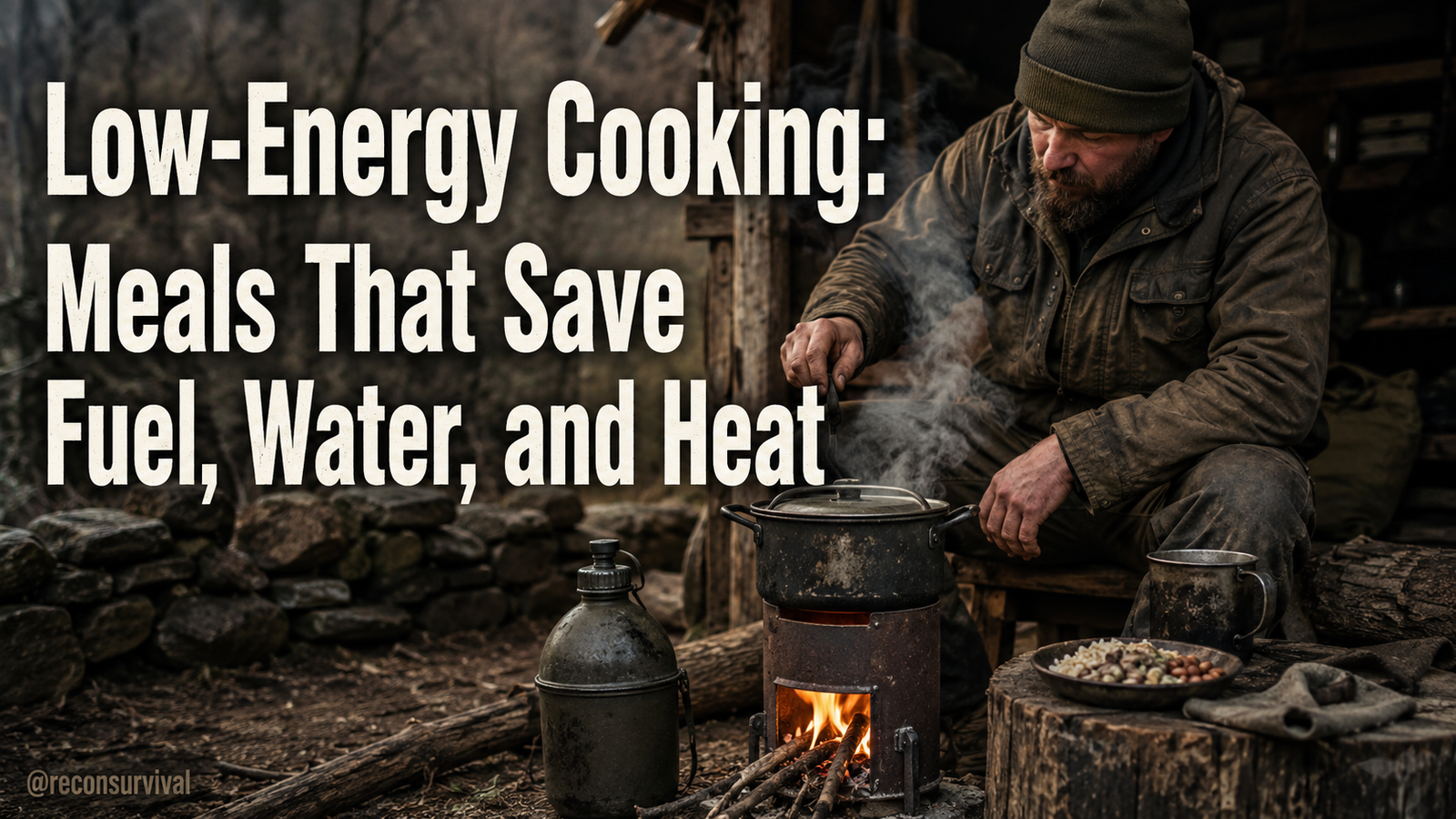
The goal is to decouple cooking output from total fuel consumption. When you cook, you want the heat to go into the pot, not the room. This requires specific techniques for electric, gas, and induction stoves. For electric units, using lids is mandatory to trap convective heat. For gas, managing the flame size to match the pot surface area is key. For induction, ensuring the pot is flat and the magnetism is perfect prevents the unit from working harder than necessary.
This approach also integrates with your pantry strategy. Instead of cooking three separate meals over a three-day grid failure, you prepare a "hot meal stock" that can be reheated in minutes. This single pot method reduces water usage and fuel time. By reducing the number of active heating elements, you lower the total energy drawn from your source, whether that is the main grid or a generator. This directly extends your endurance time.
Step-by-Step Implementation for a Normal Household
To break this system down into clear steps, start with your existing equipment. Step one is an inventory of your cookware. You need a heavy-bottomed pot or a Dutch oven. Thin metal pots react to heat changes too quickly, leading to overcooking or burning. Heavy bottoms store heat, allowing you to use lower flame settings while maintaining a steady boil. If you do not have heavy pots, look for cast iron or multi-layer stainless steel.
Step two involves managing the lid. Always use a tight-fitting lid when simmering. If your lids do not seal well, add a layer of foil or a damp cloth around the rim to improve the seal. This reduces evaporation, which is a major source of fuel waste. Water takes significant energy to turn into steam; keeping that liquid in the pot keeps your fuel efficient.
Step three is scheduling. Do not run multiple burners simultaneously unless necessary. If you are making pasta and soup, do them in separate batches or use a multi-use pot if space allows. Cooking one large meal allows you to turn off the stove completely while the leftovers sit, rather than keeping heat on for multiple small tasks.
Step four is water management. Reuse the water from cooked vegetables to make soups or sauces. Do not discard the cooking liquid if you can avoid it. This reduces the need to treat and boil fresh water for every meal.
Step five is ventilation. If you are cooking with gas, ensure your range hood or window is open to remove combustion byproducts. If you are using propane or charcoal in a confined area, ensure there is no risk of carbon monoxide poisoning. Ventilation is a safety requirement, not just a comfort feature.
Defining the Minimum Viable System
Before discussing upgrades, it is essential to define the minimum viable system. For a normal household, the minimum viable system consists of one heavy-bottomed pot with a tight-fitting lid, a functional range hood or window, and a strict rule to never cook with an open pot. This is it. You do not need to buy a new stove or a complex induction cooktop immediately.
If your current electric stove has a faulty burner element, that is a maintenance issue, not an upgrade necessity. If you can achieve a boil with the existing hardware by adjusting your technique, that is sufficient. The system works because it forces efficiency without requiring a total kitchen overhaul. Upgrades, such as adding a solar charger for induction or installing a secondary propane tank, come only after you have mastered the basics.
Safety Limits, Maintenance, and Realistic Failure Points
Safety limits are non-negotiable. When reducing fuel and heat, you must respect the limits of your equipment and your environment. For gas stoves, never allow flames to lick the sides of a pot, as this indicates a burner blockage or an air mixture issue. Fix this before cooking. For electric stoves, ensure the coils are not warped and the contact is even. A damaged coil can crack the glass top or burn out the heating element.
Maintenance involves keeping your burners clean of debris and food residue. A buildup of grease can ignite unexpectedly or cause uneven heating. Check your range hood filter monthly; a clogged filter forces the motor to work harder and reduces ventilation efficiency. If you are using a generator or backup power, ensure it is rated for continuous duty load. Do not exceed the kilowatt rating of your system.
Realistic failure points include running out of fuel, a battery failure in an induction cooktop, or a loss of heat in a propane tank due to temperature drops. If your fuel source fails, you must have a contingency. This might be a stored supply of wood, charcoal, or even simple methods like cooking over a fire pit outside if the indoor heat becomes dangerous. If your primary heat source is electric, do not rely solely on it for cooking if you have a backup generator. The generator may be dedicated to refrigeration and medical devices. Your strategy must account for the generator running dry or the battery failing.
Recon Survival Takeaway
The core takeaway from this lesson is that efficiency is a habit, not just a gadget. By reducing cooking fuel and indoor heat, you create a buffer against supply disruptions and environmental stress. This approach ensures that your family can eat well even when resources are tight. It also keeps your home cooler, which is vital during summer heatwaves. Remember that resilience is built through small, consistent actions, not grand, expensive projects.
Recon Survival Principle
Recon Survival is not about waiting for stress to make the decision. It is about turning weak signals into household action while the fix is still small. A practical way to reduce cooking fuel and indoor heat while still making filling emergency meals, but most advice is either too generic, too gear-focused, or too late.
Do Today
Apply these principles immediately to build your readiness. 1. Inspect your cookware to ensure you have at least one heavy-bottomed pot with a tight-fitting lid. If you do not have one, identify which pot to use for your next meal and note the purchase. 2. Check all burner lids for proper fit. If they do not seal, note the brand and model, or improvise a seal with foil or a damp cloth to test the effectiveness. 3. Clean the burners and heating elements of your stove. Remove any food debris that could cause uneven heating or fire hazards. 4. Verify that your range hood or kitchen window is open and unobstructed when cooking. 5. Plan your next meal to use a single pot if possible, reducing water usage and fuel consumption. 6. Review your generator or backup power capacity to ensure it can handle your essential cooking loads without overloading. 7. Write down your findings and adjust your cooking schedule to avoid peak heat hours when possible.
Do This Next
Continue your assessment by reviewing your pantry. Identify which ingredients can be cooked in one batch to minimize fuel use. Consider adding a secondary fuel source, such as a small propane tank or a supply of firewood, if you live in an area prone to blackouts. Test your system by cooking a meal using only the heavy pot and lid, then time how long it takes and how much fuel you use compared to your usual method. If you find that the heavy pot saves time and fuel, make this your standard.
Finally, remember that this is a continuous process. As your skills improve and your gear evolves, you can integrate more advanced techniques. But the foundation is built on simplicity, safety, and discipline. By mastering the basics of fuel-efficient cooking, you are not just saving energy; you are securing your family's ability to eat well in any season. This is the essence of practical food resilience.