Late summer outages often drag on long enough that discomfort shifts into a security risk. When power fails in August, the heat lingers, the humidity clings, and the household routine fractures. In that friction, families make rushed decisions about lighting. A full-blown floodlight turns on instinctively, revealing every window, door, and movement to anyone watching from the street. The house looks either abandoned or like a resource-rich target. The goal is not to live in the dark, but to move through the night with enough visibility to stay safe while keeping a low profile.
As an Amazon Associate, I earn from qualifying purchases.
The Visibility Paradox in a Home Outage
Security during an extended outage relies on a simple trade-off: you need light to avoid tripping hazards or to secure entry points, but too much light broadcasts your location and inventory. The most dangerous moment isn't the total darkness; it is the bright beacon that draws attention while the power company is still searching for a line down. When the grid fails, the house becomes an island. If you flood the yard with light, you eliminate your element of surprise and signal that you have power to burn. This isn't about hiding from the world; it is about maintaining a calm, controlled environment where your household remains safe without inviting external curiosity.
The Bright Spot Mistake
The most common failure in emergency lighting is the "panic switch" reaction. Households install backup systems or grab the first flashlight they find, then turn everything on at maximum output the moment the lights go out. This behavior assumes the threat is external and immediate, rather than a logistical challenge to navigate safely. It turns a quiet street into a lighthouse.
In a typical home, this mistake often starts in the kitchen or the garage. Someone grabs a high-lumen tactical flashlight or an led lantern with full brightness, walks through the main living area, and opens the front door. The beam cuts through the darkness, illuminating the driveway, the porch, and the windows of neighboring houses. The result is that you know where you are, but everyone else on the block knows you have backup power, and they can see exactly which rooms are occupied. This binary approach – total light or total dark – leaves the household vulnerable to bad decisions made under stress.
Zone-Based Light Discipline
A more effective approach treats lighting as a tool for specific zones rather than a general house-wide solution. You should map your home into distinct operational areas: the main thoroughfares, the immediate perimeter, the storage and utility areas, and the personal safety zones. Each zone requires a different intensity and duration of light.
Start by identifying the main thoroughfares inside the house. These are the hallways, stairwells, and the route from the bedroom to the bathroom or kitchen. The goal here is to see your feet and avoid obstacles, not to illuminate the entire room. Use amber-tinted or red filters on your flashlights for these paths if you are moving at night, as these colors preserve night vision and are less visible from the outside.
Next, define the immediate perimeter. This includes the front porch, the back door, and the immediate driveway. Light here should be low and directed. A single low-wattage lantern placed on a step or a porch table, aimed downward, provides enough visibility to unlock a door or check a lock without projecting a beam across the yard.
Finally, consider the storage and utility zones. This is where you keep your water, food, and backup power. These areas need to be secure and visible to you, but they should never be the source of bright, outward-facing beams. Keep a dedicated light source here that is only turned on when you are actively accessing supplies, and ensure it is shielded or directed inward.
The Minimum Viable Lighting Setup
You do not need a complex solar array or a generator running continuously to achieve safety. The minimum viable system relies on human-powered and low-draw chemical light sources, paired with strategic placement.
Begin with a dedicated "go-bag" for each household member. Each bag should contain a flashlight with adjustable brightness, a headlamp for hands-free movement, and a supply of spare batteries. Test these lights once a month. If a battery is dead, rotate it immediately.
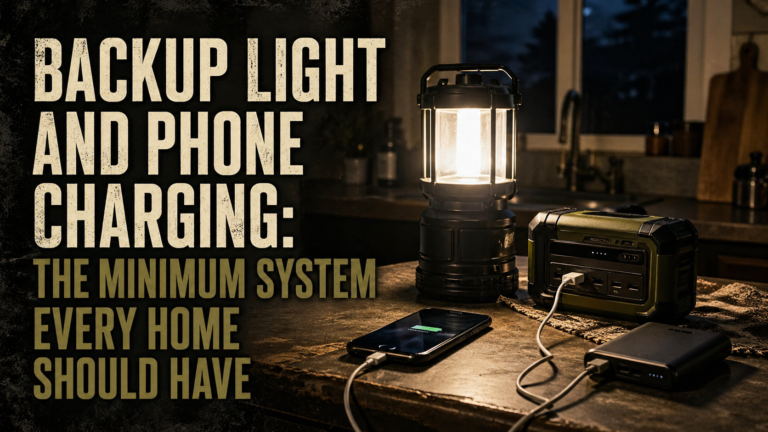
Stage a central light source in the main living area. This should be a lantern with a dimmer switch or a setting for low output. Place it on a table in the center of the room, not on the floor or near a window. This provides ambient light for the whole family to move without shining a direct beam outside.
Label your containers. Use waterproof markers to mark battery types on storage bins. If you have fuel for a generator or camp stove, label the fuel containers clearly to prevent accidental mixing or spills. This organization prevents the confusion that leads to dangerous improvisation during a crisis.
The Walk-Through Sequence
To integrate this system into your routine, perform a specific walk-through sequence when the lights go out. Do not rush to turn on every light. Instead, follow this order:
- Check the main switch: Verify the outage is confirmed and stable. Do not assume it will return in five minutes.
- Secure the perimeter: Walk the front and back doors. Check locks and latches. Do this with a low-light source to avoid drawing attention.
- Light the path: Turn on the low-output lantern in the living area or main hallway. Move to the kitchen or water storage with a headlamp, keeping it directed downward.
- Assign roles: If you have children or other adults, assign specific tasks. One person stays at the entrance to monitor. Another retrieves the water cooler. A third checks the battery packs.
- Verify the utility area: Check the generator or battery bank. Ensure it is running safely and vented if necessary. Do not run a generator inside the house or near an open window.
- Re-check the exterior: After the initial moves, turn off the porch light if it is too bright. Keep only the directed, low-level light on.
- Rest and reassess: Once the family is settled and the immediate needs are met, turn off all non-essential lights. Wait in the dark for a few minutes before making the next move.
This sequence prevents the "all-hands-on-deck" panic that leads to over-lit homes. It creates a rhythm of movement and stillness that keeps the household calm and efficient.
Safety Limits and Realistic Failure Points
Even the best system has limits. Fuel for generators or camp stoves degrades over time, and batteries self-discharge. You must accept that your lighting system will fail at some point.
Ventilation is critical. If you are using fuel-burning light sources, ensure the area is well-ventilated to prevent carbon monoxide buildup. Install carbon monoxide alarms in any sleeping area and near fuel-burning appliances. Test these alarms monthly.
Batteries are a common failure point. Do not rely on a single source. If your primary battery pack fails, you need a secondary source. This could be a chemically activated light stick or a wind-up flashlight. Rotate your batteries every six months to ensure they hold a charge.
Labels and organization prevent failure when stress is high. If you cannot find a spare battery in the dark, you are forced to use the wrong one, which can damage your device or fail to provide light. A labeled, organized system ensures you can find what you need quickly.
Recon Survival Principle
Light discipline is the balance between visibility for safety and invisibility for security. Use lighting for safety without advertising resources or blinding the household. The house is your sanctuary, not a billboard.
Do Today
Take these seven concrete actions to prepare your home for the next outage:
- Inspect all flashlights and headlamps for loose connections or dead batteries.
- Mark your battery storage bins with the type and date of purchase.
- Designate one low-output lantern for the main living area and one for the utility area.
- Test your carbon monoxide alarms and replace any that are older than five years.
- Create a simple map of your home's lighting zones and print a copy for each adult.
- Purchase a few chemically activated light sticks as backup for each family member.
- Conduct a one-hour night-time drill where you navigate the house using only low-output, directed light.
By preparing your home this way, you ensure that when the power fails, you remain safe, visible to your family, and invisible to the outside world. This preparation turns a potential crisis into a manageable, temporary inconvenience.