A practical way to choose essential devices and avoid wasting power on comfort items too early, but most advice is either too generic, too gear-focused, or too late.
As an Amazon Associate, I earn from qualifying purchases.
When the grid fluctuates or fails, the first appliance you reach for shouldn't be the one that makes your home comfortable; it should be the one that keeps you safe and connected. Late June brings a specific set of conditions where summer grid stress is already visible, storm activity is increasing, and the demand for air conditioning puts immense pressure on the electrical system. The real-world problem this article solves is the difficulty of distinguishing between what your house needs to survive a power event and what it merely needs to enjoy. Most readers face a situation where advice is either too generic, too focused on expensive gear, or arrives too late to be useful for immediate planning. This guide provides a calm, realistic, value-first approach to choosing essential devices and avoiding the waste of limited backup power on comfort items too early.
Why Summer Grid Stress Changes Your Power Strategy
Summer grid stress is not a matter of fear; it is a matter of resource management. As the season progresses into mid-June, air conditioning usage peaks, and the electrical grid operates near its limits. This dynamic makes power resilience more important because the likelihood of a brownout or blackout increases. During these events, the goal is not to run every device you own but to run the minimum viable system required for safety, communication, and basic sanitation. Without a deliberate strategy, a generator or battery bank will run out of fuel or capacity while you are still worried about whether the Wi-Fi is still up. The reality is that comfort items like large TVs, coffee makers for non-essential use, and high-draw electronics consume a disproportionate amount of energy. Prioritizing the wrong devices means you might have a refrigerator full of spoiled food before the batteries even drain. Understanding this balance is crucial for navigating a stressful event without panic.
The Common Mistake: Comfort Over Critical
The most common mistake people make when preparing for blackouts is assuming that their backup power needs to mirror their normal household usage. Many households plan to run the air conditioner, the electric water heater, the freezer, the microwave, and the internet router simultaneously. This approach treats a power outage like a simple inconvenience rather than a shift in operational priority. When the power goes out, the priority must shift from "how normal does life feel?" to "how safe do I stay?" Trying to maintain normalcy immediately leads to a situation where critical systems fail first. People often wait until a storm hits to make these decisions, finding themselves overwhelmed by the choice of which light to dim or which phone to charge. The mistake is viewing power availability as a right that should be maintained for comfort rather than a limited resource that must be rationed for survival.
The Recon Survival Critical Loads System
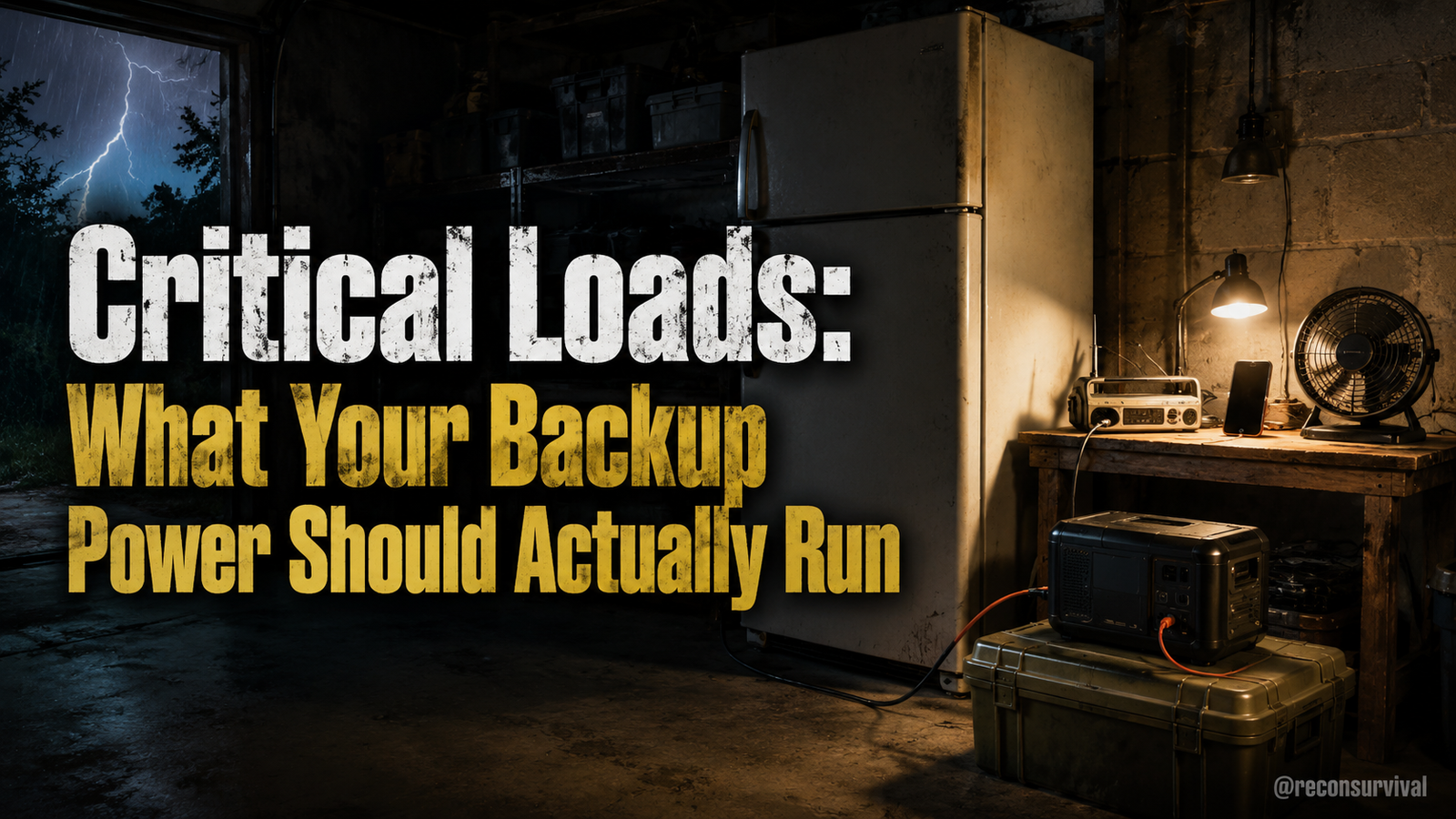
The Recon Survival practical system for handling this scenario relies on a strict categorization of devices into three tiers: Critical, Secondary, and Comfort. Critical devices are those without which life is not just unpleasant but unsafe or dangerous. These include life-safety lighting, medical equipment, communication radios, and refrigeration for perishable food. Secondary devices support basic quality of life but are not immediately life-saving. These might include personal electronics for entertainment, small fans for comfort, or non-essential lighting. Comfort items are those that provide enjoyment and can be easily substituted. This includes televisions, gaming consoles, electric hair dryers, and kitchen appliances used for non-essential cooking. By categorizing your equipment beforehand, you create a mental and written checklist that allows you to act decisively when the lights go out. This system helps you avoid wasting power on comfort items too early in a calm, realistic, value-first way.
Step-by-Step Selection for Your Household
To implement this system, follow these clear steps a normal household can use to organize their power strategy. First, take inventory of every device you intend to use during a blackout. List them by wattage and draw. Second, assign each device to one of the three tiers mentioned above. Ask yourself: Can I run this without it, and is it safe to run it? Third, establish a power budget. If you have a portable generator, determine how long it can run on a tank of fuel. Match your device selection to that limit. Fourth, label your cords and outlets. Use tape or tags to mark which outlets are for critical loads only. This physical separation prevents accidental plug-in of comfort devices. Finally, rehearse the transition to critical loads only. Run a drill where you disconnect everything except the critical tier and test your battery life or generator runtime. This step-by-step approach ensures that a normal household can manage limited power resources effectively.
Defining the Minimum Viable System
Before discussing upgrades or adding more batteries, it is essential to define the minimum viable system. This is the absolute baseline required to function safely in a power-outage scenario. For most households, the minimum viable system includes battery-powered or manual light sources, a battery-powered or hand-crank radio for weather updates, a charged cell phone for communication, and a refrigerator to keep food safe. It does not include the air conditioner, the electric stove, or the television. Some people argue that a fan is essential, but a battery-powered fan is often a comfort item that can wait. If your goal is to stay cool, cross-ventilation is safer and uses less power than an electric fan that consumes the last of your battery capacity. The minimum viable system is what you can do with zero fuel and zero grid power. Anything added beyond this baseline is an upgrade that should only be pursued after the basics are mastered. This definition prevents the common trap of starting with a list that is too ambitious and quickly becoming unusable.
Safety Limits and Realistic Failure Points
Safety limits are the hard constraints of your off-grid power planning. Lithium-ion batteries have temperature and discharge limits; exceeding them reduces their lifespan or creates a fire hazard. Gas-powered generators produce carbon monoxide, which is odorless and lethal in enclosed spaces. You must place the generator outside and away from windows and doors, ideally downwind. When selecting devices, check manufacturer manuals for voltage requirements and power factor. Many high-draw appliances like dehumidifiers or air conditioners require significantly more surge power than their running wattage. If your inverter or generator cannot handle the surge, the unit will shut down or fail. Realistic failure points include battery degradation over time, fuel lines clogging in cold weather, and the inability to sustain high-draw loads indefinitely. Plan for the worst-case scenario where your backup system fails after four hours. In that case, you must know how to transition to manual or low-power alternatives. Always have a backup plan for fuel storage that adheres to local fire codes and safe storage practices.
Recon Survival Principle
Recon Survival Principle
Power availability is a function of priority, not capability. Your ability to run a device in a crisis is determined by its necessity, not how much it is connected to the wall. In a stable grid, comfort items are secondary. In a blackout, critical items are the only ones that count. This principle dictates that you must make hard choices before the grid fails. Do not let the availability of power tempt you to run the toaster or the TV when the batteries are low. Stick to the critical tier. If you cannot justify the device as life-safety or essential communication, it goes on the shelf. This mental filter prevents panic and preserves resources for the long term.
The Maintenance Cycle
Even the best-planned system degrades without maintenance. Batteries lose capacity, fuel lines dry out, and connections oxidize. To keep your system ready, you must test your backup power monthly. For lithium batteries, this means running them down to a certain level and recharging to maintain cycle life, following the manufacturer's instructions. For generators, run them under load weekly to prevent gum buildup and ensure the carburetor or fuel injection system works. Inspect cords for fraying and replace any damaged units immediately. Carbon monoxide alarms are non-negotiable; test them monthly and replace batteries annually. Keep ventilation clear around gas units. Store fuel in approved containers away from heat sources. Failure to perform these maintenance tasks can render a perfectly planned system useless during an actual event. A system that sits unused for a year is likely to fail the first time it is needed.
Do Today
Today, take a single action to align your household with this system. Review the following checklist and mark your status for each item. Do not rush to buy new gear if you already have items that fit the criteria. Use what you have.
- List every device you use in your kitchen and living room.
- Label each item as Critical, Secondary, or Comfort.
- Identify three comfort items you can cut from your backup list immediately.
- Check that your emergency radio has fresh batteries.
- Locate your manual flashlight or lantern and verify it works.
- Ensure your carbon monoxide detectors is within the expiration date.
- Write down the wattage rating of your primary battery or generator.
By following these steps, you move from a state of uncertainty to a state of readiness. You are now prepared to make difficult but necessary choices when the grid fails. This calm, practical approach ensures that you and your family are safe regardless of the season or the storm outside.