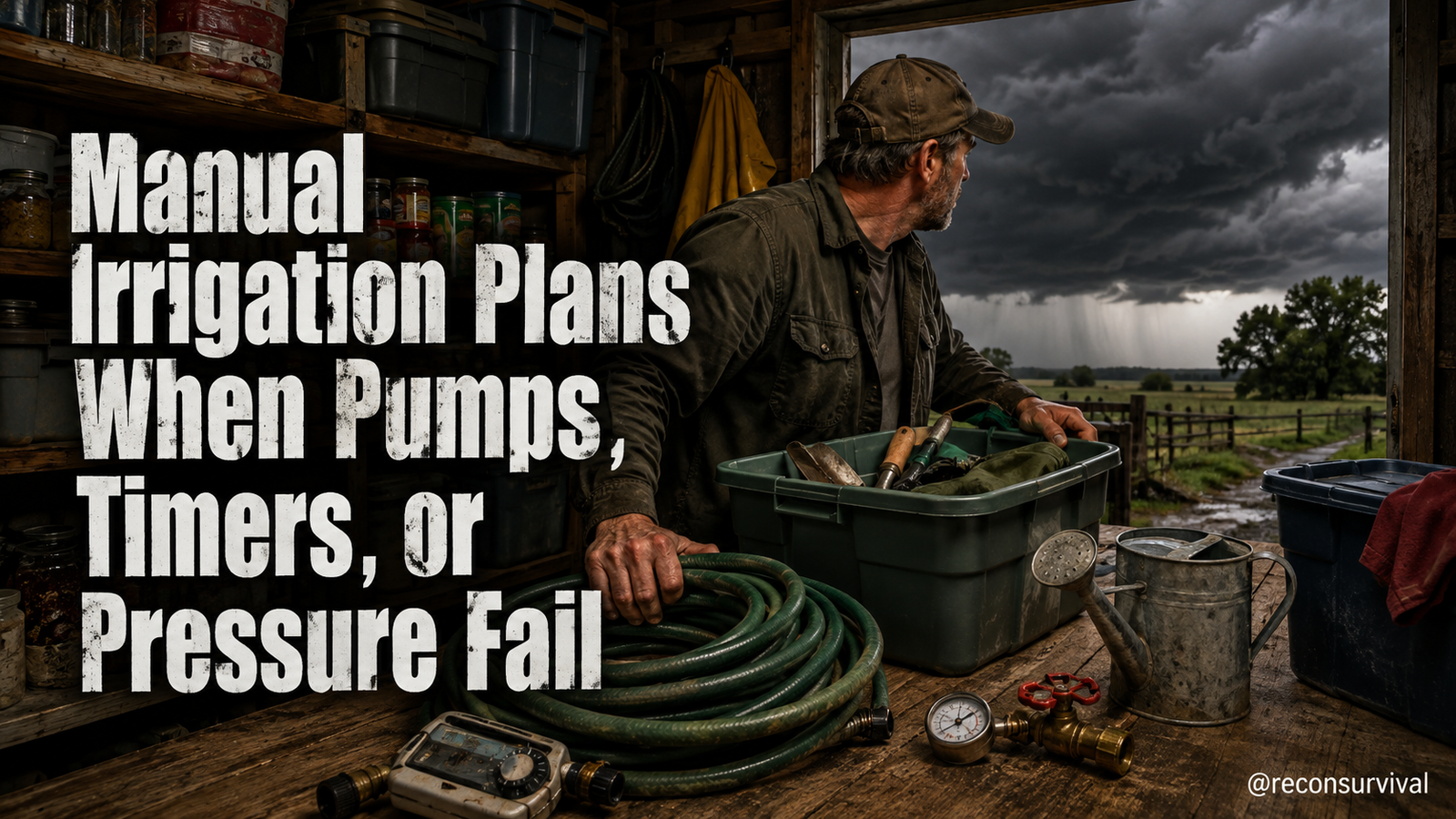
The first thing to break is not the main line; it is the pressure sensor or the timer relay that has sat idle for months. When the grid goes down in August, electric pumps stop, and automated controllers freeze, leaving vegetable beds to wither in the heat before you even notice the outage has escalated. This is the reality of late summer: the crop stress peaks just as your reliance on technology hits its limit. You need a manual irrigation plan that works when the electronics fail, not one that requires a new purchase when the temperature is already critical.
As an Amazon Associate, I earn from qualifying purchases.
Why Late Summer Relies on Manual Systems
Late summer presents a unique bottleneck for garden survival. The soil is already warm, the air is heavy, and evaporation rates are at their highest. A power outage that lasts twenty-four hours in January is a minor inconvenience; in late August, it can turn a productive patch into a dry wasteland. The goal is not to prevent the outage but to ensure the garden survives the interruption without panicking or depleting resources.
This season requires a shift from automated efficiency to manual resilience. Your garden's ability to withstand a loss of pressure depends entirely on whether you have pre-positioned the tools to move water by hand. When the sun is at its peak and the crops are demanding every drop, the difference between a recoverable plant and a lost harvest is how fast you can engage a backup method.
The Automatic Trap
The most common mistake is assuming that a functional pump means a functional watering system. Gardeners often spend the season optimizing electric timers and pressure regulators while ignoring the manual connection points or the physical capacity to move water without power. When the grid fails, the reliance on an automatic system creates a false sense of security. You end up staring at a garden that needs water, a pump that needs power, and no plan to bridge the gap.
This trap delays action until the stress becomes visible. By the time you see the plants wilting, the window for easy recovery has closed. The system is only as good as its weakest link, and that link is often the assumption that the grid will remain on.
Water Source Identification and Flow Capacity
Before you can plan a manual system, you must know exactly where your water is coming from and how much you can move. Walk your property and identify three distinct sources: the primary municipal or well supply, a secondary gravity-fed tank, and a static storage container like a rain barrel or cistern. Check the flow rate of each. Can you get a five-gallon bucket from the spigot in under thirty seconds? Is your rain barrel accessible without tools, or does it require a ladder and a hose reel?
Map these sources on a simple sketch. Note the distance from the water source to the garden beds. Calculate the time it takes to fill a standard 5-gallon bucket at your fastest spigot. This number is your baseline. If it takes you three minutes to fill a bucket, you know you can deliver 5 gallons every three minutes. This calculation informs your strategy: do you need a hose for reach, or a bucket for capacity?
The Three-Tier Triage Ladder
When power fails, you cannot fix everything at once. Use a triage ladder to prioritize your response based on time and risk.
First Hour: Secure the Source
Check your primary pump. If it is silent, switch immediately to manual flow. Open the manual bypass valves if your system has them. If there is no bypass, connect your manual hose directly to the spigot. Do not attempt to repair the pump or the timer yet. Your priority is to get water moving to the nearest beds. Grab a bucket and a watering can. If you have a hand pump, deploy it now.
Same Day: Distribute the Load
Once water is moving, you must distribute it efficiently. The goal is to water the most vulnerable crops first. In late August, this means focusing on tomatoes, peppers, and young seedlings. Move water in small, frequent bursts rather than soaking once. If you have a gravity tank, prioritize that area. If you are using buckets, pair your household members: one fills, one distributes. This division of labor doubles your output.
Next Day: Stabilize and Assess
By the next morning, check the soil moisture. Is the mulch still intact? Are the plants recovering, or is the damage permanent? Adjust your manual routine based on what you see. If the soil is still dry, increase the frequency of manual watering. If the plants have survived the night, you may be able to reduce the frequency to once per day. This step ensures you are not wasting effort on areas that have already been watered by the morning dew.
Minimum Viable Manual Kit
You do not need an expensive backup generator or a complex filtration system to survive a outage. A minimum viable kit includes five items that any household can assemble in an afternoon.
The 5-Gallon Bucket
Select a food-grade bucket with a lid. This serves as your primary transport and storage vessel. It is durable, stackable, and easy to clean. Label the lid with the date you filled it and a "Use First" marker. Keep this bucket in the garage or utility room, close to your primary water source, so it is the first thing you grab.
The Hand Hose
Keep a 25-foot section of garden hose coiled and ready. Do not store it in a tangled heap. Use a reel or a hanger to keep it straight. This length allows you to reach the majority of a standard garden bed without dragging the hose across the soil, which can damage roots.
The Watering Can
A 2-gallon watering can with a rose attachment is essential for targeting specific plants. It allows you to control the flow and avoid washing away soil or damaging delicate seedlings. Store this near the bucket.
The Hand Pump
A portable hand pump that fits onto standard water barrels or cisterns is a critical upgrade. It allows you to move water from a storage tank without electricity. Test the pump monthly to ensure the handle moves smoothly and the seals are intact.
The Quick-Connect Fittings
Keep a small bag of plastic quick-connect fittings. These allow you to attach a hose to a spigot, a rain barrel, or a cistern in seconds. They eliminate the need to twist and tighten clamps during a high-stress moment.
Safety Limits and Realistic Failure Points
Manual systems have limits that electric systems do not. You must be realistic about your physical capacity and the safety of the water you are moving. A human can carry roughly 30 to 50 gallons of water before fatigue sets in, and this takes hours. Do not attempt to replace a full irrigation system with manual hauling for large plots; it is a temporary bridge, not a permanent solution.
Be mindful of the water source. If you are drawing from a rain barrel or cistern, ensure the water is not stagnant or contaminated. Check the barrel's lid for insect access. If you are moving water from a static source, be aware of the risk of slipping on wet ground or overextending your reach.
Ventilation is also a concern if you are using a backup generator to run a small pump. Never run a generator indoors or in an attached garage without an open door. Carbon monoxide is an odorless killer. Keep the unit at least 20 feet from windows and doors, and test your carbon monoxide alarm before the season ends.
Recon Survival Principle
A manual irrigation plan is not about having the most equipment; it is about having the most predictable routine. The system fails when you have to think about how to move water during an outage. The survival principle is to automate the preparation, not the delivery. Your preparation must be so routine that you can execute it without thought.
This means the bucket is always full, the hose is always coiled, and the pump is always primed. It means you know exactly which valve opens the manual bypass. It means you have practiced the first-hour response so often that you can do it while your hands are full of tools. The goal is to make the manual method the default, not the emergency backup.
Do Today
You have no time to wait for the next outage to discover your gaps. Today, you must conduct a full inventory of your manual water capacity.
- Count stored water by person and day, then write the number where the household can see it.
- Date the oldest container and move it to the front of the rotation.
- Add extra water for pets, heat, illness, cooking, or anyone with higher needs.
- Stage the filter, clean pot, funnel, and water-moving container together.
- Write the no-power water sequence on paper: drink, cook, wash, flush, refill.
- Check every cap, container, shelf, and storage spot for leaks or heat exposure.
- Assign one person to refill, one to rotate, and one to recheck after the next alert.
Inventory Step One: The Bucket Test
Grab a 5-gallon bucket and fill it from your primary spigot. Time the process. If it takes longer than three minutes, identify the bottleneck. Is the spigot flow low, or is the bucket hard to lift? Adjust your strategy accordingly. If the bucket is too heavy, switch to a 3-gallon option or a wheeled cart.
Inventory Step Two: The Flow Path
Walk from your water source to the furthest bed. Note every obstacle: a gate that sticks, a hose that kinks, a spigot that is rusted shut. Clear the path. If a hose is damaged, cut it off and replace the end. If a valve is stuck, lubricate it or replace it now.
Inventory Step Three: The Connection Check
Take your hand pump and attach it to your rain barrel or cistern. Test the pump five times. Does it move water smoothly? Does the seal hold? If it fails, repair it or replace it immediately. Do not wait for the season to end.
Inventory Step Four: The Safety Sweep
Check your carbon monoxide alarms. Test them with the battery test button. If they are old, replace them today. Ensure your generator is outdoors and stored safely.
Inventory Step Five: The Distribution Plan
Decide which three beds are your priority. Mark them with a stake or a flag. These are the beds you will water first when the power goes out. Keep your manual tools in a bin near these beds so you do not waste time searching.
Inventory Step Six: The Communication
Tell your household members where the manual tools are stored. Show them how to fill a bucket and how to use the hand pump. Ensure everyone knows the plan. If the power goes out tonight, you do not want to spend ten minutes explaining what to do.
This inventory takes less than an hour, but it saves your garden when the lights go out. The difference between a lost harvest and a recovered one is the preparation you make today.