Recon Survival Principle
Heat to load to water demand to decision trigger: When external temperature spikes, the electrical load from cooling surges, the water supply evaporates, and the household shifts from passive survival to active crisis management.
As an Amazon Associate, I earn from qualifying purchases.
Field Memo: The Off-Grid Gridlock and the Three-Point Failure Chain
The moment the grid goes down is rarely the moment the off-grid lifestyle succeeds; it is usually the moment the hidden dependencies that the system was built upon are revealed as single points of failure. A sudden loss of municipal power or a prolonged heatwave does not merely remove electricity; it initiates a cascading sequence where the lack of active climate control forces a massive surge in human metabolic cooling needs, which immediately outpaces the capacity of passive cooling or battery-backed water pumps. This specific chain reaction – where heat increases the body's need for cooling, which increases the demand for water to stay hydrated and cool, which in turn drains the limited water storage used for both drinking and sanitation – creates a bottleneck that no amount of extra solar panels can solve without a specific operational shift. The failure point is not the generator or the batteries; it is the assumption that off-grid living is a static state of self-sufficiency rather than a dynamic system of resource trade-offs.
The Heat Load Surge
The primary driver of off-grid vulnerability during extreme weather events is not the lack of fuel, but the sudden and non-linear increase in thermal load placed on the dwelling. In a grid-tied home, air conditioning is a demand-side solution that is essentially infinite; if the thermostat hits a set point, the system draws whatever power is necessary to restore it. In an off-grid environment, however, the cooling capacity is hard-capped by the size of the battery bank and the efficiency of the photovoltaic array. When ambient temperatures rise above 90°F (32°C), the heat gain through walls, roofs, and windows accelerates exponentially. This forces the internal temperature of the dwelling to climb rapidly unless active cooling is applied.
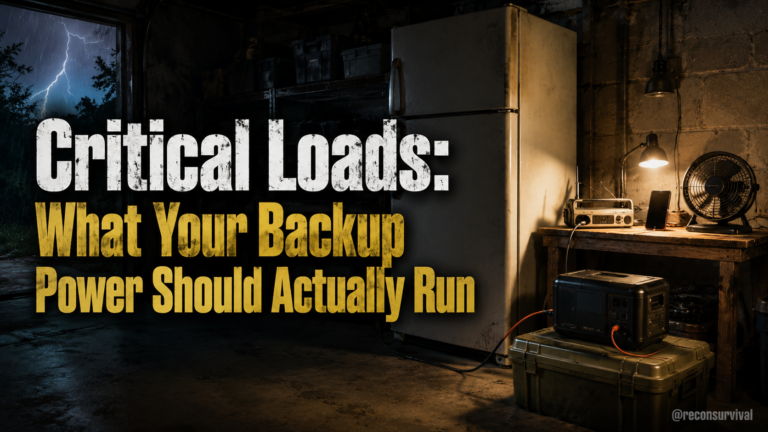
Unlike the grid, where the load is invisible, the off-grid user must physically feel the heat load as a tangible depletion of their stored energy. As the house heats up, the battery bank discharges at a much higher rate to run fans, dehumidifiers, or small air conditioning units. This creates a dangerous feedback loop: the more you cool, the more you deplete the battery; the more you deplete the battery, the less capacity remains for essential pumps, radios, and lighting. The "Heat Load Surge" is the moment where the system moves from maintaining a comfortable temperature to fighting a losing battle against the thermal envelope of the structure. If the battery bank dips below a critical threshold (often 30% depth of discharge for lead-acid or 20% for lithium to ensure cycle life), the system begins to throttle, meaning cooling becomes intermittent or stops entirely, leading to rapid overheating of both the living space and the sensitive electronics that keep the home functional.
The Hidden Load: Water and Sanitation
While power is the most visible resource, the hidden load that actually precipitates a crisis in off-grid scenarios is water. The assumption that "off-grid" implies "infinite water" is a fatal error; most off-grid systems rely on a finite source, whether it is a rain catchment system, a well with a pump, or a stored reserve. The thermal dynamics of the "Heat Load Surge" directly amplify the water demand. High temperatures increase human perspiration and respiration rates, raising daily water consumption from the standard 1 gallon (3.8 liters) per person to 2 or 3 gallons in extreme heat to prevent heat stroke.
Furthermore, the water storage and sanitation systems are inextricably linked to the power grid. A well pump or a pressure tank in an off-grid setup requires electricity to function. If the battery bank is drained by the attempt to cool the home, the water pump stops. Without water, the ability to cool via evaporative methods (swamp coolers, misting) is lost. Additionally, the sanitation load becomes immediate; without water for flushing or cleaning, the risk of disease spikes, and the psychological burden of managing waste in a confined, hot space increases significantly. This creates a secondary failure point: the system is not just running out of power; it is running out of the medium (water) required to mitigate the effects of that power loss. The "Hidden Load" is the realization that water is not just a resource for drinking; it is a cooling medium and a sanitation essential, all of which are now competing for the same depleted battery capacity.
The Decision Trigger
The critical moment in an off-grid crisis is not when the sun sets or the generator sputters, but at the precise decision trigger where the user must choose between maintaining temperature and preserving water/power reserves. This trigger is defined by a specific intersection of metrics: battery voltage falling below the critical threshold (e.g., 11.5V for a 12V system) while ambient temperature continues to climb. At this point, the "heat load to water demand" chain has reached its breaking point. Continuing to run the cooling system will deplete the energy reserves needed to pump water for the night or operate emergency communication devices, potentially leading to a situation where the user is trapped in a hot, dry house with no way to cool down or call for help.
The decision trigger requires a shift from "comfort optimization" to "survival triage." This involves a deliberate, often counter-intuitive, reduction in activity and a conscious surrender of climate control. The system must be allowed to warm up to a dangerous but survivable internal temperature (often 85-90°F) to preserve the last reserves of energy for water pumping and lighting. This is the moment where the "recon" aspect of the system becomes active: monitoring the specific interplay between temperature, water levels, and battery voltage to determine when to cut the load entirely. The decision trigger is the moment the user realizes that the grid connection is gone and the off-grid system is no longer a luxury but a life-support system that must be managed with extreme frugality.
Action Thresholds and Resource Management
Once the decision trigger has been hit, the operational protocol shifts to a strict set of action thresholds designed to extend the viability of the system. The first threshold is the "Cooling Cutoff": immediately stop all non-essential electrical loads, including lights, computers, and ventilation fans that are not directly contributing to heat dissipation. The goal is to halt the drain on the battery bank. The second threshold is the "Water Rationing Protocol": reduce water usage to the absolute minimum required for hydration and hygiene, prioritizing drinking water over sanitation or cooling until power is restored or solar input increases.
The third threshold involves the "Passive Cooling Maximization": open all windows and vents to create cross-ventilation, even if it means inviting in hot air, because the alternative is a sealed, overheated box. Use wet towels on the skin or damp sheets to facilitate evaporative cooling, which consumes water but requires no electricity. Finally, the "System Monitoring" protocol requires checking the battery voltage and water levels every 30 minutes. If the battery voltage recovers due to a drop in load, the user can briefly cycle the cooling fan, but never run it continuously. This cycle of monitoring and adjusting is the core of the action thresholds, ensuring that the system does not collapse under the weight of its own energy demands.
The Recon Survival Principle Revisited
The Recon Survival Principle in this context is the recognition that off-grid living is not a static state of self-sufficiency but a dynamic system of resource trade-offs. The failure to understand the "Heat to Load to Water Demand to Decision Trigger" chain leads to premature system collapse. The user must treat the home not as a house that needs to be kept cool, but as a system that needs to be balanced. The priority is not the temperature of the house, but the preservation of the energy required to pump water and maintain light. By accepting the heat and managing the load, the user ensures that the critical resources (water and power) remain available for the most essential functions: survival and communication. This is the only way to survive a prolonged grid failure or extreme weather event without depleting the system's reserves.
Do Today
To prepare for the inevitable "Heat Load Surge," you must begin by calibrating your system's thresholds and identifying your decision triggers. First, audit your battery bank and solar input capacity relative to your cooling load; calculate the maximum time your system can sustain air conditioning before reaching the critical voltage threshold. Second, establish a water rationing plan that accounts for increased consumption during heat waves, ensuring you have a reserve that can last longer than your typical grid-outage expectations. Third, practice the "Cooling Cutoff" drill: simulate a power outage and practice shutting down non-essential loads to preserve energy for water pumping. Finally, map out your home's passive cooling pathways and identify the most effective areas for cross-ventilation. By doing these three things, you transform your off-grid setup from a fragile luxury into a resilient survival system capable of withstanding the heat load surge.