The First Frost as a Systems Signal
If the temperature dropped below freezing tonight, would your household already know how to handle it? Or would you be searching for a battery, hunting for a power adapter, or trying to decide if the water pipes are safe? Most advice on winterizing homes arrives too late. It is either too generic, offering broad platitudes about "being ready," or too gear-focused, assuming you have specific survival hardware on hand. The result is a household that feels prepared until the first night of repeated cold, when small problems compound into system failures. This article solves that gap by treating the first frost not as a weather event to fear, but as a systems test. It is a trigger to connect observable signals – water, heat, power, travel, and food – to concrete household decisions before the cold makes those choices harder to make.
As an Amazon Associate, I earn from qualifying purchases.
Why Frost Is a Systems Test
Early November is the time to winterize outdoor systems. By the time repeated cold sets in, minor leaks become major bursts, and battery drains accelerate. The value of checking systems now is that it happens while conditions are stable enough to fix a problem without a generator humming or a heater struggling. If you wait until the power flickers or the water stops, the window for a fix is closed. A first frost signals that you should verify the status of your systems while you still have time to act.
The Common Mistake
The most common mistake is treating winterization as a gear purchase or a late-night panic. People often assume that having a backup battery or a stockpile of food is sufficient. They wait for the worst-case scenario to trigger their planning. This approach fails because it connects preparation to the failure event, not the warning sign. You are already reacting to the drop in temperature rather than proactively checking the systems that will fail under that pressure. The mistake is waiting for the cold to force a decision, which often leaves you with fewer options and higher stakes. The Recon Survival approach flips this. You use the first frost as the start point for a review, not the endpoint of a crisis.
The Recon Survival System: Connecting Frost to Signals
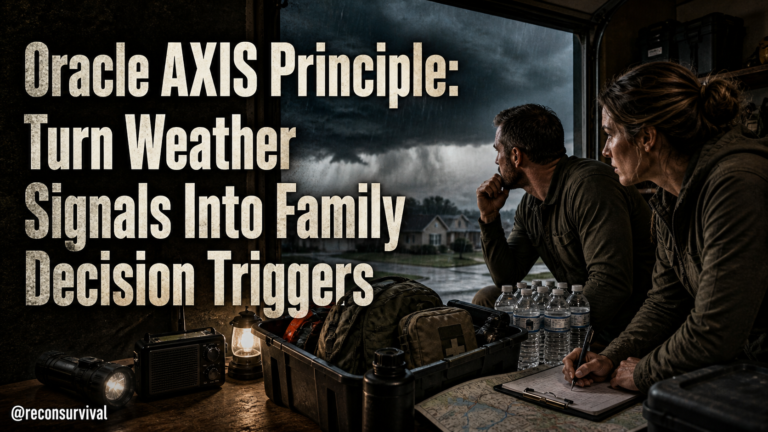
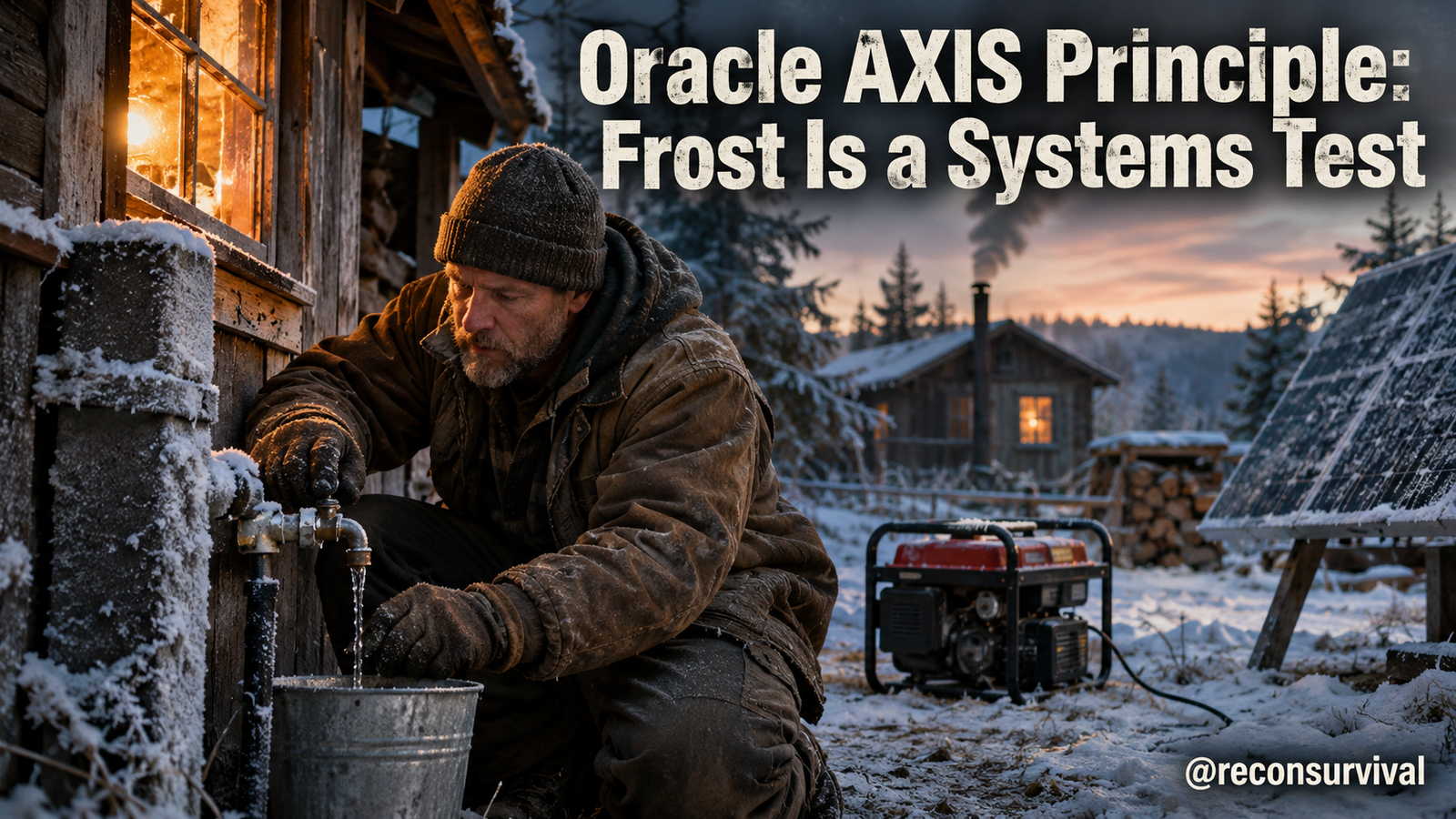
The Oracle AXIS Principle treats frost as a diagnostic tool. You do not need complex equipment or specialized training to execute this system. You only need a way to observe the five critical areas: water, heat, power, travel, and food. The objective is to translate big-picture signals into household-level decisions. When the thermometer drops, you check the status of each system against a known baseline. If a system is functioning normally, you confirm it. If it shows stress, you take action before the situation worsens. This system works because it removes the need for prediction. You are not guessing what might happen in a week; you are verifying what is happening today.
Step 1: Verify Water and Heat
The first two systems are interdependent. Water pipes freeze because heat leaves the building. Start by checking the water supply. If you have an outdoor spigot or hose bib, ensure it is drained or capped. This is a action that prevents a burst pipe, which can flood a basement or cause a loss of water pressure. Check your indoor pipes in unheated areas like garages or crawl spaces for insulation or signs of leakage. Next, assess your heat source. If you use a furnace, check the filter and ensure the thermostat is functional. If you rely on a space heater, verify that the power cord is not frayed and the unit is away from flammable materials. The mechanism here is simple: removing the path for heat loss prevents the path for freezing. If the water supply is secure and the heat source is active and insulated, the system holds.
Step 2: Test Power and Travel
Power and travel are linked by the same cold. A loss of power cuts heat, which in turn freezes pipes and blocks roads. Test your power backup now. If you have a battery backup for essential devices, turn it on and let it run for a few minutes to confirm it holds a charge. Check the status of your sump pump if you have one. Do not wait for a storm to find out the battery is dead. Regarding travel, check your vehicle. Are the fluids rated for the expected low? Is there a charged phone and a backup power source for navigation? Do you have a clear path to the nearest shelter or grocery store if roads become blocked? The signal is clear: if you cannot move, you cannot resupply. If you cannot generate power, you cannot maintain heat.
Step 3: Assess Food Security
Finally, connect frost to your food system. This is not just about having a full pantry. It is about access and storage. Check if your food storage is safe from temperature fluctuations. Canned goods are generally stable, but fresh produce in a root cellar or porch must be monitored. Ensure you have the means to cook without electricity if the power goes out. The tradeoff is clear: you can have food, but if you cannot access it or cook it, it becomes useless. The test is whether your household can sustain its caloric needs for a few days without grid support.
Household Decisions from the Signals
Once you have checked these five areas, you have the data to make a decision. * Stay: If water, heat, power, travel, and food are all stable and accessible, the system is holding. No immediate evacuation or major action is required. * Leave Early: If water is leaking, heat is failing, or power is unreliable, and you have a safe location to go, the signal is to leave now while travel is still possible. * Wait and Monitor: If one system is marginal but fixable, take action to repair or reinforce it, then re-test in 24 hours. Do not assume the problem will resolve itself. These decisions are not based on fear. They are based on the status of the systems.
The Practical Takeaway
The goal of the Oracle AXIS Principle is to end with a clear action plan. You do not need a new gadget or a complex protocol. You need a physical reminder that connects the first frost to the five systems. The most effective way to ensure this happens is to write the action down. A digital notification can be missed or ignored. A paper card on the door is a physical constraint that forces a review every time you leave or enter.
Action Plan
Do this today:
- Grab a piece of paper or a sticky note. 2. Write the following list clearly:
- Water: Drained spigot? Insulated pipes? * Heat: Filter clean? Thermostat working? * Power: Backup charged? Sump pump tested? * Travel: Vehicle fluids ready? Emergency kit full? * Food: Cookable without power? Storage secure? 3. Place the card by the main door or on a visible wall. 4. Review it the next time the temperature drops. This simple act ensures that when the frost comes, your household knows exactly what to check and what to do. You are no longer reacting to the cold; you are managing the systems that the cold tests.