A practical way to prioritize official signals, local conditions, and household decision triggers without getting pulled into social media noise, but most advice is either too generic, too gear-focused, or too late.
The first week of June marks a natural pause in the annual rhythm for many households, a time when the transition from spring weather patterns to sustained summer conditions often begins. This shift brings new variables: higher ambient temperatures, increased power load as air conditioning systems engage, and a change in the daily schedule for working families and students. While these shifts are routine, they also alter the environment in which a household operates. The real-world problem this article solves is the growing difficulty of filtering information in an environment where every household member holds a smartphone and a constant stream of unverified news, rumors, and sensationalized clips flows through social media. When heat waves arrive, when utility companies issue load shedding notices, or when local infrastructure faces stress, the information landscape becomes cluttered. The goal is not to ignore the world, but to ensure that a family's attention is directed toward official signals, local conditions, and specific household decision triggers without getting pulled into the noise that increases stress and delays action.
The Information Landscape Shifts With Summer Heat
Why does this matter specifically for early summer household information routines? As summer approaches, the reliability of utility grids and local infrastructure can become variable. Power stress is a common occurrence during peak demand periods. When the grid strains, utility companies often begin issuing notifications regarding rolling blackouts, energy conservation measures, or potential delays in repair crews responding to storm damage. In this environment, distinguishing between a verified notice from the utility provider and a rumor circulated on a social feed is critical. A household that reacts to unverified social media claims about an imminent blackout may take unnecessary actions that waste resources or create safety hazards. Conversely, a household that prioritizes official signals can adjust their routine – such as adjusting thermostat settings or charging essential devices – before a disruption occurs. This matters because the cost of reacting to noise is not just financial; it is the cost of wasted mental energy and delayed response to actual threats.
The Most Common Mistake Is Waiting For Confirmation
Identifying the most common mistake people make with this topic reveals a pattern often seen during periods of stress. Many households wait for a crisis to fully develop or for a social media post to become undeniable fact before taking action. This hesitation is dangerous because the conditions that signal a crisis are often subtle and precede the main event. People often scroll through feeds, seeing conflicting reports, and end up paralyzed by the need to "know for sure." By the time the news confirms a situation on television, the critical window for preparation may have closed. The mistake lies in treating social media noise as the primary source of situational awareness. Social media is designed to drive engagement, not to deliver timely, factual updates on infrastructure status or emergency protocols. Relying on it as a primary signal source leaves a household vulnerable to misinformation that can derail their response plans.
The Recon Survival System For Prioritizing Signals
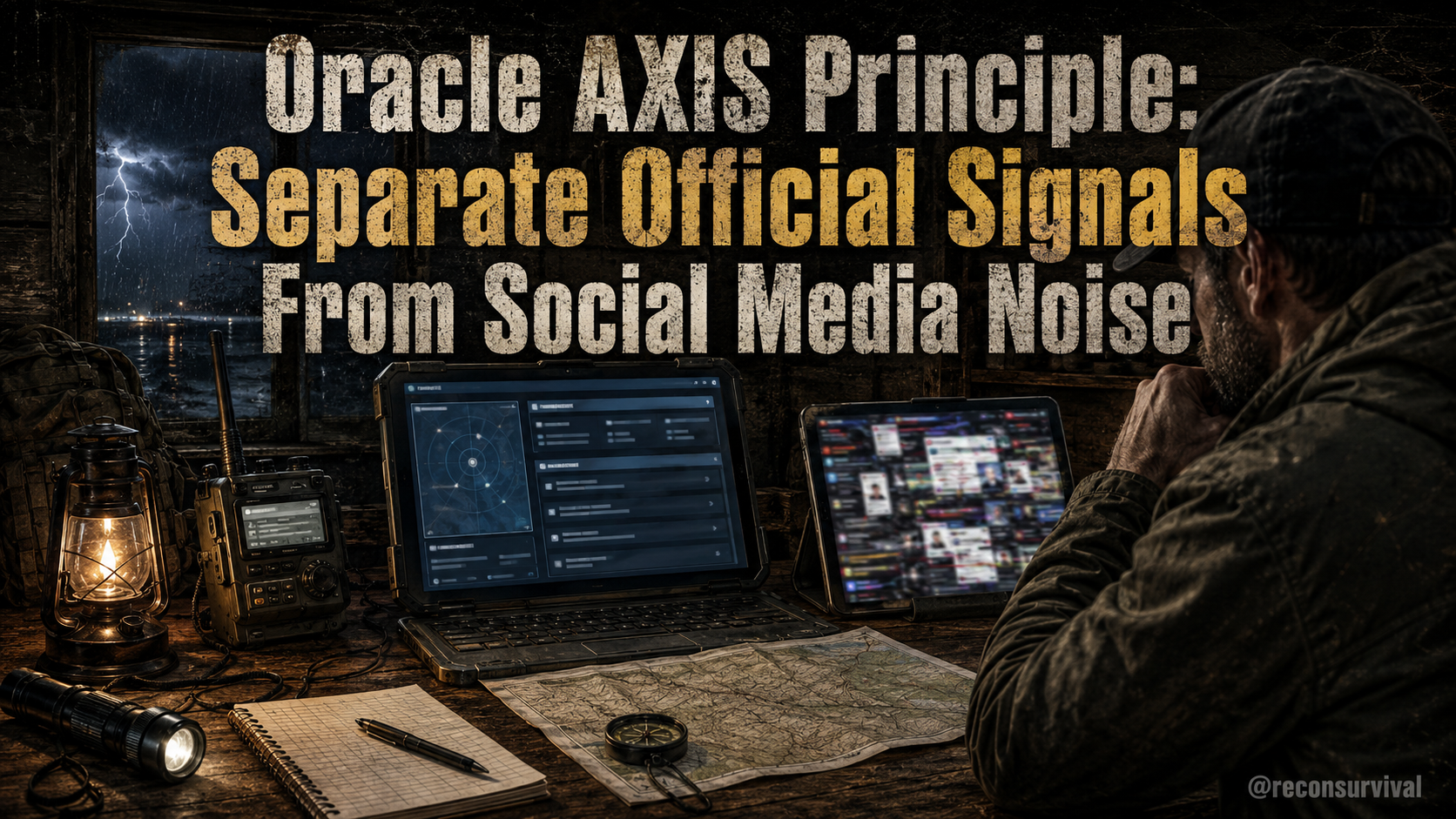
To address this, Recon Survival offers a practical system for how to prioritize official signals, local conditions, and household decision triggers without getting pulled into social media noise. This system is built on a hierarchy of information sources that filters out the noise at the gate rather than trying to sort it out later. The core principle is to establish a clear chain of trust for information. At the top of this chain are official government and utility channels. Below that are local news organizations with a history of accuracy. Social media serves only as a supplement for gathering community sentiment or seeing real-time photos, never as a primary source for decision-making. This structure ensures that a household's attention is always on the most reliable data available. By separating official signals from social media noise, the household maintains a calm perspective even when the information environment becomes chaotic. This approach aligns with the Oracle AXIS Principle, which connects early summer household information routines to signal awareness, decision triggers, and calm household action. It treats awareness as a mission, not a passive activity, ensuring that the family is always ready to act on verified facts.
Step 1: Establish The Primary Signal Chain
Break the system into clear steps a normal household can use, starting with the definition of a Primary Signal Chain. This list should be printed or stored digitally in a dedicated folder. It must include the local emergency management website, the website of the local utility provider, and the official social media accounts of local fire and police departments. These are the only sources that can provide verified alerts on power status, road closures, or emergency orders. The household should verify that the links to these sites work before an event occurs. If a family member sees a post on a popular platform about a specific issue, they are instructed to cross-check that claim against the items on the Primary Signal Chain first. If the chain does not contain an official confirmation of the event, the post is treated as unverified rumor until proven otherwise by a source on the chain. This step prevents the household from making decisions based on isolated or biased posts.
Step 2: Verify Local Conditions Independently
Step 2 involves verifying local conditions independently of the internet where possible. In early summer, local conditions often include water quality reports, air quality indices, and traffic or road status updates. These can be found on official state health department pages or via dedicated local apps, distinct from general news feeds. For example, if there is a rumor of a boil-water advisory, the household should check the health department website or the specific municipality's alert system before boiling water for drinking, saving time and resources. If the official site is down or silent, the household looks to neighbors or community radio stations that are known to report accurately. This layer of verification ensures that the household is responding to what is actually happening in their immediate vicinity, rather than what is trending globally or regionally without relevance to their specific location.
Step 3: Define Household Decision Triggers
Step 3 requires defining household decision triggers. A trigger is a specific, verifiable condition that automatically prompts a family action. For instance, a trigger might be "Utility company website posts 'Load Shedding Alert' for my sector." When this trigger is activated, the household action is "Initiate energy conservation protocol B." Another trigger might be "Local news station confirms flooding in the drainage district." The action is "Move low-value possessions to the upper floor." By defining these triggers ahead of time, the household avoids making ad-hoc decisions under stress. They do not need to debate whether the situation is serious; the official signal provides the necessary context, and the pre-agreed trigger dictates the response. This removes ambiguity and reduces anxiety during high-stress moments.
Translating Big-Picture Signals Into Household Decisions
Keep the analysis practical and nonpartisan by translating big-picture signals into household-level decisions. When a national event occurs, it rarely has an immediate impact on a local household's daily needs. However, a local official signal about a heat wave is a big-picture signal that translates directly into household decisions. The signal "Temperature forecast exceeds 100°F for three days" translates to the decision "Check refrigerator temperature daily and stock cold meals." When a utility company reports high demand, the signal translates to "Reduce air conditioner usage by 10% for two hours during the day." This translation process filters out the noise of political rhetoric or sensationalized headlines. The household focuses only on the specific instruction relevant to their infrastructure and resources. By doing so, they remain adaptable to whatever conditions the season brings, whether it is a mild summer or an unusually hot one. The focus remains on the functional outcome: keeping the household safe and functioning.
Step 4: Review The List Daily
Step 4 is to review the list daily. This involves checking the Primary Signal Chain once a day, preferably at a consistent time when the household is calm, such as morning coffee or evening dinner. The goal is not to consume endless news, but to verify if any new official signals have been posted. If a new alert is found, the household checks their triggers and updates their status accordingly. If no new alerts are posted, the household confirms their status and moves on with their daily routine. This habit prevents the accumulation of unaddressed information and ensures that the household is always aware of the current baseline. It also reinforces the discipline of relying on verified sources rather than reacting to the latest viral post. Over time, this daily review becomes a muscle memory that protects the household from distraction.
Step 5: Maintain The Household Decision Tree
Step 5 is to maintain the household decision tree. This is a living document that maps out the actions associated with specific triggers. It should be updated as new triggers are identified or as old ones become obsolete. For example, if a new utility policy changes how load shedding is communicated, the household must update their contact list and verification steps. The decision tree should be simple enough for any family member to understand and use. It serves as a backup if the primary communication channel fails. By maintaining this tree, the household ensures that their response plan is always current and relevant to the local infrastructure they depend on. This step turns abstract preparedness into a concrete, operational capability that the family can rely on when it matters most.
Recon Survival Principle: Oracle AXIS
The Oracle AXIS Principle serves as a mission framework for maintaining calm signal awareness and decision support. It connects early summer household information routines to signal awareness, decision triggers, and calm household action. This principle does not claim to predict specific disasters or offer certainty about future events. Instead, it presents a platform for continuous awareness, where the household actively filters information to prioritize what is actionable for their specific location. The principle emphasizes that preparedness is a daily discipline of separating official signals from noise. By adopting this mindset, the household transforms from a passive consumer of information into an active participant in its own safety. This approach ensures that when a disruption occurs, the family is already aligned on what to do, based on verified data and pre-planned actions. The ultimate benefit is a household that remains resilient, making calm, informed choices regardless of the season's conditions.
The Daily Review Habit
The daily review habit is the engine that keeps the Oracle AXIS Principle functioning. Without it, the household drifts back into reliance on social media noise and reactive panic. The review habit takes only a few minutes and reinforces the importance of verified sources. It also provides an opportunity to update the household decision tree and check the integrity of the Primary Signal Chain. If a link breaks or a new source becomes available, the household can integrate it immediately. This small, consistent effort prevents the gradual degradation of the household's information posture. It ensures that when a storm, heat wave, or grid issue hits, the family is not caught off guard by the information environment. They are ready, not because they know what will happen, but because they know how to find out what is happening and how to respond based on facts. This readiness is the hallmark of a secure household in an unpredictable climate.
A Simple Way To Start Today
A simple way to start today is to write down the current utility provider's alert number and website, then add the local emergency management website and the local police/fire department's alert account to a dedicated folder on your phone or computer. Print these out and pin them to the fridge or dashboard where you can see them daily. Then, identify one trigger that currently exists for your household, such as "If the temperature forecast is above 95°F, I will turn off the AC for two hours." Write this down as a rule and stick it next to your alert list. By taking these small steps, you establish the infrastructure for signal awareness and calm decision-making. This foundation allows the household to adapt as summer progresses and conditions change. The result is a family that is not only safer but also more relaxed in the face of the inevitable uncertainties of the season.
Do Today
- Walk the main system named in the brief and write down the first weak point.
- Assign one person to own that fix before the day ends.
- Check the related supplies, tools, batteries, labels, or documents by hand.
- Put the next review date on a calendar instead of relying on memory.
- Move one critical item to the place where it will actually be used.
- Tell the household what changed and where the updated item now lives.
- Repeat the check after the next outage, storm warning, trip, or schedule change.