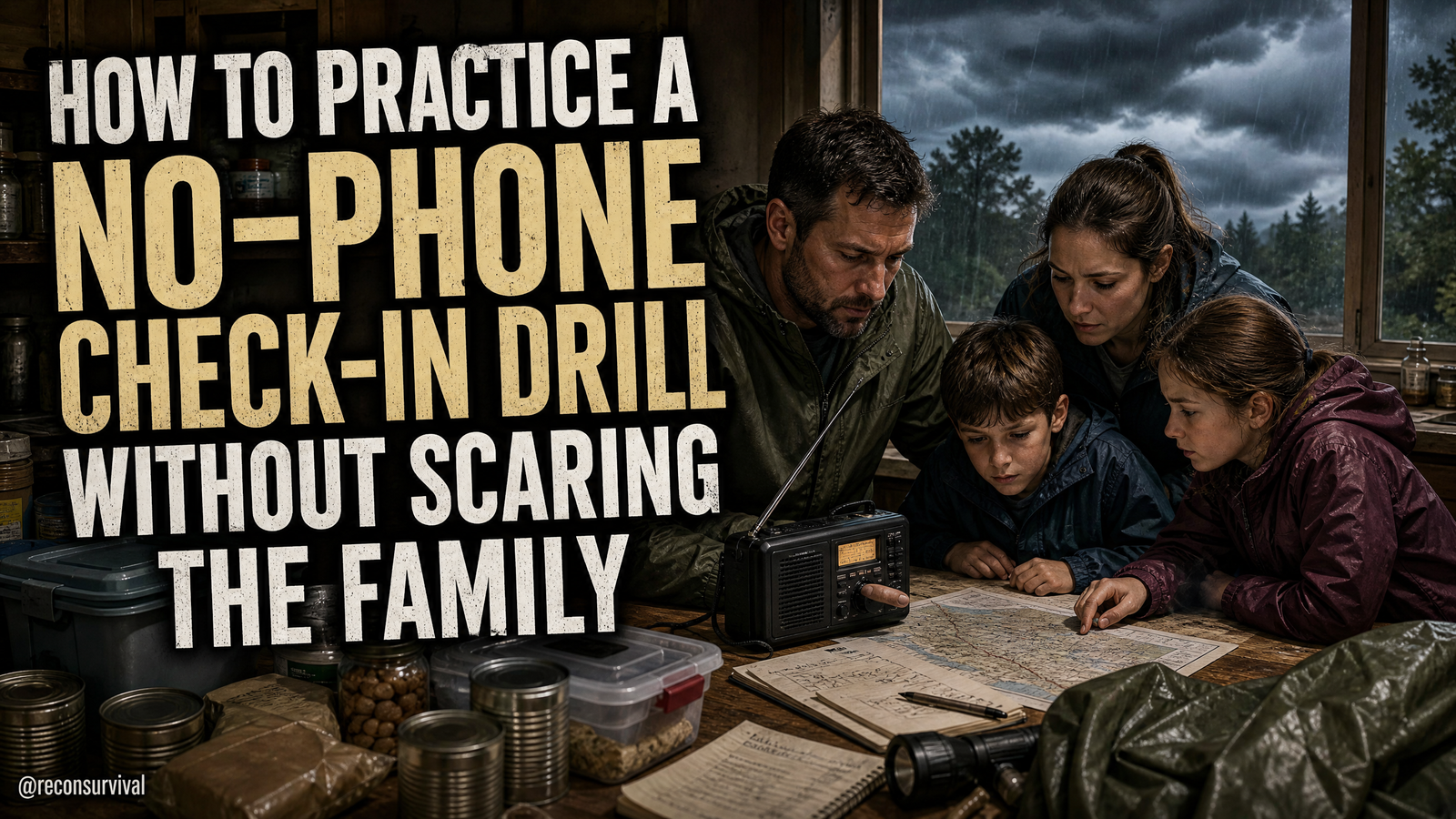
The moment the group chat spins and bars drop to zero is not when you want to figure out how your family checks in. Simulate those minutes now so everyone knows their role, where to go, and who to call when the phones don't help.
As an Amazon Associate, I earn from qualifying purchases.
Why Phones Fail And Households Stall
Phones are great until networks jam, batteries die, or a wet power strip takes down your Wi‑Fi. In that gap, families freeze because the plan is buried in a text thread or living only in one person's head. The result is wasted time, duplication, and risk: multiple people driving the same route, kids waiting in the wrong place, and nobody updating the person who could relay the all-clear.
A simple, no-phone check-in drill turns vague intentions into muscle memory. When everyone knows the card they grab, the route they walk, the radio channel they switch to, and the person they update, the silence between rings stops being a crisis. Treat it like any other household system: label, assign, rehearse, and time it.
The Common Mistake: Silent Plans, Untested
Most people either buy radios and never turn them on, or they talk about a meeting point once at dinner and consider it done. That leaves big gaps:
- No printed contact info on the fridge, in wallets, or in backpacks.
- One "meet at home" point with no backup, no time windows, and no alternative if the street is blocked.
- Radios tossed in a drawer with dead batteries, no shared channel plan, and no call procedure.
- An "out-of-area" contact picked but never told what to expect or how to log messages.
The fix is not more gear. It's a short, calm drill that proves each link works from the kitchen table to the curb and back again, with clear triggers, owners, and timing.
Contact Cards: Print, Place, and Prove Them
Contact cards are your offline backbone. They should exist in three places per person: wallet or lanyard, backpack or glove box, and on the refrigerator.
Build one simple card template on a half-sheet index card (3×5) or business-card sized slip:
- Front: household surname, home address, two local emergency contacts, one out-of-area contact, school/work numbers, radio channel plan (e.g., "Primary: Ch 3, Code 0; Alt: Ch 8, Code 0"), and meeting points with time windows (e.g., "MP1: Front porch, +15 min; MP2: Elm & 3rd stop sign, +30 min").
- Back: brief message format: "We are [OK/Need Help]. At [location]. Next move [go/stay]. Next check [time]. -[Name]"
Practical build steps:
- Print six copies per person. Use plain printer paper and clear packing tape to laminate. Hole-punch one corner and add a short cord for backpacks.
- Date each card in the bottom right corner. Rotate every 6 months by writing a new date and rechecking numbers. – Stage cards: one on the fridge under a magnet labeled "CHECK-IN," one in each wallet or student ID sleeve, one in the vehicle glove box in a zip bag.
Proof it works:
- Test by having each person retrieve the fridge card with their eyes closed, from memory. Time it. Goal: under 10 seconds.
- Call the out-of-area contact once to confirm they can read your message format out loud and log it on paper.
Meeting Points You Can Reach On Foot
Phones down means you may have to move without coordination. Meeting points should be obvious, reachable on foot for all ages, and sequenced with time windows.
Set three tiers:
- MP1 Home: a specific spot like "front porch bench by the blue pot." Time window: 0 to +15 minutes. Owner: the first adult home stays put for the window.
- MP2 Neighborhood: a visible landmark 5-10 minutes away like "Elm & 3rd stop sign by the fire hydrant." Time window: +15 to +45 minutes. Owner: if MP1 window ends with no link-up, move to MP2. – MP3 Out-of-neighborhood: a public building within 30 minutes on foot like "North Branch Library, west entrance." Time window: +45 to +120 minutes. Owner: if MP2 fails, move to MP3 and update the out-of-area contact from a landline or after the drill ends.
Make them concrete:
- Walk each route on a Saturday morning. Count crosswalks. Note shaded spots for summer heat. Time the slowest walker's pace. Write those times on the card.
- Tape a printed map inside the shoe cabinet with a highlighter tracing the three routes. Write "MP2: 9 min at child pace; MP3: 26 min."
Safety details:
- Assign a buddy rule for kids. Nobody walks alone in the dark. If it's night, MP1 window extends until daylight unless the house is unsafe.
- Stage a small sling bag on a hook by the door with two water bottles, a whistle, a thin rain jacket, and the family radio.
Family Radios: Setup, Channels, and a 5-Minute Net
Handheld FRS/GMRS-type radios are only useful if they're labeled, charged, and everyone knows how to speak on them. Keep it simple and lawful; follow your device manual and local regulations.
Setup:
- Label each radio with painter's tape: "Kitchen," "Car 1," "Bedroom A." Write the primary channel and code on the tape.
- Standardize one primary channel/code and one alternate. Example: Primary Ch 3 Code 0 (no privacy code), Alternate Ch 8 Code 0. Keep codes at 0 unless you intentionally set the same code on all radios. – Power: keep one charged radio in a bowl by the front door with a lanyard. For AA/AAA radios, pair each with a labeled 4-pack of batteries in a zip bag dated with a Sharpie. Rechargeables sit on a shelf outlet charging dock in the mudroom. Rotate and top off monthly. – Accessories: clip a small LED and an extra antenna (if removable) into the same bowl. Keep a paper quick sheet taped inside the cabinet: "On/Off, Volume, Channel, PTT button, Call procedure."
Practice a 5-minute net:
- Call-up format: "Household Net, this is [Leader]. Radio check, over." Responses: "This is [Name/Location], loud and clear, over." End with "Net closed. Return to plan."
- Mic discipline: talk 2 inches from the mic, normal voice, push-to-talk pressed before speaking, pause 1 second before talking.
- Range test: one person stands on the front steps; another goes to MP2 corner. Confirm copy. If noisy, switch to the alternate channel and try again.
The Out-of-Area Contact That Cuts Through The Noise
When local networks are busy, a contact in a different area often gets through later or by different routes. Choose a reliable person who's often reachable and comfortable acting as a message hub.
Set it up:
- Pick one primary out-of-area contact and one backup. Write their full names, city/state, mobile, and a landline if available on the cards. Confirm time zones.
- Teach them the script. They log in a notebook by the house phone: "Date/Time, Caller name, Status, Location, Next plan, Next check time." They do not call 911 for you unless asked explicitly.
Message format to send when possible:
- Text/voicemail: "Smith family OK. At home porch. Moving to MP2 at 5:15 pm if no contact. Next check 5:30 pm. -Alex"
- Ask them to reply with "Got it" and hold messages until you confirm the family is consolidated.
Drill-friendly option:
- If you're simulating a no-phone scenario, write the message on an index card during the drill and hand it to your scribe. After the drill, actually place the call or text and confirm timing.
Triggers, Owners, and Timing
Make your communications practice automatic with household triggers. When X happens, Y person starts Z action. Keep it printed on one sheet by the fridge magneted under "CHECK-IN."
Examples:
- Trigger: NOAA weather alert radio issues a warning for your county. Owner: Adult at home. Action: Announce "No-Phone Check-In Drill," place all phones face down in the kitchen bowl, start 20-minute timer, open the radio bowl and begin the net.
- Trigger: School sends early dismissal due to network issues. Owner: Parent with vehicle. Action: Switch to radio primary channel before leaving, retrieve the sling bag, and set MP1 window to +30 minutes at home. – Trigger: Family road trip day with split vehicles. Owner: Driver 1. Action: Set both car radios to the primary channel, agree on the next check-in mile marker, and verify out-of-area contact time window before departure. – Trigger: Neighborhood power outage after dark. Owner: First adult home. Action: Place one flashlight in each bedroom, move the "Kitchen" radio to the front porch, and begin the 5-minute net.
Each trigger has a timing note. Write the start time on a Post-it stuck to the fridge, and call out the time windows: "MP1 holds until 5:15. If no link-up, move to MP2."
The 20-Minute No-Phone Check-In Drill
Run this when the house is calm. Keep it light, keep it short, and praise smooth moves. No scare talk, no what-ifs. The goal is to build speed and clarity.
Setup:
- Tools on the kitchen table: timer, bowl for phones, two handheld radios, the fridge contact card stack, a clipboard with a run sheet, a pen.
- Roles: Leader (announces steps), Radio Lead (manages radios), Runner (walks to MP2 if part of the plan), Scribe (times, logs, notes misses). Rotate roles each drill.
Drill timeline (20 minutes total):
- Minute 0-1: Leader says, "Phones down drill. Place phones in the bowl." Scribe starts the timer and writes the start time on the run sheet.
- Minute 1-3: Everyone retrieves their wallet/backpack contact card and reads meeting points out loud. Scribe times the slowest retrieval. – Minute 3-6: Radio Lead powers on both radios, sets the primary channel, and runs a 5-minute net with each person in a different room (kitchen, living room, front porch). Scribe notes if any button mistakes occur. – Minute 6-12: If safe, Runner walks to MP2 corner and does a radio check from there. They observe a safe waiting spot and estimate the MP2 time window signage they'd choose (hydrant, bench, tree). Scribe logs copy quality. – Minute 12-15: As a family, read the MP1/MP2/MP3 time windows on the fridge map. Leader asks each person to point to the routes with a finger. Scribe notes any confusion. – Minute 15-18: Write an out-of-area message on an index card using the card format. Leader picks a check-in time and says it out loud. If you choose, actually send it from a landline or after the drill. – Minute 18-20: Leader ends the drill: "Phones up. Reset radios on chargers. Return cards to fridge/wallets." Scribe records total time and top 3 fixes.
Keep it friendly. If a child gets stuck, show the move once and repeat it next time. End on what went right.
Measuring Improvement: Score The Drill, Fix The Gaps
If it's not measured, it won't improve. Post a single-page scorecard on the side of the fridge or inside a pantry door.
Track these five metrics:
- Card retrieval time: goal under 10 seconds per person from announcement.
- Radio net success: goal 100 percent check-ins heard and acknowledged within 3 minutes. – MP2 range check: goal clear audio from MP2 corner; if not, test alt channel or move MP2 closer. – Message format: goal one clean, complete out-of-area message written in under 60 seconds without prompts. – Total drill time: goal 20 minutes or less without skipping steps.
Mark each item green/yellow/red with a date. If any item is red twice in a row, add a 5-minute micro-practice that week focused only on that link:
- If radio button errors persist, tape a small photo-labeled quick sheet to the radio bowl.
- If retrieval is slow, move the fridge cards lower on the door and add a bold "CHECK-IN" label. – If MP2 walk is uncertain, walk the route again and snap a printed photo of the exact landmark to tape on the map.
Once a quarter, run one drill at dusk to test lighting and handoff of flashlights. Always keep the tone calm and the timing tight.
Recon Survival Principle
Communication isn't a gadget problem. It's a household choreography problem. You reduce chaos by setting clear triggers, assigning owners, and rehearsing short, repeatable actions until nobody has to think. Printed cards, simple meeting points, and a practiced radio net beat an unread group text every time.
The takeaway: practice for the silence. If the plan can run with paper, feet, and one clear voice on a handheld, it will run when the apps freeze.
Do Today
- Print and tape three contact cards per person: one on the fridge, one for the wallet, one in the glove box. Write the date in the corner.
- Choose MP1, MP2, and MP3 and walk MP2 once. Time it at a child's pace and write those minutes on the fridge map.
- Label two handheld radios with painter's tape showing the primary channel. Charge them or pair each with a dated 4-pack of AA/aaa batteries.
- Pick one out-of-area contact and call them. Read them your message format and ask them to keep a paper log near their phone.
- Create a one-page trigger sheet with at least three triggers, owners, and actions. Magnet it under the "CHECK-IN" label on the fridge.
- Stage a bowl by the front door: place the "Kitchen" radio, a small LED, and a lanyard inside. Add a Sharpie to mark times during drills.
- Run the 20-minute no-phone check-in drill this week. Use a timer. Log times and write down the top three fixes.
- Schedule a 5-minute radio net once a month. Put it on the family calendar: first Saturday, 10:00 am, Channel 3.
- Move a small sling bag to the door hook with two water bottles, a whistle, and a thin jacket for MP2 walks.
- Set a reminder to rotate and re-date contact cards and radio batteries every 6 months. Print the reminder date on the card backs.