The Signal Lag
A household that gets every warning through the same phone has one information path. If power or connectivity disrupts that path, checking another app may not provide an independent input. Plan a separate way to receive information before you need it.
The core issue is not a lack of information, but a reliance on a single point of failure. Most emergency advice treats awareness as a software update or a gear purchase. You might have the latest application, but an app requires a tower, a tower requires power, and the grid powering that tower is susceptible to weather. When that single line goes dark, the digital feed dies with it.
Resilient awareness does not wait for a signal to stabilize. It assumes the first input is compromised and builds a household signal chain before the weather turns. This approach is not about fear; it is about the mechanical reality of how information flows when infrastructure stops conducting electricity.
The Hidden Load of Digital Reliance
The most common mistake is assuming one source is sufficient because it is the primary source. News and weather apps on the same phone share a failure point. If that phone or its data connection is unavailable, both feeds can become unavailable together. A separately powered broadcast radio gives the household another input. This creates a fragile chain where the strength is determined only by the weakest link.
When a storm hits, the load on cellular networks spikes. Even if towers remain powered, they may be overwhelmed by many simultaneous connection attempts. A message that sends in seconds during a calm week might time out or fail entirely during a crisis. A map application that loads quickly may stall without data. Relying on a single feed creates a false sense of security while the system is under heavy load.
The failure sign is not a loud alarm; it is silence. The screen goes gray. The text fails to send. The internet disappears. At that moment, the household is no longer receiving information; it is hoping for a signal that may not arrive when it is needed. The hidden cost is the delay in decision-making. Time is spent refreshing an app that will not update while the storm moves.
Layered Signal Inputs
The Recon Survival approach replaces the single feed with a layered input system. This does not require a lab or expensive prototypes. It requires recognizing that different signals travel through different paths. One path uses the airwaves, another uses the road network, and a third uses the street.
This system operates on the principle of redundancy. If one path is blocked by weather, power loss, or network congestion, the others remain active. You are not adding devices to clutter the house; you are diversifying the information channels so the failure of one does not leave the household blind.
Broadcast Chain
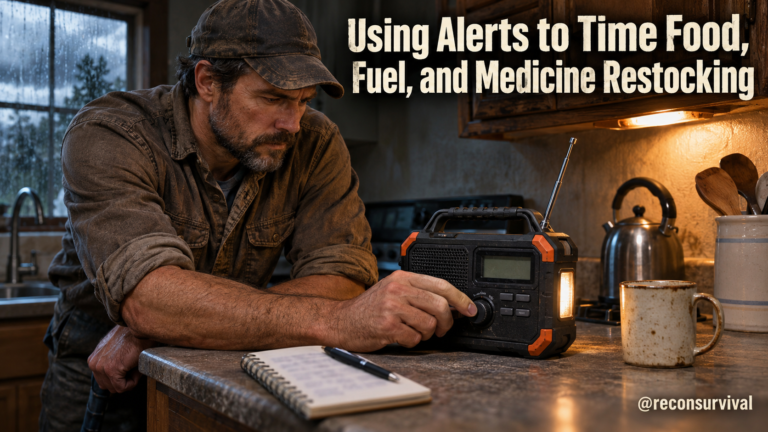
A battery-powered or hand-crank radio provides a reliable layer. It operates on standard broadcast frequencies that do not rely on cellular data or internet connectivity.
- Action: Ensure the device has fresh batteries or is fully charged according to the manufacturer's instructions.
- Check: Verify the device turns on and you can hear a broadcast without plugging it into a wall outlet.
- Limitation: The radio provides information but not specific directions. You must still understand what that information means for your location.
Physical Map Chain
A map that depends on a live data connection can stop updating when that connection is lost. A current paper map provides a separate reference. A physical map allows the household to locate resources, routes, and shelters without a screen.
- Action: Store a current map of your local neighborhood and a regional map in your emergency kit and near the main exit.
- Check: Confirm that any adult in the household can identify the nearest shelter or hospital location on the paper map without needing to ask for directions.
- Limitation: A map is static. It shows what was true when it was printed, not where traffic is currently backed up.
Human Chain
The most reliable signal is often the one closest to you. Neighbors, local community groups, and established check-in procedures provide information when electronics fail.
- Action: Establish a clear check-in protocol. Define who calls whom and where the meeting point is if the house becomes inaccessible.
- Check: Verify that everyone knows who to contact and where to meet if they cannot reach the house.
- Limitation: This relies on the presence of people and their own safety.
The Decision Trigger
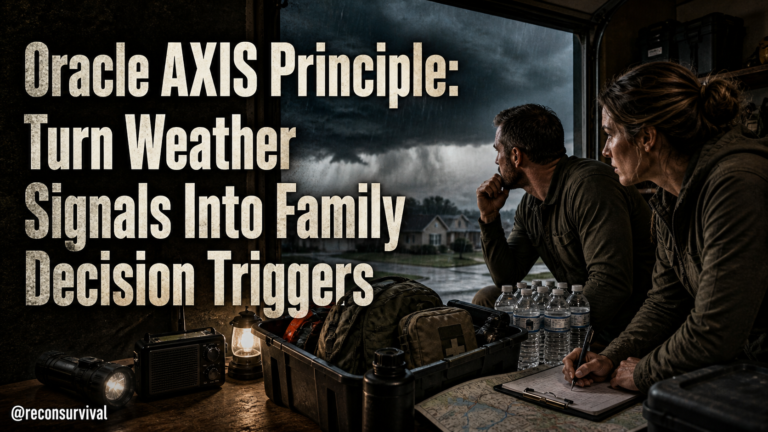
A future-facing concept in this context is the "Decision Trigger." This is a rule that moves the household from observation to action without debate. In a crisis, decision-making capacity drops. The goal is to shift the burden of the decision to a pre-written plan.
The trigger converts a signal into an action. For example, a specific weather warning might trigger a packing routine, or a confirmed power outage might trigger a fuel conservation plan. This separates the "what" (a storm is coming) from the "how" (we pack and move). The household does not need to discuss what to do when the first layer of information arrives. The action is already defined.
Link each warning source to a decision already chosen in the household plan. Keep the action card with the contact information and tools it depends on.
Recon Survival Principle
Resilient awareness is not about having the most advanced gear. It is about having a system that survives the failure of the most likely point of weakness: the single digital feed. By layering broadcast radio, physical maps, and human checks, the household maintains awareness even when the grid fails.
The value is not in the gear itself, but in the time saved during an interruption. While others wait for a phone to load, the prepared household is already moving to the next step because the decision was made in advance. This approach separates what is practical today from what is experimental, ensuring you rely on proven methods first.
Do Today
The single most effective action you can take this week is to write and place the household action card. This is the bridge between the theory of redundancy and the reality of your home.
- Get a card: Use a piece of paper or a small notebook.
- Write the Trigger: Write the trigger already chosen for your household plan.
- Write the Action: Write the exact steps to take (e.g., "Pack the bag, check the radio, meet at the front porch").
- Place It: Put the card by the main door or in your emergency kit.
The Check: Ask yourself: "If I picked this up right now, would I know exactly what to do without checking my phone?" If the answer is yes, the redundancy is working. If the answer is no, add a specific instruction until it is.