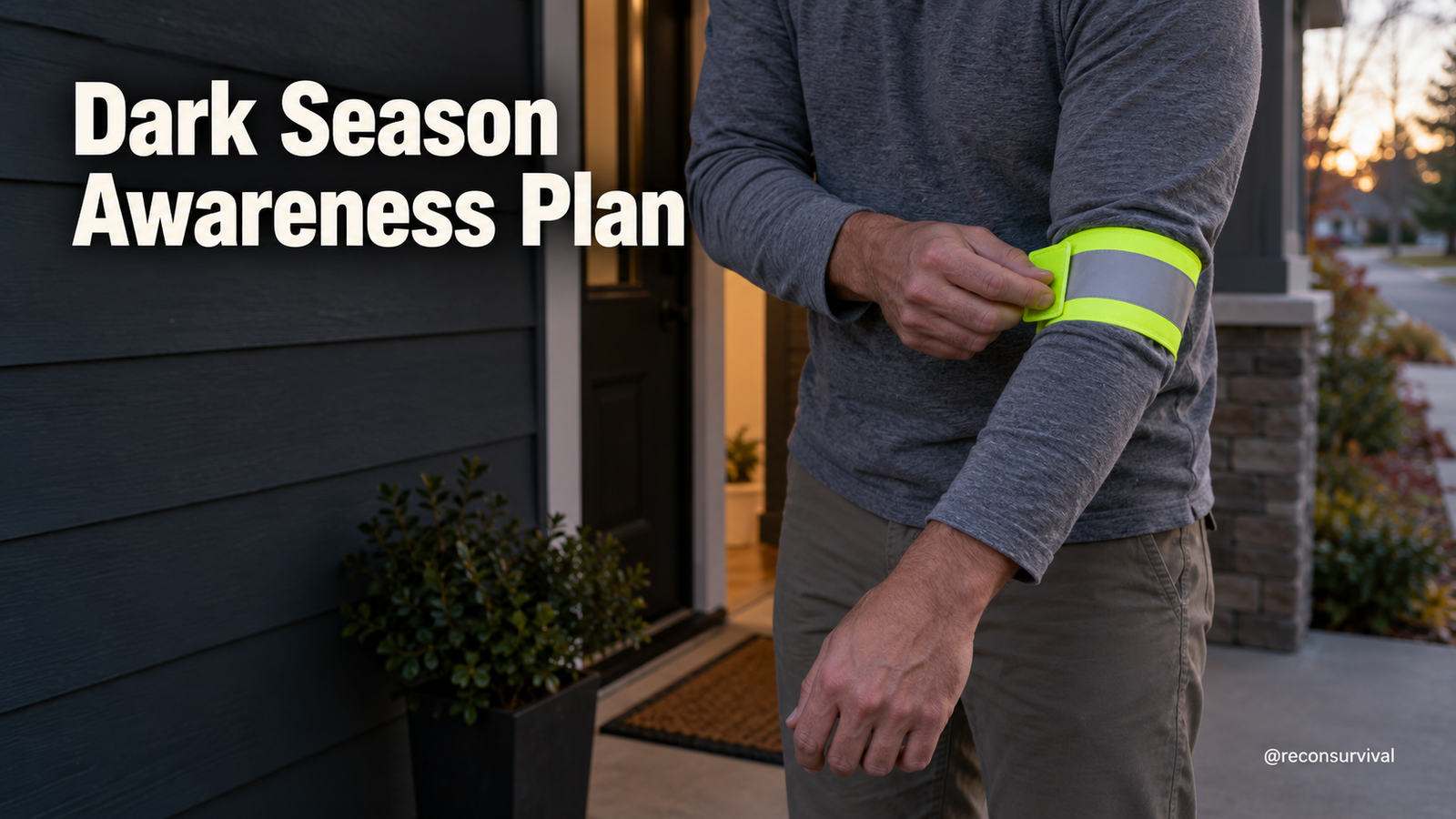
If an incident occurred tonight, would your household already know how to handle it? The most common mistake is waiting until the event is already underway to figure out the plan. People rely on memory or "seeing what happens." By then, the household is reacting to a crisis rather than executing a known routine. A first physical check beats a generic reminder every time. The Recon Survival practical system for this season focuses on one core action: establishing a single, visible household rule for movement and routine checks during dark hours. This is not a list of twenty new tasks. It is one clear instruction that covers how the family moves when daylight is gone and how they handle events or schedule changes. Implement this system in three steps. <p class="rs-affiliate-disclosure"><em>As an Amazon Associate, I earn from qualifying purchases.</em></p>
As an Amazon Associate, I earn from qualifying purchases.
Step 1: Anchor the plan to a physical cue. Write the household action on a small paper card. The text should be a single sentence, such as: "Before we leave after sunset, check the door and lights." Place this card by the main exit, near the keys, or on the kitchen counter where everyone gathers before leaving. This removes the need to recall instructions from memory. A first physical check beats a generic reminder because it creates a consistent trigger for the family to pause and verify their status. ## Step 2: Define the movement boundary. Decide on a rule for night movement that applies to all family members. This rule might specify that no one leaves the immediate neighborhood after dark without a designated check-in, or that headlights and flashlights are turned on immediately upon stepping outside. The boundary is not a restriction; it is a safety buffer. It ensures that everyone knows the condition under which movement is permissible. This rule must be practical and legal. Do not invent tactics that require specialized gear or training. The rule should work for a parent walking a dog, a teenager driving to a late event, or a family member going out for groceries. ## Step 3: Schedule the family check-in. Add a five-minute window to your routine after sunset or before any evening event. During this time, the household performs a quick visual scan: Are the entry points secure? Are the lights on or off as planned? Is everyone present and accounted for? This is not a security audit; it is a rhythm check. It confirms that the household is ready for the dark season. If the scan reveals a gap – like a door left unlocked or a missing flashlight – the household fixes it immediately before anyone moves. This approach does not require new equipment or complex training. It uses what is already in the home: a paper card, a flashlight, and the family members themselves. The constraint is that the rule must be simple enough to remember under stress. If the household cannot recall the rule quickly, it is too complex. The decision to adapt household awareness for shorter daylight, events, school schedules, and night movement is not a one-time choice. It is a habit that changes with the season. ## What to do today:
Write the household action on a paper card. Place it by the main exit. Read it aloud so everyone knows the rule. This takes minutes but establishes the physical cue that triggers the rest of the plan. ## What to do this week: Practice the movement boundary. Walk the perimeter of your home after dark. Check that flashlights work and that everyone knows where they are, following the manufacturer's instructions for use and storage. Test the check-in routine by doing it one evening without a specific event. If the routine fails, adjust the rule until it works. ## What to do later this season: As daylight fades further, revisit the rule. If events become more frequent or schedules change, update the card. The rule should remain relevant to the current conditions. If the family grows or routines shift, the card must be rewritten. This keeps the plan alive rather than letting it become a static piece of paper. The end of October brings more darkness and changing routines. Next: adapt household awareness for shorter daylight, events, school schedules, and night movement. The prepared version of you checks the list while everyone else is searching for batteries. This is not about fear; it is about having a calm, realistic, value-first way to handle the season. The core lesson for the season is that the best plan is the one you actually use. A single, visible instruction beats a long list that sits in a drawer. If you can execute the check and follow the movement rule without hesitation, you have achieved the goal. ## Your Dark Season Action Plan:
- Write the household action on a paper card. 2. Place it by the main exit or where the family gathers. 3. Define one simple movement rule for night activities. 4. Practice a five-minute evening check-in once a week. This checklist ensures you adapt household awareness for shorter daylight, events, school schedules, and night movement. Start with the card. It is the first step toward a calmer, more prepared household.