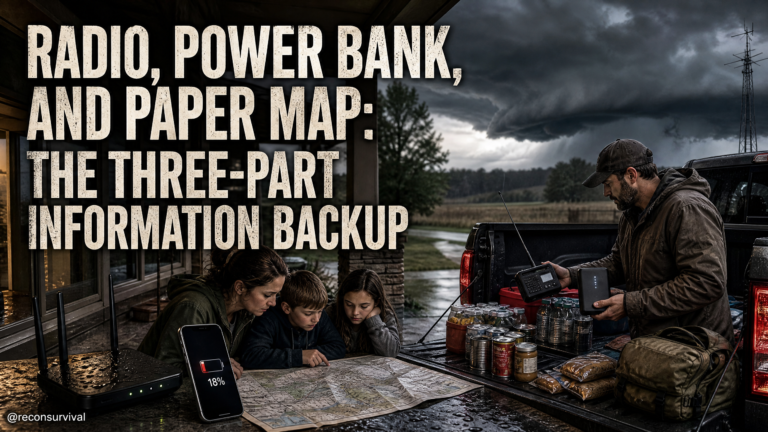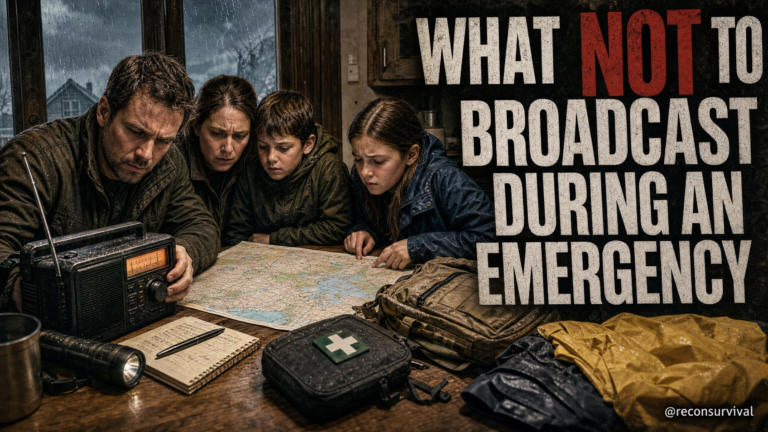
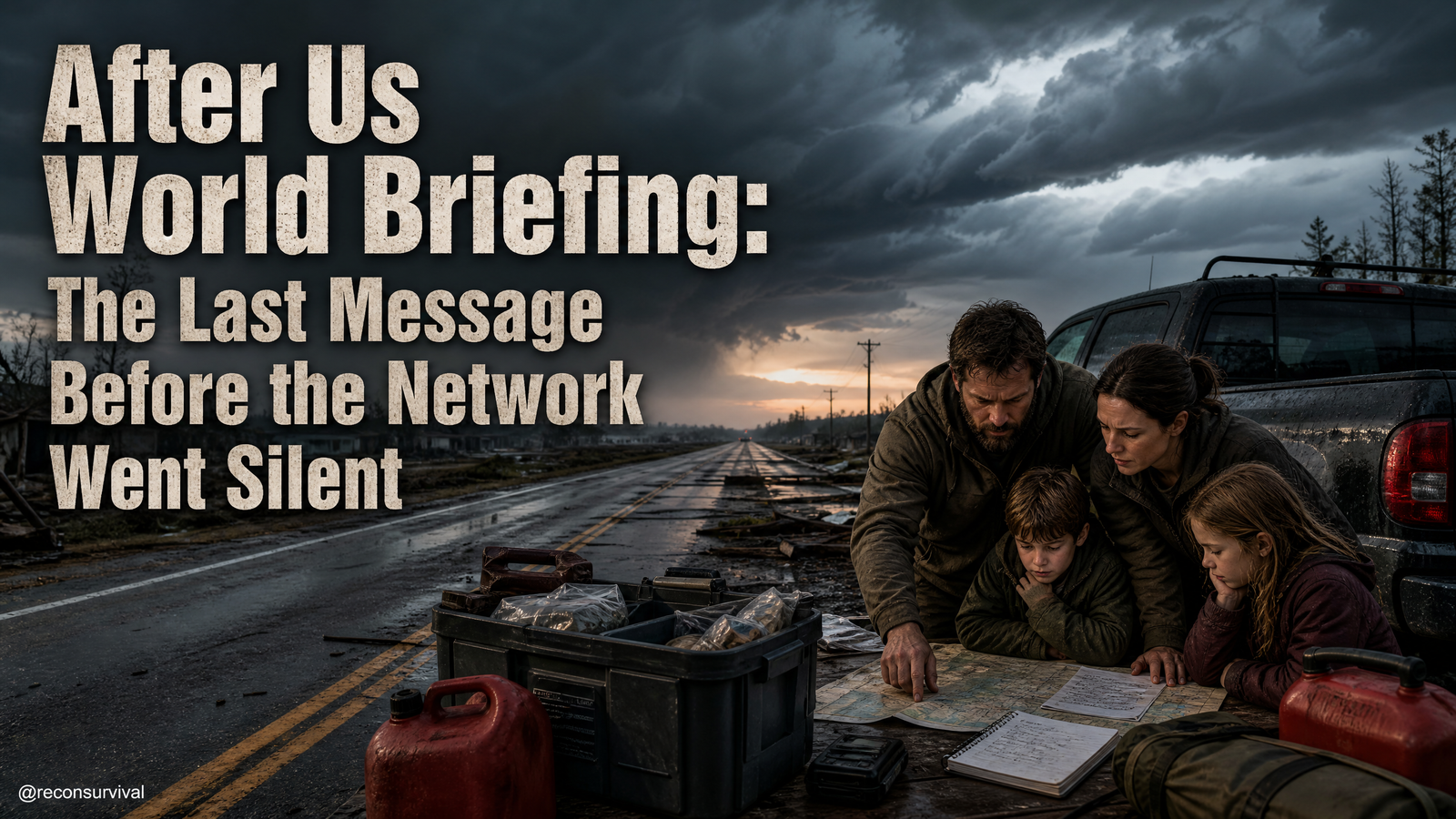
You're on a two-lane highway after a storm cell rolled through. Power blips. The bars on your phone blink, then go flat. You've got family in two vehicles and one person at home watching the weather. Run this drill tonight so that when that silence hits, your people already know exactly how to move the message.
As an Amazon Associate, I earn from qualifying purchases.
The Intercept Drill: Run It Tonight
Set a 15-minute kitchen-table drill that starts with a single "intercepted" message and ends with your household proving two independent ways to pass it. Keep it small and repeatable. You'll use a short fictional transmission to spark the exercise, then score your real-world redundancy.
Your scene:
- Location: kitchen table with a printed card, living room radio on the bookshelf, garage shelf with two radios on charge, glove box with a laminated channel card, and the bedroom nightstand with a battery bank.
- People: one person plays "sender," one plays "receiver," at least one "relay." If you're solo, run it as sender + receiver using two devices and a radio. – Timer: set 15 minutes on the stove clock or phone timer.
Outcome you're aiming for tonight:
- At least two different paths deliver the message across your group in under 15 minutes. Example: SMS plus handheld radio; or Wi‑Fi call plus AM/FM local bulletin; or neighbor relay plus radio. If you only have phones, you'll prove text beats voice and define when to switch to radio or in-person relay.
Preparation: Print, Stage, and Brief
You'll need one sheet of paper, two pens, two sticky notes, a roll of painter's tape, and whatever comms you already own. No shopping.
- Print a one-page "Intercept Card" with:
- Household names and roles
- Two rally points (near and far)
- One primary out-of-area contact
- Your radio channel plan (example below)
- A short 3-line message format
- Stage gear where you'll actually grab it:
- Kitchen drawer: one charged battery bank labeled with today's date, one 3-in-1 cord, one Sharpie.
- Hall closet shelf: two handheld radios (charged), each with a strip of blue painter's tape labeled "Ch 3, Code 22," plus a paper quick-start taped inside the door.
- Glove box: laminated 3×5 channel/rally card and a cheap AM/FM radio with fresh aaa batteries.
- Nightstand: flashlight and the NOAA weather radio set to your county.
- Brief your people at the table:
- "If we lose signal, we try text first for 3 minutes. If no delivery, we switch to radio on Channel 3, Code 22 at the top and bottom of each hour. If radio fails, we move to Rally Point A. Out-of-area contact is Aunt Dana in area code 406."
Recovered Transmission: The Last Message
Use this short fictional excerpt from After Us as the spark for your drill. Read it out loud, then act.
"Intercept 7-18 // 14:22L 'Grid wobbly. Towers blinking. Road shoulders flooded near mile marker 118. We are diverting east at Exit 12. If you read this, switch to Channel 3, Code 22. Check at 14:30 and 15:00. If all else fails, meet at the brick library lot. Carry paper. Keep it short: WHO, WHERE, NEXT. – Lark'"
Archer's Field Note: We pulled this minutes before the network throttled to nothing. The crews who practiced short, pre-agreed messages still moved. Everyone else stood staring at blank screens.
Keep the fiction short. The teaching is real.
Household Debrief: What the Message Teaches
That 4-sentence intercept carries the bones of redundancy. Extract them and make them yours:
- Short formats move when networks clog. Use WHO, WHERE, NEXT and keep it under 160 characters for SMS.
- Time windows matter. "Check at 14:30 and 15:00" creates predictable radio and text check-ins.
- Pre-set channels save time. "Channel 3, Code 22" only works if your radios are labeled and programmed.
- Physical rally beats guessing. "Brick library lot" is a specific, known landmark with parking.
Checklist for your fridge:
- Write your WHO, WHERE, NEXT format on a sticky note and tape it next to the kitchen calendar.
- Print your two rally points with addresses and a small map. Put one in the glove box and one by the door. – Label radios with channel/code. Test them weekly for 60 seconds, Sunday nights at 19:00. – Pick two check-in times per day to practice: 07:30 and 19:30.
Drill Steps: 20-Minute Redundancy Walk
Use the intercept above. Set a 20-minute timer. Move fast but clean.
- Sender writes the message
- At the kitchen table, write your version on paper using WHO, WHERE, NEXT.
- Example: "WHO: Dad/Blue SUV. WHERE: Diverting East at Exit 12. NEXT: Check Ch3/22 at 19:30; Rally A if no contact."
- Try Path 1: Text beats voice
- Sender texts the exact message to Receiver. If you're home and your "Receiver" is in the yard or garage, it still counts.
- If delivery fails in 3 minutes or less, stop trying voice calls. Note the time.
- Try Path 2: Handheld radio
- Both parties move to their radios. In the living room and garage, set Channel 3, Code 22. Confirm by reading the radio screen.
- Make a 10-second call: "Blue SUV calling Home on Three-Twenty-Two. Copy?" If no response, move one person to a window or outside patio. Try again.
- Try Path 3: Broadcast intake
- Turn on your NOAA or AM/FM radio. Can you receive a weather bulletin? Note signal strength and station on a sticky note.
- The Receiver repeats any weather summary back to the Sender via radio to prove intake and relay function.
- Try Path 4: Neighbor relay (optional)
- Send a child to the next-door fence with the paper message. They hand it over and ask the neighbor to read it back over the fence or by text to your Receiver. Time it.
- Lock in the NEXT
- End with both parties stating the next check-in time and place. Write it on paper and put it on the fridge. Example: "Next attempt 19:30 Ch3/22. If no contact by 20:00, meet at Library Lot."
Note your start and end times. You should be able to confirm the message on two paths in under 15 minutes indoors; under 10 minutes if you move to better radio positions.
Scoring: Pass / Fix / Retest Standard
Use a simple grade that forces action instead of hand-waving.
- Pass:
- Two independent paths successfully moved the message within 15 minutes.
- Radios connected without re-programming.
- Everyone can state WHO, WHERE, NEXT and the next check-in time without looking.
- Fix:
- Only one path worked, or it took longer than 15 minutes.
- A radio wasn't charged, wasn't labeled, or someone didn't know how to push-to-talk.
- No one could name the rally point address.
- Retest:
- After fixes, repeat the drill within 48 hours.
- Rotate roles so a different person leads comms.
Write PASS, FIX, or RETEST with a date on the Intercept Card. Tape it inside the hall closet door.
Fixes: Patch the Gaps You Found
Close the gaps immediately, using the same table and gear.
If text failed:
- Open your phone settings and enable Wi‑Fi calling if available. Write the steps on your Intercept Card for the least tech-savvy person.
- Pre-write two 160-character templates in your Notes app labeled "Outage Check" and "Rally Change." Example: "OUTAGE CHECK: We are ok. Phone spotty. Try text on the hour. Ch3/22 at 19:30. If no contact by 20:00 go Library Lot."
If radio failed:
- Charge all handhelds today. Write "Charged" with today's date on painter's tape and stick it to the radio body.
- Program one primary and one backup channel/code. Label both radios identically: "Ch3/22 primary; Ch1/0 backup." If you don't know how, open the manual and follow the basic channel/code set instructions. [FACT CHECK REQUIRED: verify radio model-specific programming steps in the manufacturer manual]
- Add a 3×5 quick-start card to the radio pouch: On/Off, Volume, Channel, Code, PTT, Call times.
If roles failed:
- Assign a Comms Lead, a Runner, and a Recorder. Write names on the Intercept Card. Put the card on the fridge.
- Teach the youngest capable person to press-to-talk and speak the message format: "Home from Blue SUV: Diverting to Exit 12. Check at 19:30. Next is Library Lot."
If broadcast intake failed:
- Move the weather/AM-FM radio to a window shelf facing your local transmitter direction and extend the antenna fully.
- Write down two reliable local stations and the NOAA frequency you receive in your area. Tape the list to the radio.
Retest: Run the Silent-Network Timer
Set a "Silent-Network" timer for 10 minutes and simulate a dead cell zone.
- Everyone silences phones for 10 minutes.
- Sender uses radio only. Receiver confirms. At minute 5, Sender places a single pre-written text and then leaves the phone untouched.
- At minute 10, everyone states the next check-in time and rally point out loud from memory.
If you pass, set a calendar reminder to repeat this whole drill the first Sunday of each month at 19:00. If you fix, retest within 48 hours so the muscle memory sticks.
Common Mistake: Gear Without Roles
Most households buy radios and then toss them in a drawer without a channel plan, labels, or check-in windows. Others depend on a single app that needs data when data won't be there. The result is a scramble: people hunting through menus, calling when text would work, or driving in circles because no one said WHERE and NEXT.
Correct it by stripping your plan down to three things you can do under stress:
- A short message format (WHO, WHERE, NEXT) you can speak, text, or write.
- A labeled, pre-set radio channel with two daily check-in times. – A clear rally point with an address that lives in three places: fridge, glove box, wallet.
Why This Matters in a Real Outage
Outages don't need to be dramatic to be disruptive. Summer storms, highway accidents that take out a fiber line, or a stadium event swamping the network all feel the same in your hand: spinning wheels, failed calls, "message not delivered." In those moments, clarity and redundancy buy you time and reduce bad guesses.
Redundancy means independent paths, not just extra gadgets. A text and a call are not independent if they ride the same broken network. A handheld radio and a paper note via a neighbor are. So is a weather bulletin plus a radio check-in. This is why your drill proves two paths within one time window, using tools staged in predictable places like the hall closet and glove box.
Channel Card: What Goes on the Fridge and in the Glove Box
Create one small, durable reference that anyone can use at 02:00 or in a parking lot.
- Household Channel Plan
- Primary: FRS/GMRS Ch 3, Privacy Code 22 [Follow local rules for radio use in your area]
- Backup: Ch 1, Code 0 (no code)
- Check-in windows: 07:30 and 19:30 daily, plus "top and bottom of the hour" during disruptions
- Message Format
- WHO: Person/vehicle
- WHERE: Current location or last known
- NEXT: Time/channel or rally point
- Rally Points
- A: "Brick Library Lot" 123 Main St. Map thumbnail with nearest cross street
- B: "North Park Shelter #2" 455 Oak Ave. Map thumbnail
- Contacts
- Out-of-area: Aunt Dana 406-555-0108 (voice/text)
- Local neighbor relay: Sam 555-0133
Print two copies, laminate if you can, or slide them into a zip bag. One on the fridge with painter's tape, one in the glove box behind the registration.
Kitchen Table Scenarios: Three 90-Second Reps
Keep your skills warm with micro-reps while dinner's in the oven.
- Rep 1: No bars at the soccer field
- You: Speak a WHO/WHERE/NEXT from the porch.
- Partner: Text the same line from the living room, then read it back on radio Ch3/22.
- Rep 2: Split vehicles on a road detour
- You: From the garage, radio a 10-second update and call the next check-in time.
- Teen: From the driveway car, confirm, write it on a sticky note, and stick it to the dash.
- Rep 3: One person home, one out with kids
- Home: Turn on NOAA radio, write down a 1-line weather update, and radio it out.
- Car: Repeat back, then state the rally point if contact drops.
Each rep should take under 2 minutes and end with both parties stating the next check-in or rally. Put a small dot on the fridge calendar each time you run one.
Recon Survival Principle
Redundancy isn't a pile of devices. It's a pre-decided set of independent paths, clear roles, and short messages that work when attention is thin. You do the thinking at the table so you can do the moving in the field. Keep it boring: same channels, same words, same staging spots, same times. When the screen goes blank, your people won't improvise brilliance; they'll execute the last clean thing you practiced.
Do Today
- Print a one-page Intercept Card with WHO/WHERE/NEXT, two rally points, an out-of-area contact, and your radio channel plan. Tape it inside the hall closet door.
- Label both handheld radios with painter's tape: "Ch3/22 primary, Ch1/0 backup." Test for 60 seconds at a window and write "Charged [today's date]" on the tape.
- Pre-write two 160-character outage messages in your Notes app. Share them with your household via AirDrop/email so everyone has the same templates.
- Place one battery bank and a 3-in-1 cord in the kitchen drawer. Write the date on a sticky note and set a monthly calendar reminder to top it off.
- Create and laminate two 3×5 Channel Cards. Put one on the fridge and one in the glove box behind your registration.
- Set daily check-in windows on your family calendar: 07:30 and 19:30. Practice a 60-second radio check twice this week.
- Run the 15-minute Intercept Drill tonight using the "Last Message" excerpt above. Score it Pass/Fix/Retest and write the result with today's date.
- Add a neighbor relay: walk next door with a printed copy of your Channel Card, exchange numbers, and agree on a simple fence-line handoff for paper notes.
- Move your NOAA or AM/FM radio to a window shelf, extend the antenna, and write down two strong stations plus the NOAA frequency you receive. Tape the list to the radio.
- Assign roles on the Intercept Card: Comms Lead, Runner, Recorder. Rotate roles next week and retest within 48 hours after any fix.