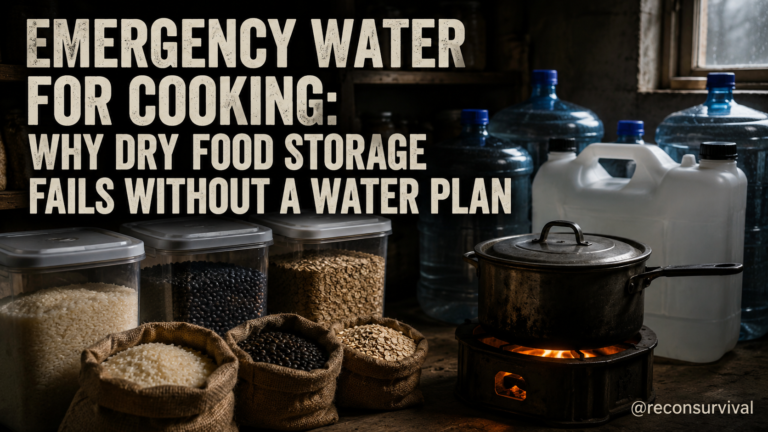
The resources that define a community's stability are not usually the luxury items we stockpile first. In a prolonged disruption, the ability to store and access safe water determines survival more immediately than having extra sleeping bags or a heavy-duty flashlight. Today, we shift focus from the usual gear acquisitions to the foundational system that often gets overlooked until it is no longer functioning.
As an Amazon Associate, I earn from qualifying purchases.
The Reality of First Resource Fought Over
Most preparedness conversations revolve around food calories. This is a logical starting point because hunger is a visceral, daily threat. However, the human body cannot operate without hydration. When infrastructure fails, the most common point of friction is not a locked pantry, but a drying tap.
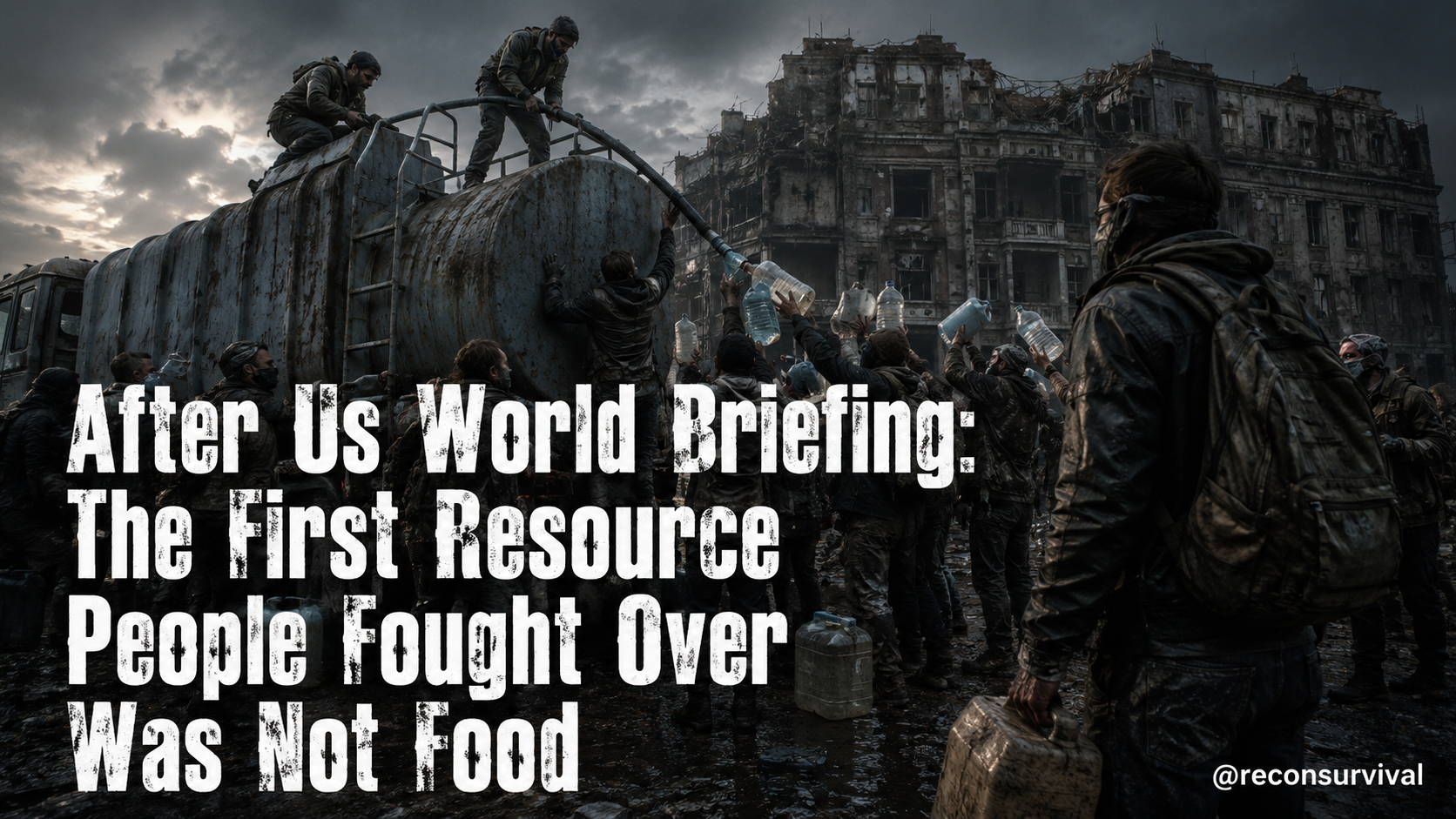
In the After Us world, we frequently analyze recovered documentation from communities that did not collapse due to violence or lack of food. They collapsed because the distribution system failed. The most common resource people fought over in these scenarios was not food, but water. The first visible sign of systemic failure in After Us field reports is rarely a shortage of canned goods, but rather the silence of municipal pumps and the appearance of guards at community water points. This narrative device highlights a critical lesson: water planning is a prerequisite for any other survival effort. If you cannot secure hydration, you cannot focus on cooking, first aid, or decision-making.
Why Water Planning Must Precede Gear Buying
There is a logical sequence to preparedness that is often skipped in favor of shiny objects. The sequence is: Water, Shelter, Heat/Cooling, then Food. Many families rush to buy the highest-rated generator or a massive cache of dehydrated food while ignoring the plumbing system that delivers the water required to cook that food or clean wounds.
This matters for storm season readiness. Summer storms often bring flash flooding that contaminates local water sources, or power outages that stop water pumps. If a household has purchased expensive gear but has not secured a water storage solution that works offline, the gear becomes less effective during the most stressful hours of a crisis. A high-quality sleeping bag is useless if you are dehydrated and unable to clear a heat stroke. The priority is to ensure the basic biological need for water is met before spending resources on equipment that cannot function in a vacuum.
The Common Mistake with This Topic
The most common mistake people make with this topic is assuming that "water is easy." They see a faucet and assume it will run. This is a catastrophic failure of risk assessment. The mistake involves waiting until a storm approaches to think about storage, or buying a single "survival kit" bucket that is deemed sufficient for the whole family.
This mindset ignores two variables: quantity and location. A family of four requires significantly more than one gallon a day to function, and they need access to that water when the grid goes down, not just when the rain stops. Waiting for a crisis to force a change in behavior is a recipe for disaster. The transition from normal life to emergency mode happens in a matter of hours. If your water plan relies on the municipal system, you are not prepared when that system is stressed by a regional heatwave or a storm surge.
The Recon Survival Practical System
The Recon Survival practical system is not about fear; it is about establishing redundancy before a threat appears. We use an in-universe briefing approach to teach this because a scenario-based briefing bypasses the cognitive bias that says, "That won't happen to me." By framing the lesson as a recovered document or field note from a scenario where access broke first, we force the reader to confront the mechanics of water security without the distraction of sensationalism.
The goal is to integrate water storage into the existing home structure or immediate environment before the summer heat hits. We look at three layers of water security:
- Immediate Access: Water that is stored in the kitchen or living area for emergency consumption. 2. Sanitation Reserve: Water stored separately for hygiene, cleaning, and washing dishes, which is often the first casualty of an emergency. 3. Infrastructure Inspection: A check of the home's plumbing and well systems to understand current capacity and failure points.
By breaking the system into clear steps, a normal household can build a robust water security plan that integrates with their other planning documents. This approach ensures that when the time comes, the household does not have to make difficult triage decisions about who gets water first; the plan is already set.
Breaking the System into Household Steps
To implement this system, a household can follow these steps to establish water security:
- Audit Current Capacity: Calculate the household's daily water usage. A typical person needs about one gallon per day for drinking and cooking. Add another gallon for hygiene. If you have a family of four, you need a baseline of 6 to 8 gallons per day for drinking alone, plus a buffer for sanitation.
- Locate Storage Space: Identify a cool, dark place in the home or a secure outdoor location where water containers can be stored. Basements, under staircases, or in a detached shed work well. Avoid areas that flood easily.
- Select Containers: Use food-grade containers. Ensure they are tightly sealed to prevent contamination. Consider stacking them in a way that allows for easy access without needing to move heavy items unnecessarily.
- Check Filtration: If relying on well water or local sources, ensure you have a filtration system ready for use. Test the system annually.
- Rotate Inventory: Replace water that is nearing its expiration or check it regularly to ensure seals are intact. While properly treated water can last years, checking periodically is best practice.
- Map Access Points: Know exactly where your stored water is. If you move to a new area or remodel, update these maps immediately.
Using the After Us world as a teaching device, imagine a recovered log from a community where the water line was cut. The entry notes how the first three days were spent rationing what little was left, and how the lack of stored water made the evacuation of children impossible. This fictional scenario reinforces the practical reality that water storage is a logistical priority, not just a comfort.
Real-World Lessons and the Practical Checklist
The lesson from the fiction is that water access breaks the first. In the real world, this translates to a need for immediate, accessible storage. When a storm hits, the first hours are critical. If you do not have water, you cannot prepare food, clean supplies, or treat minor injuries effectively.
Here is the practical checklist for establishing your water security foundation:
- Calculate total household daily water need (drinking + hygiene).
- Acquire food-grade containers equal to 7 days of household need, or more for larger families. – Store containers in a cool, dark location away from sunlight and chemicals. – Label containers with the purchase date and rotation status. – Verify that water filtration or purification methods are in place and tested. – Ensure all water storage locations are accessible in an emergency. – Review the household emergency plan to include a section on water access. – Keep a log of inspections and replacements for all water containers. – Educate family members on the location of water storage and how to handle containers safely. – Plan for a method to transport water to a shelter or safe location if the home is inaccessible. – Establish a protocol for checking water quality periodically. – Connect water storage needs with the broader disaster plan, ensuring it is not an isolated activity. – Practice a scenario where you must use stored water only, to identify gaps in the system.
By following these actions, you build a layer of security that protects your family from the immediate biological risks of a disruption. This preparation allows you to focus on other aspects of survival once the water crisis is managed.
Recon Survival Takeaway
The most effective preparedness strategy is often the one that addresses the most vulnerable point of the system. Water is that point. By prioritizing water planning before gear buying, you ensure that your family has the capacity to operate even when external systems fail. This approach is not about fear; it is about creating a buffer that allows for calm decision-making during a crisis. When you have water, you have the ability to cook, clean, and maintain health. Without it, the stress of a crisis is amplified, and the quality of your survival decisions degrades quickly.
Start small if you must, but start with water. The After Us briefings show us that the fights over resources begin where normal access breaks first. By securing your own access now, you remove that threat from your future.
Recon Survival Principle
Recon Survival is not about waiting for stress to make the decision. It is about turning weak signals into household action while the fix is still small. A practical way to use an in-universe water scarcity briefing to teach why water planning comes before gear buying, but most advice is either too generic, too gear-focused, or too late.
Do Today
- Check your current water storage capacity against your household size.
- Locate the nearest food-grade container or bulk purchase option.
- Write down the locations of your current water storage in your emergency binder.
- Test one of your current water containers for leaks and seal integrity.
- Review your plan for moving water to a shelter if your home is compromised.
- Identify the safest place in your home to store bulk water.
- Calculate the cost of adding a week's worth of water and budget for it.
- Talk to your family about the location of your stored water and ensure everyone knows where it is.
- Schedule a date in the future to check your water inventory and rotate it.
- Ensure you have a method to filter or treat water if your source is contaminated.
By taking these steps, you establish a foundation that supports all other survival efforts. Water is the lifeblood of any community, and securing it at the household level is the first act of a robust disaster plan. It allows you to maintain your sanity, your health, and your ability to care for others when the world around you changes.