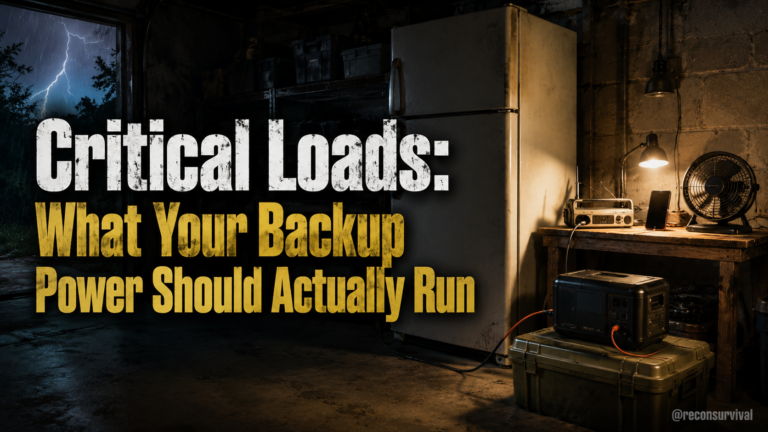

The surge of cold air hitting the hallway is the first sign the grid has failed, but the real test begins inside the utility closet where the inverter hums and dies. You're standing there with a single generator or a battery bank holding just enough charge for a fraction of the night. The thermostat in the living room is already dead, the fridge in the kitchen is silent, and the basement sump pump has stopped making its usual rhythmic whir. This is the moment Recon Survival trains for: the transition from "power available" to "power rationed." You cannot run everything. You must choose.
As an Amazon Associate, I earn from qualifying purchases.
In a survival scenario, energy is a finite currency. If you waste it on non-essentials, you risk the failure of the systems that keep you warm, hydrated, and connected. The goal isn't to keep the lights on; it's to keep the body alive and the communication line open.
The Utility Room and Garage: The Power Source Audit
Before you flip a single switch, you must assess the generator and battery bank. In a storm, the fuel source (gasoline, diesel, propane) and the storage medium (batteries, solar banks) are the only things that matter.
If you have a generator, check the fuel level and the air filter immediately. A generator running on fumes or clogged by storm dust will fail exactly when you need it most. If you have a battery inverter, look at the amp-hour readout. Are you at 50% capacity? That dictates your duration. If you have solar panels, note the cloud cover; a heavy storm screen might be draining your solar input to zero, meaning you are now on a closed loop of stored energy.
- Fuel: Ensure the tank is at least 50% full or that you have a safe, dry location for refueling.
- Battery Health: Verify the voltage is stable and that no cells are dead.
- Transfer Switch: If you have a manual transfer switch, ensure it is in the correct position to disconnect from the grid and connect to your load center.
The Kitchen: Preserving the Cold Chain
The refrigerator is often the first appliance people try to power in a storm, but in a triage scenario, it is the second priority. The goal is not to keep the ice cream frozen; it is to prevent food spoilage and, more critically, to preserve space in the freezer for ice packs or medical supplies.
If your power is limited, you must minimize the opening of the door. Every time the door opens, cold air escapes, forcing the compressor to run longer and harder than necessary. In a storm, this is the fastest way to drain your battery bank.
- Group Food: Consolidate items to the center of the freezer. This creates a "cold block" that retains temperature longer.
- Close Tight: Check the door seals. A leaky seal is a silent drain on your power reserve.
- Manual Override: If you have a cooler with ice packs, move perishables there immediately if the compressor is running inefficiently.
The kitchen is also where the water comes from. A water pump often draws a significant load. If you have a pressure tank, it may cycle on and off frequently. In a low-power scenario, the pump might struggle to maintain pressure.
- Water Flow: Monitor the pressure gauge. If it drops, reduce the use of faucets and showers.
- Ice Making: Turn off the automatic ice maker. It is a high-energy process that is unnecessary during a storm.
The Living Area: Heat and Light Priorities
Once the source is verified and the cold chain is secured, the living area becomes the human comfort zone. Here, the triage logic shifts from "equipment preservation" to "human survival."
In a storm, hypothermia is a genuine threat. You need to decide between full-room heating or a localized heat source. Running a central furnace or a whole-house electric heater is often a power hog that will kill your battery bank in an hour.
- Zone Heating: Focus on one room. Close doors to other rooms to create a smaller, easier-to-heat space.
- Lighting: Switch to LED bulbs immediately if they are on. Incandescent bulbs generate heat but waste massive amounts of electricity.
- Radiant Heat: Use a propane or kerosene heater only if you have ventilation. Electric heaters are the last resort when power is tight.
The living area is also where the communication device lives. A dead phone means you are cut off from emergency services. This is a non-negotiable priority.
- Communication: Keep a single radio or phone on a low-power setting. Use it sparingly to conserve charge.
- Lighting: Use a small, battery-powered lantern focused on the task at hand, not the whole room.
The Bathroom and Bedrooms: Hygiene and Rest
The bathroom and bedrooms are often neglected in power triage, but they are critical for long-term survival. A lack of water for washing or a cold sleeping environment can lead to illness and exhaustion.
If your water system is electric, you may need to carry water from the kitchen or a stored container. In a storm, hygiene is a trade-off between cleanliness and water usage.
- Water Conservation: If the pump is struggling, switch to a bucket system for washing.
- Insulation: Check windows and doors for drafts. Seal gaps with wet towels or tape to retain heat.
- Sleeping: Use sleeping bags or blankets to minimize the need for heating the bedroom.
The bedroom is also where the rest of the household rests. A calm environment is essential for recovery.
- Noise Control: Keep the radio volume low or use headphones to avoid disturbing the family.
- Warmth: Ensure everyone has access to a warm layer. Hypothermia can set in quickly in a cold room.
The Vehicle: An Alternative Power Hub
Your car or vehicle is often an underutilized power source in a storm. If you are trapped inside or need to power a specific device, the vehicle's alternator can provide a steady stream of electricity, provided the engine is running.
However, running a vehicle indoors is a fire and carbon monoxide hazard. You must only use the vehicle outdoors, with the exhaust directed away from the house.
- Power Output: Use a 12V DC inverter to power small devices like phones, radios, or lights.
- Fuel Management: Ensure the vehicle has enough fuel to run for a reasonable duration. Do not run the engine continuously if not necessary.
- Safety: Never leave the engine running unattended. Ensure the exhaust is not blocked by snow or debris.
Recon Survival Principle
Power is a finite resource that must be allocated to life-sustaining functions first. In a storm, the hierarchy is always: Communication (to call for help), Thermal Regulation (to prevent hypothermia), Water (to prevent dehydration), and Food (to maintain energy). Everything else is secondary. When power is limited, do not try to run everything; run the essentials and accept the loss of comfort.
Do Today
You have a storm coming, or you are already in one. The time for debate is over; the time for triage is now.
- Check your power source: Verify the fuel level of your generator or the charge level of your batteries.
- Audit your loads: Identify which devices are essential and which are luxuries. Turn off the non-essentials.
- Seal your zones: Close doors and windows in the room you are occupying to maximize heat retention.
- Communicate: Ensure your radio or phone is charged and ready for emergency calls.
- Plan your rotation: Decide which room will be the "hot zone" for the night and which will be the "cold zone."
The storm will pass. Your survival depends on how you manage the power you have. Start now.