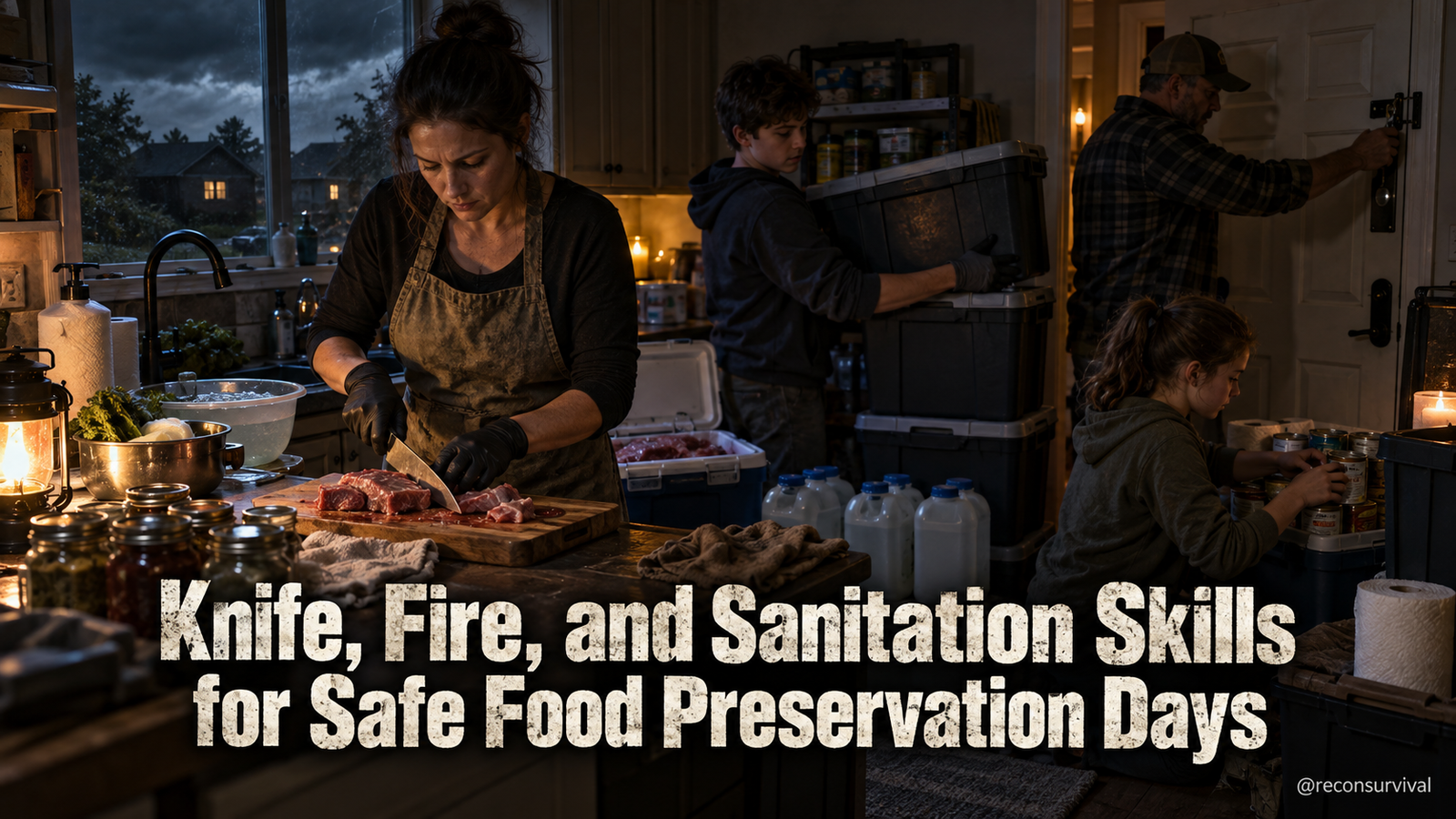
First Hour: The Silent Spoilage That Starts at Your Counter
The food you intend to preserve for tomorrow's dinner begins to rot the moment your counter temperature exceeds 90°F and you leave a cutting board with raw meat juices sitting in the sun. Before you can reach for the knife or light the fire, a cascade of microbial activity begins in the sanitation gap where clean surfaces meet dirty residue. This isn't about missing a deadline; it's about the precise moment your "safe" prep area becomes a bacterial incubator. If you skip the sanitation check, the knife becomes a weapon for spreading pathogens, and the fire becomes a hazard that burns what it should be cooking.
The failure mode for Safe Food Preservation Days usually isn't a lack of tools; it's a lack of temporal discipline. You have a limited window where heat, cold, and cleanliness intersect to stop spoilage. Once that window closes, no amount of fire or sharpening will fix the biological reality that has already set in.
The Triage Ladder: Hour One, Day One, Day Two
To stop the rot before it starts, you need a immediate visual assessment of your resources against the clock.
First-Hour Checks (The Immediate Filter)
- The Knife Edge: Is the blade clean? A dull knife requires crushing force, which ruptures cells and releases juice that spoils faster than tissue that is sliced cleanly. If the blade is nicked or dull, stop and sharpen or swap. * The Sanitation Surface: Is the workspace dry? Moisture breeds bacteria. Wipe down with a sanitizing solution. If water isn't available, use boiling water or high-proof alcohol to sterilize the immediate cutting zone. * The Heat Source: Is the fire ready to burn hot and clean? A smoky, low-fire creates ash contamination rather than preservation heat. Establish a hot bed before placing food.
Same-Day Checks (The Stability Phase)
- Tool Calibration: Verify all equipment is accounted for. Is the fire tending kit complete? Are the cleaning rags fresh? * Environmental Scan: Check for cross-contamination risks. Are raw meats separated from ready-to-eat items? Is the ventilation sufficient to remove smoke particles that can taint food? * Timing Audit: Calculate the "cooling window." How long will the food sit at ambient temperature before it must be cooked or cured?
Next-Day Checks (The Verification)
- System Integrity: Re-check the structural integrity of your fire pit or stove. Has it shifted or cooled unevenly? * Supply Chain: Verify you have enough fuel and cleaning agents for the full duration of the preservation process. * Final Audit: Ensure no perishable items were left in the "danger zone" (40°F-140°F) for more than two hours during the initial setup.
The Three Non-Negotiables for Recon Survival
To survive a failure-triage scenario where food spoilage is the enemy, you must treat three specific elements as distinct, non-interchangeable pillars. If one fails, the entire operation collapses.
Knife Mastery as a Sanitation Control
The knife is not just a cutting tool; it is your primary sanitation instrument. A clean, sharp knife minimizes surface area trauma, reducing the amount of liquid (juice) that drips from the food and pools on the work surface. This liquid is the medium for bacterial growth. In a Recon Survival context, where water for washing may be scarce, a sharp knife acts as a mechanical sterilizer by shearing through contaminants rather than crushing them. If you cannot maintain a sharp edge, you cannot maintain food safety.
Fire as a Temporal and Thermal Anchor
Fire is the only variable in this system that you can control to accelerate preservation and eliminate pathogens simultaneously. It is not merely a source of heat; it is a timer. A well-maintained fire creates the thermal conditions necessary to denature proteins and kill bacteria faster than the environment can spoil the food. However, a poorly managed fire (too much smoke, uneven heat) introduces toxins and uneven cooking, rendering the food unsafe. The fire must be lit, stoked, and monitored before the food is touched.
Sanitation as the Invisible Shield
Sanitation is the most often overlooked "tool" in this triad. It includes the cleaning routines for your hands, your tools, and your environment. In a field setting, this means using boiling water, high-concentration alcohol, or ash (if available and safe) to create a sterile zone. Without this invisible shield, the knife and fire become useless because they are operating in a contaminated environment. The rule is simple: no sanitation, no cutting.
The Recon Survival Principle
Sanitation, Heat, and Sharpness are a triad; removing one breaks the chain of safety. You cannot substitute a clean knife for a fire, nor can a fire replace the need for a clean surface. The principle dictates that all three must be verified and operational before a single piece of food is prepared. In a failure scenario, the sanitation check is the first point of failure, the knife sharpness is the second, and the fire management is the final. If the sanitation is compromised, the entire process must halt immediately, regardless of how hot the fire is or how sharp the blade is.
Do Today
- Sanitize the Zone: Immediately wipe down your primary work surface and all tools with a sanitizing solution or boiling water. Ensure the area is dry before starting.
- Sharpen the Blade: Check your knife. If the edge is dull or nicked, sharpen it immediately or locate a backup blade. Test it by slicing a piece of vegetable; it should cut cleanly without crushing.
- Stoke the Fire: Light your fire source and ensure it burns hot and clean. Verify you have enough fuel to maintain the necessary temperature for the duration of your food preparation.
- Verify the Clock: Identify the "cooling window" for your food. Mark a timer for when the food must be moved from the prep zone to the heat or cold storage. Do not exceed this limit.