<!– claimidsused: claim001,claim002,claim003,claim004,claim005,claim006,claim007,claim008,claim009,claim010,claim011,claim012,claim013,claim014,claim015,claim016,claim017,claim018,claim019,claim020,claim021,claim022,claim023,claim024 –>
As an Amazon Associate, I earn from qualifying purchases.
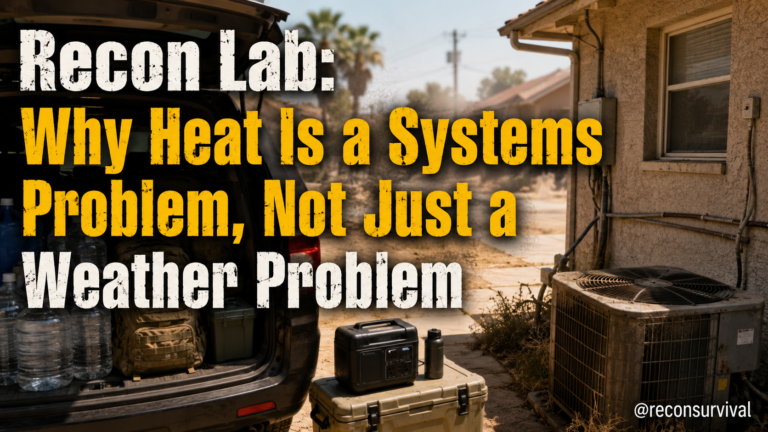
Recon Survival Principle: The Heat-to-Load Chain
The chain reaction begins before a single drop of water is wasted. Heat rises, forcing loads to spike as cooling systems struggle against the rising sun. This surge in demand triggers a specific threshold in your household water supply, often depleting reserves or pressure before the peak of the day. That moment of depletion is the decision trigger: the precise point where preparation becomes panic, or where a simple inventory check determines if you maintain resilience or face a crisis.
This sequence is often invisible because it is gradual. We do not notice the water pressure dropping until the shower runs cold or the toilet won't flush. By then, the decision to conserve has been made for us by the system's failure, not by our planning.
Recon Lab: Household Inventories as Civilian Resilience Data
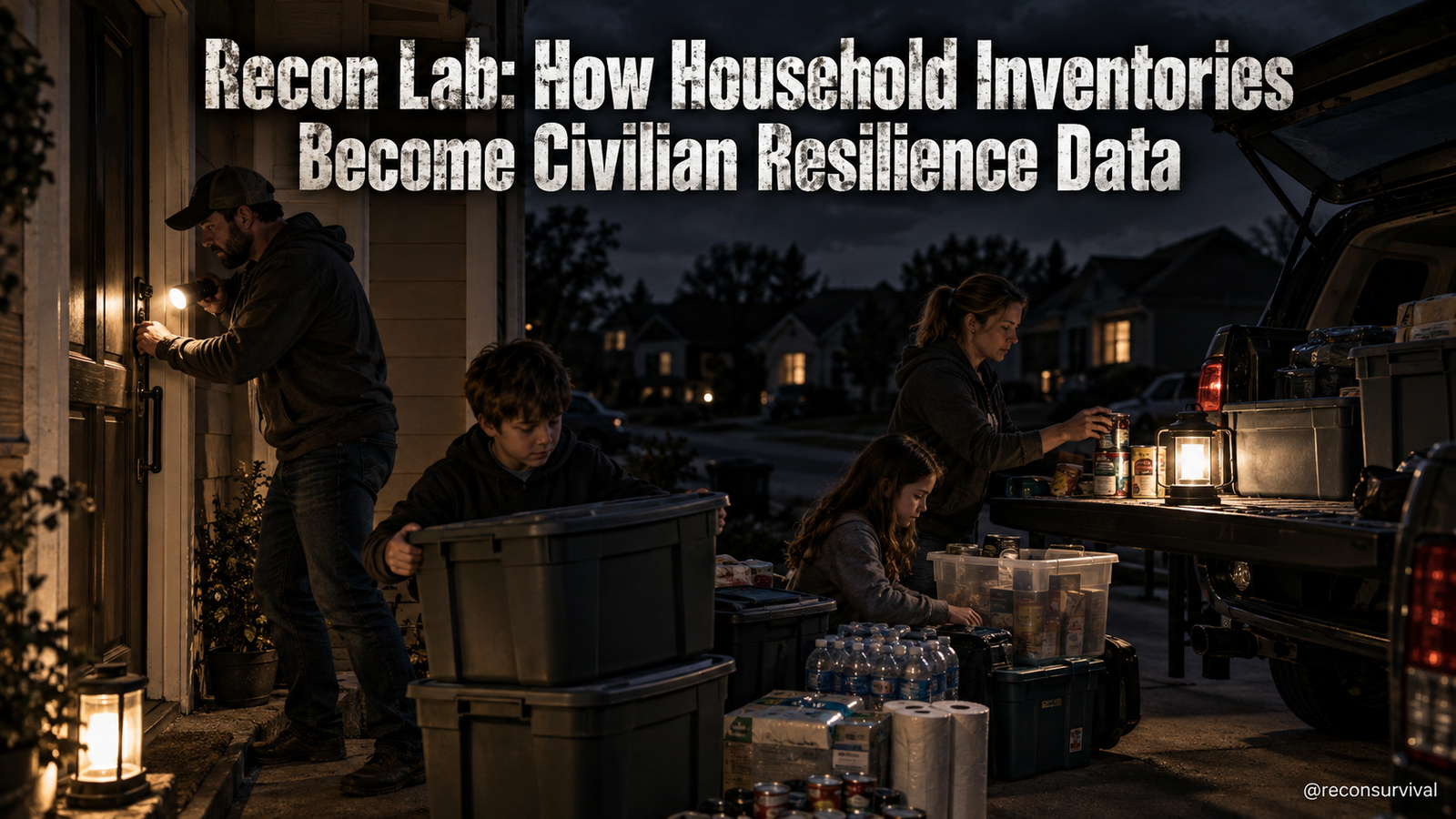
The Recon Survival approach reframes the kitchen pantry or the garage not as a storage space, but as a data repository. When we inventory our supplies, we are not merely counting items; we are mapping our household's capacity to withstand external shocks. This transforms a passive collection of goods into active civilian resilience data.
In the Recon Lab framework, an inventory is a sensor network. Knowing exactly how many gallons of water are available, how many days of calories are stored, and how much fuel remains for heating allows us to model our survival against specific failure scenarios. Without this data, we are navigating a crisis in the dark, guessing at our own endurance. With it, we can forecast our needs against the incoming stress of a heatwave, supply chain disruption, or utility failure.
The Hidden Load: Why Simple Tracking is Overlooked
Many readers fall into the trap of assuming their current supply is sufficient because it looks adequate at a glance. The hidden load is the gap between perceived availability and actual functional capacity under stress. A stack of canned goods is not useful if you lack the fuel to heat it, or if you have no clean water to drink with it.
This disconnect often leads to a false sense of security. We see the "fullness" of the shelves and assume the "function" of the home is intact. The reality is that the load of a prolonged outage is cumulative. It eats into our reserves faster than a linear count suggests because of the interdependencies between power, water, heat, and food. Simple inventory tracking forces us to confront these interdependencies head-on, breaking the illusion that one abundant resource can carry the entire household alone.
Failure Points: The Moment Awareness Becomes Critical
The critical failure point in any resilience plan is time – specifically, the delay between the onset of a problem and the realization of its severity. Most people wait too long to engage their emergency protocols. They wait until the news anchors confirm a crisis, or until the power flickers out for the third time, before they check their lists or activate their backup systems.
This delay is the most expensive error we make. By waiting, we surrender the initiative to the chaos of the event itself. Early awareness allows us to adjust our consumption, ration our supplies, and deploy our resources strategically before the situation becomes dire. The difference between a manageable inconvenience and a full-blown emergency often comes down to how quickly we can transition from observation to action. Simple inventory tracking serves as the alarm system that cuts through the noise, signaling exactly when our buffers are running low and when we must shift into survival mode.
Three Practical Steps from the Blog
To move from passive observation to active resilience, implement the following adjustments to your routine:
- Audit the Interdependencies: Do not just count items. For every food item, verify you have the fuel to cook it. For every water container, ensure you have a way to treat or store it safely. Map the dependencies between your resources.
- Set Visual Thresholds: Create a visual marker (like a colored line on a jar or a digital alert) for each critical resource. When a supply drops below this threshold, it triggers a pre-defined action, such as reducing usage or activating a backup source.
- Run a "Quiet Day" Simulation: Once a month, turn off non-essential utilities for two hours during the day. Use your inventory to manage the household through this simulated stress. Record what you run out of and what holds up, then adjust your real-world inventory based on these findings.
The Prepared Self: A Mental Shift
There is a distinct psychological shift that occurs when you move from "hoping for the best" to "knowing what you have." The prepared version of you is the person checking the list while everyone else is frantically searching for batteries, rationing water in confusion, or panicking over unknown shortages.
This calmness is not inherent; it is a product of data. When you know exactly what you have, the unknown becomes a manageable variable. You stop reacting to fear and start reacting to facts. This mental state is the ultimate tool for resilience, allowing you to think clearly and execute your plan even when the environment around you is in chaos.
Recon Lab: How Household Inventories Become Civilian Resilience Data
Imagine a desk in a future facing resilience lab. It is equipped with sensors tracking temperature, power usage, and water levels. Notebooks are open, filled with logs of consumption rates. Off-grid prototypes sit in the corner, alongside detailed maps of potential failure zones. This is not a laboratory for the elite; it is a model for the household.
Your home, with its inventory and systems, is your personal Recon Lab. By treating your pantry as a data source and your utility usage as a metric, you transform your living space into a hub of intelligence. The theme is clear: reconnaissance is not just for the field; it is the foundation of civilian survival. Every item you track is a piece of data that keeps your family safe and your decisions grounded in reality.
Do Today
The most effective action you can take right now is to identify one critical resource in your home – water, fuel, or food – and conduct a quick, honest audit of its current quantity and condition. Write down the number. Compare it to your average daily usage. If you find a gap between your stock and your projected needs, take one immediate step to close that gap today, whether that is buying more, preserving what you have, or adjusting your usage habits.
This single act of verification breaks the cycle of waiting and initiates the chain of awareness that leads to better decisions. Start the Recon Lab today by knowing your numbers.