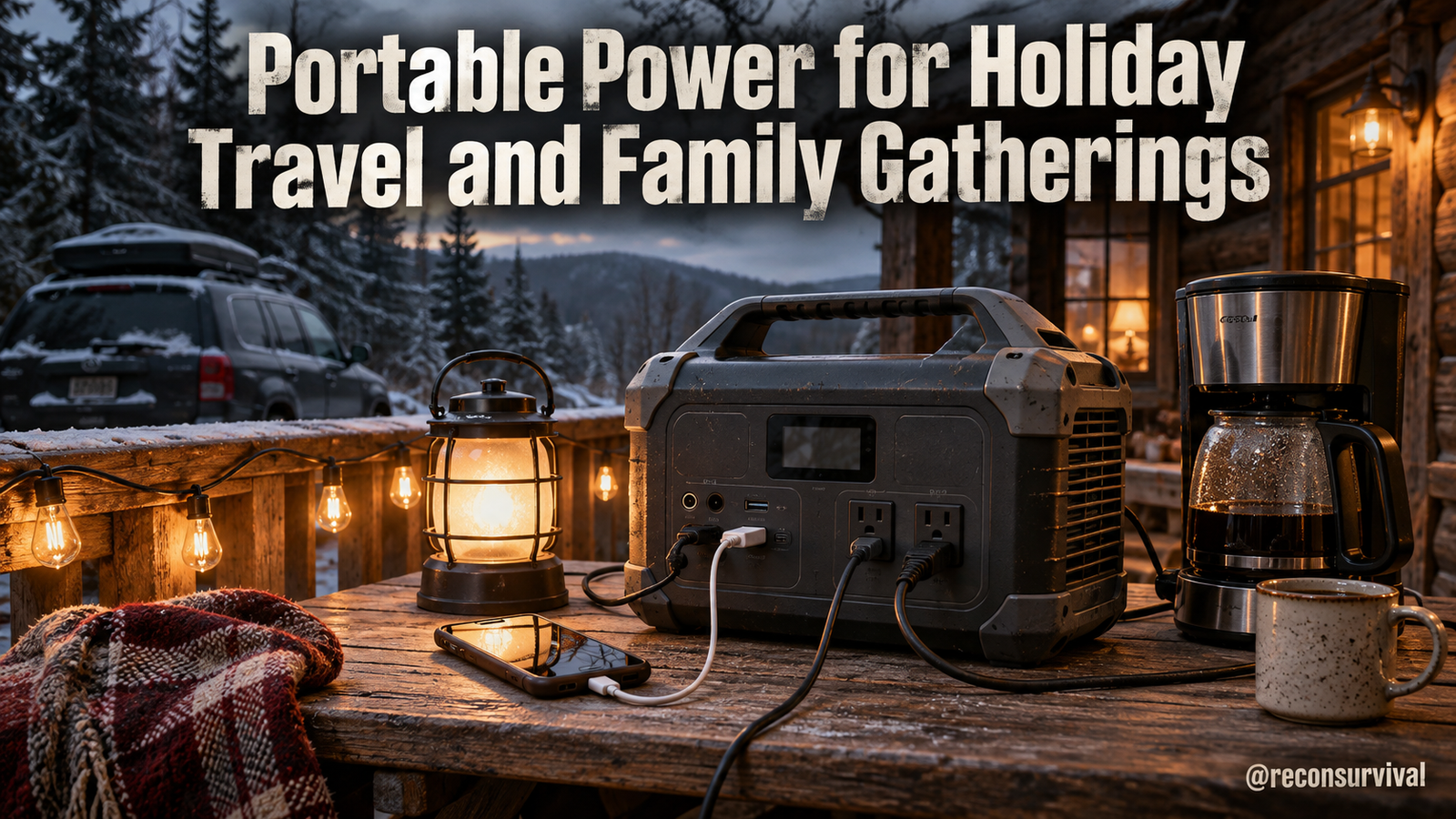
The moment a winter storm cancels your departure or a holiday gathering hits a power outage, the decision shifts from routine to urgent.
If the power went out tonight, what would fail first in your house? This Recon Survival guide prepares chargers, battery packs, cords, radios, and backup info for travel and guests before stress makes decisions harder.
Portable Power Triggers
Holiday travel and family gatherings rely on predictable schedules that often break under weather or grid instability. The threshold for a problem occurs when digital navigation fails, communication with guests is lost, or essential lights go dark. At this point, a household can maintain function by ensuring power sources are physically separated and ready to deploy. The goal is not to power the entire house or vehicle indefinitely, but to keep critical paths open: navigation for the road, information for the family, and light for safety. Preparation is not about buying the largest battery bank available. It is about ensuring that the devices you need for travel and the house you are hosting can function independently of the grid.
The Minimum Viable Power System
The practical system for holiday readiness centers on a minimum viable setup that covers both travel and home. This system relies on four categories of items that every household can assemble: chargers, battery packs, cords, and radios, supported by a printed backup plan.
Chargers and Cords Do not rely on a single multi-port charger for everything; if it fails or gets lost, you have no backup. Store these cords in a single pouch so they are not scattered in bags or glove boxes. Use only manufacturer-approved cables to prevent damage to your devices. ### Battery Packs External battery packs (power banks) act as a reservoir for your devices. For travel, a high-capacity pack is necessary to keep navigation and communication active for extended periods. For home, a smaller pack can keep a phone or emergency radio running during a short outage. The limit of this system is the capacity of the battery itself. Check the label on the battery to understand its rated output. A battery rated for a specific capacity might deliver less to a device due to energy loss. Do not assume a battery will power a device for days unless the manufacturer's data supports that duration. ### Radios A portable radio is the most reliable way to receive information when the internet and cellular networks fail. It operates on battery power and does not rely on a data connection. A standard AM/FM weather radio can provide storm updates and emergency broadcasts. Ensure the radio has fresh batteries or a built-in rechargeable option. If the battery is dead or the device is damaged, you lose the ability to receive critical updates. Check the radio's functionality before a trip or before hosting guests. ### Backup Information The physical backup for travel and home readiness is the most critical component. Print the route for your trip, including alternate paths and known rest stops. Print a home checklist that outlines how to handle a power outage, such as turning off specific appliances, securing the fridge, and contacting emergency services. These documents must be placed in the glovebox of the vehicle and a known location in the home. A printed route does not require power or signal. It remains functional even if the GPS fails. ## Safety Limits and Maintenance
Portable power systems have safety limits that must be respected. Lithium-ion batteries used in power banks and vehicles can be hazardous if damaged or overheated. Avoid storing batteries in a vehicle where temperatures drop below freezing or rise above extreme heat limits. Consult your battery manufacturer for specific temperature guidelines. Cold temperatures reduce battery capacity, and extreme heat can cause internal damage or fire. Store battery packs in a cool, dry place when not in use. Fuel-powered generators, if used, require strict safety protocols. Operate them only outdoors in a well-ventilated area to prevent carbon monoxide poisoning. Never run a generator inside a home, garage, or attached structure. Follow the manufacturer's instructions for fuel storage and maintenance. Regularly check the fuel level and the condition of the battery terminals. A dirty terminal or a loose connection can prevent a device from charging or starting. Maintenance is a recurring action. Check the charge level of all battery packs and the batteries in radios once a month. A battery that looks full may not hold a charge. Test the radios to ensure the speakers and tuning knobs function. Replace any damaged cables or frayed cords. A frayed cord can create a fire hazard or fail to transmit power. Keep the system organized so that items are not lost or mixed with unneeded gear.
Recon Survival Principle
The core lesson for holiday travel and family gatherings is that portable power is about maintaining critical function, not running the entire household or vehicle indefinitely. By preparing chargers, battery packs, cords, radios, and backup info in advance, you create a buffer against the unpredictable nature of travel and weather. The moment the grid fails or a trip is delayed, the difference between a stressful situation and a manageable one is having these items ready.
Do Today
To implement the practical system for holiday travel and family gatherings, take this single action today:
- Print the route for your upcoming holiday trip, including a backup route and key landmarks. 2. Print the home readiness checklist covering power outage steps, appliance safety, and emergency contacts. 3. Place both documents in the glovebox of your vehicle and a designated spot in your home. 4. Assemble your kit: gather one charger, one cable, and one external battery pack for each family member's primary device, and one portable radio with fresh batteries. 5. Verify that the radio turns on and that the batteries in the power banks are fully charged.