A practical way to store water so it stays usable, accessible, and protected from sun, pests, leaks, and bad handling, but most advice is either too generic, too gear-focused, or too late.
The most common bottleneck in any survival plan is not food, it is water. When infrastructure fails, water quality and availability drop faster than almost anything else. Heat accelerates this process, promoting algae growth, microbial bloom, and chemical off-gassing in containers left in direct sun. Leaks from compromised seals create a false sense of abundance while silently draining your reserves. In a crisis, a half-full, contaminated tank is worse than an empty one. This guide solves the practical problem of storing water so it remains safe, accessible, and ready for use without relying on fear or unrealistic expectations.
Why Water Storage Safety Matters Before Stress Escalates
Storage security is about preserving usability, not just hoarding volume. When summer storms or heat waves approach, water planning becomes urgent. High temperatures can degrade plasticizers in containers, leaching chemicals into the water. Ultraviolet light degrades seals and canisters, leading to leaks. Pests like ants and rodents can infest open or poorly sealed systems, introducing contaminants that are invisible to the eye.
Addressing these risks early provides a buffer against stress. When a household has a secure water system, decision-making remains calm. When a water system is failing, panic sets in quickly because the resource is vanishing. We do not wait until a storm hits or a pipe bursts to secure our supply. We act before the window of opportunity closes, ensuring that when the need arises, the water is potable, the containers are intact, and the distribution system works.
The Most Common Mistake People Make
The single biggest error in home water storage is assuming that capacity equals security. Many households fill large jugs, stack them on shelves, and assume the job is done. This approach fails to account for the environment the water lives in. A dark garage may seem ideal, but if the temperature fluctuates wildly or humidity is high, mold and bacteria thrive on container rims. Conversely, a basement with a window is subject to light leaks and condensation. Another common mistake is ignoring access. If water is stored in a place that floods, has no lighting, or requires climbing a ladder to reach, it is useless during an evacuation or power outage. Security also means the system does not rely on a single point of failure, such as a single leaking tank that ruins the entire supply.
The Recon Survival Practical System for Water Security
Our system prioritizes protecting the resource from sun, pests, leaks, and bad handling. It is built on three pillars: Environmental Control, Accessibility Design, and Verification Habits.
Environmental Control means keeping water out of the sun and extreme temperature swings. We use opaque containers or store translucent ones in dark locations. We avoid ground-level storage where moisture wicks up from concrete floors.
Accessibility Design ensures that water is reachable without equipment. It is stored in cool, dry zones that are illuminated and have clear pathways. We organize water by rotation date so the oldest supply is used first, preventing stagnation.
Verification Habits are the non-negotiable routines that check seals, look for pests, and test clarity. These habits catch issues before they become emergencies.
Step-by-Step Implementation for a Normal Household
Follow these steps to build a robust water storage system today.
- Audit Your Current Supply. Check every bottle, jug, and tank. Look for cloudy water, floating particles, or a strange smell. Inspect the caps and rims for hairline cracks or dried residue. If the seal is broken or compromised, do not use that water. Discard it immediately.
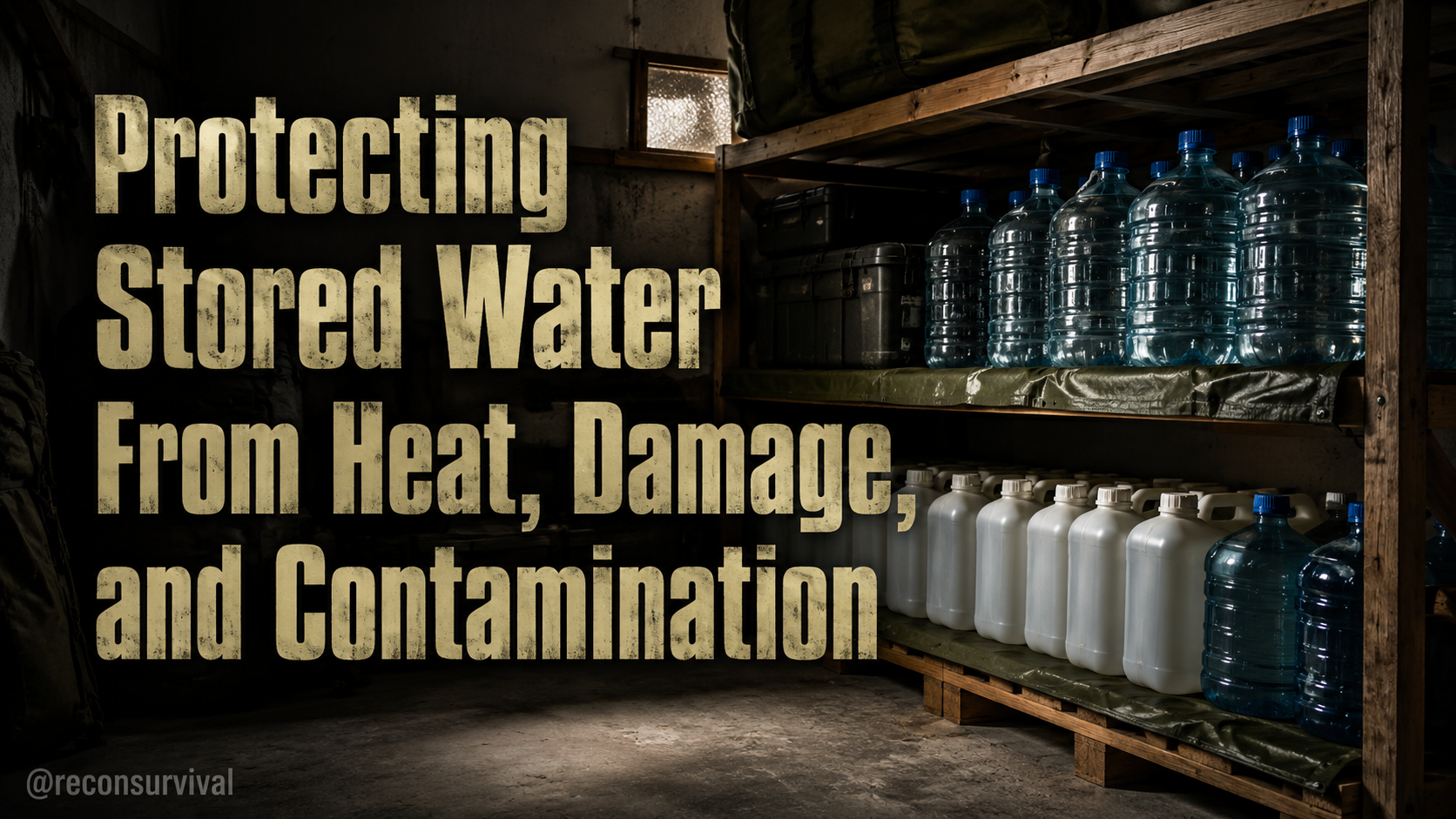
- Select the Right Containers. Use food-grade containers specifically designed for water storage. Clear plastic is not suitable for long-term storage unless kept in total darkness. Opaque blue or opaque white containers are preferred because they block UV rays. Avoid repurposed soda bottles or random plastic jugs, as they may leach chemicals.
- Manage the Environment. Move your water to a basement, crawlspace, or interior closet where the temperature is stable. Avoid attics or garages unless you can prove they are climate-controlled. Ensure the storage area is dry to prevent mold growth. Keep containers off the floor using pallets or shelving to allow air circulation and prevent moisture wicking.
- Establish Access. Place water on shelves at waist height or in zones reachable without moving furniture. Ensure the area is lit. If power fails, consider battery-operated lights to locate your water supply. Mark the storage area so family members can find it without confusion.
- Rotate the Stock. Write the purchase or refill date on every container with a marker. Use the oldest water first. If you have a large supply, rotate in batches so some water is always fresh.
Prioritizing Habits, Visibility, Communication, and Prevention
Gear cannot fix a bad routine. Prevention is about the habits that keep the system running. Daily habits include checking that lids are tight and that containers are not crushed under other items. Weekly habits involve checking for pests or signs of leakage around the storage unit. Monthly habits include testing a sample of water for clarity and smell.
Visibility is critical. If water is hidden in a dark corner, it will not be used. Use labeling and lighting to make the water obvious. Communication involves telling family members where the water is and how to access it. If everyone knows where the supply is, confusion is minimized. Prevention means keeping the environment clean so pests are not attracted to the storage area.
Defensive, Lawful, Non-Escalatory Household Checklist
Security is a mindset of prevention and awareness. Your home should be a safe place for your family. Use these checks to maintain a secure environment.
- Inspect Entry Points. Check that doors and windows are locked and that weather stripping is intact. This keeps out rain and pests that could compromise your water.
- Check Lighting. Ensure that storage areas have functional light sources. In the event of an emergency, you need to see what you are reaching for.
- Clear Pathways. Keep aisles free of obstacles so you can move quickly and safely.
- Secure the Perimeter. Ensure that fences and gates function correctly to deter unwanted entry while maintaining lawful property boundaries.
- Review Local Codes. Verify that your storage practices comply with local fire and building codes.
- Monitor Neighbors. Be aware of your community's general safety without being paranoid. Know who to call if you see signs of distress or intrusion.
- Communicate Plans. Talk with family and neighbors about emergency procedures. Share information on how to access resources without causing panic.
Recon Survival Principle
The Principle of Secure Availability. Water stored under heat and light degrades quickly. A secure system must protect the water from environmental stress while remaining accessible without tools or complex maneuvers. Availability is defined by the ability to reach the water safely and immediately. If you cannot reach it without breaking a leg or damaging property, it is not available. Prevention of degradation is the only way to ensure the water remains usable when the grid goes down.
Do Today
Action creates confidence. Complete these tasks now to secure your water supply.
- Inspect and Label. Check every water container. If the seal is broken or the container is cracked, discard it. Write the refill date clearly on every container using a permanent marker.
- Move to Shade. Relocate any water currently sitting in direct sunlight or near heat vents to a cooler, darker location.
- Check for Leaks. Wipe down the area around your storage tanks and jugs. If you see a wet spot on the floor, address the source immediately.
- Rotate Stock. Move the water with the oldest date to the front of your accessible area. Ensure the new stock is stored behind it.
- Clear Access. Remove boxes or furniture blocking the path to your water storage. Ensure the area is lit.
- Clean Containers. Wash reusable containers with hot water and bleach before refilling them to remove any biofilm.
- Verify Family Knowledge. Ask a family member to walk to the water storage without being told the location. If they cannot find it easily, improve your labeling or storage placement.
By following these steps, you ensure that your water remains safe, secure, and ready when it matters most. This is the foundation of a resilient household.