The first thing that usually fails during a neighborhood blackout is not your battery bank or your generator.
It is your ability to maintain control over your own property while the street outside goes dark and quiet. When the grid fails in late June, the immediate consequence is not just the loss of air conditioning. It is the loss of artificial boundary lines. The fences become invisible. The porch lights that define your home's perimeter vanish. The hum of the refrigerator stops, and the silence that follows is often confused with the silence of safety. This article addresses the practical reality of what happens when that silence is accompanied by a stressed grid, high heat, and a community scrambling to stay cool.
As an Amazon Associate, I earn from qualifying purchases.
We are not here to speculate about grid collapse or social breakdown. We are here to handle the specific failure of neighborhood lighting and the resulting stress on your household. The risk you face is not a hypothetical invasion; it is the very real possibility of someone in the neighborhood misinterpreting your lack of a porch light, your silence, or your need for darkness as a lack of security or a target. This guide focuses on reducing avoidable security risks during neighborhood-wide darkness and stress.
The stakes rise quickly when the grid goes down. Without power, the sensors in your home stop working. Your cameras go dark. Your alarm system relies on battery backup that may drain within a few hours of total loss. This is the moment when a quiet neighborhood becomes vulnerable to accidental trespassing, confusion, or opportunistic behavior. The stress on the community increases because people are hot, uncomfortable, and anxious. When stress rises, people make mistakes. They rely on assumptions rather than verified facts. They assume a dark house is empty, or they assume a house with no lights is hostile.
The most common mistake people make with this topic is waiting until the power is out to worry about security. This is a strategic error because preparation takes time, not just gear. By the time the lights go out, your focus shifts from security to immediate survival needs like cooling and water. You cannot effectively secure your home if you are already in panic mode. Security in a blackout requires a shift in behavior before the event, not just after. You must establish a baseline of safety that functions regardless of the time of day or the status of the grid.
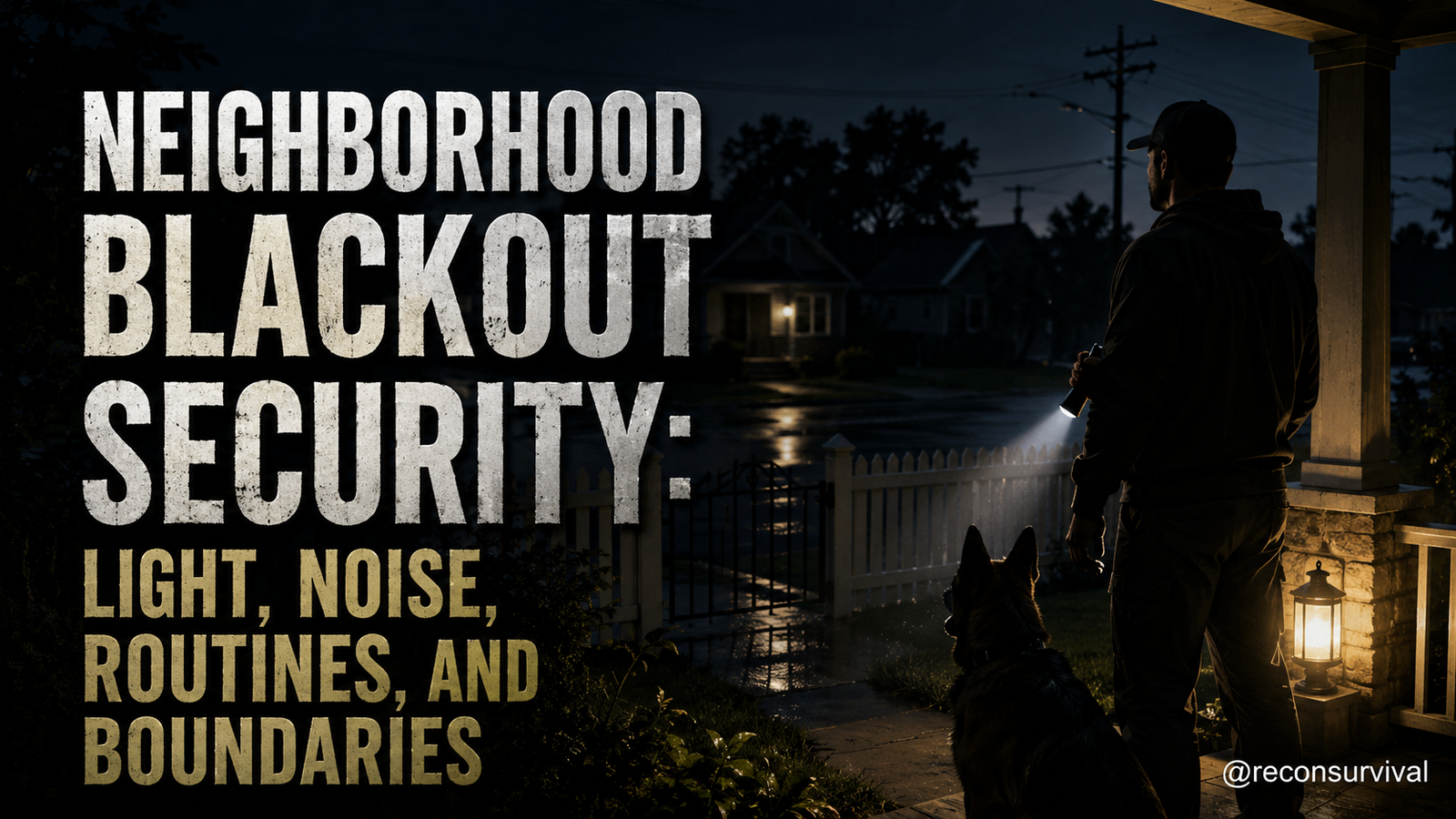
Neighborhood Blackout Security: Light, Noise, Routines, and Boundaries
The Recon Survival approach to this problem prioritizes the invisible layers of security that hold up when the visible ones fail. We focus on four pillars: light management, noise control, routine consistency, and boundary definition. These are the mechanisms that allow a household to maintain a calm posture during a stressful event. When you manage these four elements, you reduce the signals that might confuse or alarm neighbors, and you remove opportunities for misunderstandings.
Light management does not mean turning on every light in the house. It means controlling the exterior illumination so that you are visible but not glaring. A sudden flood of light can attract attention or reveal movement inside. Controlled light creates a silhouette that shows you are present. Noise control is equally critical. The sound of running generators or slamming doors can draw the eye of someone looking for problems. Routines provide a predictable pattern of activity that establishes a sense of normalcy. Boundaries are the physical limits of your property that must be clear to prevent someone from crossing into your space without permission.
The First Hour: Triage and Immediate Visibility
The first hour after a grid failure is the most critical window for establishing your posture. In this window, you must secure your perimeter and assess your internal capabilities. The priority is to ensure that your home is physically secure against unauthorized entry while maintaining a defensive stance.
During this first hour, you must check your external lighting. If your porch or driveway lights are solar-powered, they may have charged recently and should provide some illumination. If they are grid-tied, they will fail immediately. You need a backup light source that is visible from the street but does not blind anyone. A motion-activated light with a timer is often better than a light that stays on constantly. It signals that someone is monitoring the house.
Check your locks. Ensure that all doors and windows are secured. In a grid-down scenario, a broken lock is a single point of failure that invites intrusion. Verify that your deadbolts engage fully. Check the strike plates on your exterior doors to ensure they are reinforced. If you find weak points, address them immediately with simple hardware like long screws or a security bar. Do not wait until later.
Noise discipline starts here. If you have a generator or a loud cooling fan, test it in a low area first. Move it to a position where the sound does not spill into the street. This prevents unnecessary alarm. If you hear sirens or shouting from the neighborhood, do not respond unless you are certain it is directed at you. Confusion spreads quickly.
Same-Day Checks: Maintaining Routine and Communication
Once the first hour has passed, your focus shifts to maintaining your routine and communication with neighbors. A consistent routine is a powerful security tool. If you sleep at the same time every night and eat at the same time, you create a predictable pattern. Predictability reduces the likelihood of someone guessing that the house is empty.
Communicate with your neighbors. This is not about organizing a neighborhood watch. It is about letting people know that your house is safe and that you are monitoring the situation. A simple knock on the door or a text message can clarify that your lights are dim because of the blackout, not because of an emergency. This reduces the chance that someone will break into your home thinking you are trapped or injured.
Check your communication devices. If your phone service is disrupted, try alternative methods like ham radio or satellite messenger if you have one. If you are in an area with strong cellular service, keep your phones charged and ready. If the cell towers are overloaded, you will be disconnected quickly. Prioritize sending brief updates to family members and neighbors. Do not send long, emotional messages that drain your battery or slow down the network.
Your noise discipline continues during the day. Avoid loud conversations or playing music. If you must speak, keep your voice low. If you are working or repairing things, do so quietly. The goal is to blend into the background noise of the neighborhood so that you are not a target.
Next-Day Checks: Reinforcing Boundaries and Assessing Gear
By the next day, the initial shock of the blackout has worn off. This is the time to reinforce your boundaries and assess your gear. Check your solar panels and batteries. If you have a backup light system, verify that it is charging and that the battery is not depleted. Replace any depleted batteries immediately.
Review your communication plan. Who are you relying on? Do you have a neighbor who has a generator? Do you have access to a neighbor's phone? Update your list of contacts. Ensure that everyone knows where to meet if the neighborhood becomes unsafe. This is not about fear; it is about having a plan in place.
Assess your lighting again. In the evening, walk the perimeter of your property. Look for areas where your light is blocked by trees or shadows. If you have an area that is too dark, consider adding a small, low-voltage light that can run on batteries. This helps prevent someone from hiding in the shadows near your home.
If you have cameras, check their status. If they are battery-operated, ensure they have enough power to record until the batteries run low. If they are grid-tied, they are off. Have a plan for what happens if you cannot see the property. This might mean trusting your locks and your routine.
Recon Survival Principle
The principle guiding all of this is that security in a blackout is about reducing ambiguity. Ambiguity is what allows accidents, misunderstandings, and opportunities for bad actors to arise. By controlling your light, your noise, your routine, and your boundaries, you remove the variables that could turn a stressful event into a dangerous one. You are not trying to be a target. You are trying to be clear. Clarity protects you.
Defensive, Lawful, Non-Escalatory Household Checklist
This checklist is designed to be practical, lawful, and non-escalatory. It is meant to keep your household safe without putting anyone at risk of legal trouble.
- Secure all doors and windows. Verify that all deadbolts engage and that there are no obvious signs of forced entry.
- Test external lighting. Ensure that any backup lights are functional and set to a low, non-blinding intensity.
- Check noise levels. Make sure that generators or fans are positioned to minimize noise pollution.
- Establish a routine. Stick to a schedule for sleeping, eating, and moving around the house.
- Communicate with neighbors. Send brief messages to let them know your status.
- Review battery backups. Replace any depleted batteries in your security gear or lights.
- Inspect perimeter shadows. Add low-voltage lights to eliminate dark areas near your home.
- Update contact lists. Ensure that everyone knows who to contact if the grid is down.
- Keep communication brief. Avoid long conversations that drain batteries or slow down the network.
- Stay calm and observant. Monitor the neighborhood without escalating tension.
Decision Points
When the grid goes down, you will face decisions that can have immediate consequences. These decisions must be made quickly, calmly, and based on verified information rather than assumptions.
- Decision Point 1: You see a figure moving near your property line. Do you flash a light or call out?
- Action: Flash a brief, bright light to signal presence. Call out calmly to identify yourself. Do not run.
- Reasoning: This establishes that the house is occupied and that you are monitoring the situation.
- Decision Point 2: Your battery backup fails after six hours. What do you do?
- Action: Switch to manual lighting and rely on your routine. Do not panic.
- Reasoning: Your presence is more important than your lights. A calm, visible household is safer than a dark one.
- Decision Point 3: A neighbor approaches you asking for water. Do you give it?
- Action: Offer water if you have extra and feel safe. Keep the interaction brief.
- Reasoning: Community resilience is built on mutual aid, but safety remains the priority.
- Decision Point 4: You hear a loud noise from a neighbor's house. Do you investigate?
- Action: Do not investigate unless you are certain of the cause. Wait for confirmation.
- Reasoning: Curiosity can lead to escalation. Stick to your own property first.
Do Today
If you are reading this on a day when the grid is stable, do not wait for a blackout to start preparing. Today, check your external lighting. If you have solar lights, test them. If you have battery backups, replace the batteries if they are old. Update your neighbor list. Write down a plan for how you will communicate if the power goes out. Talk to your family about what to do if the lights go out. Rehearse the routine of securing the perimeter. These small steps build a foundation of security that will hold when the stress rises. Do not let the fear of a blackout prevent you from preparing for it. Preparation is the antidote to fear. Start today.
- Check every exterior door for full latch contact and smooth deadbolt travel.
- Replace loose or short strike-plate screws where the frame and hardware allow it.
- Open, close, and lock each ground-level window, then note any stuck latch or broken screen.
- Test motion lights at doors, walkways, driveway edges, and dark corners after sunset.
- Trim one visibility problem near a door, window, gate, or walkway.
- Put a working flashlight and charged battery bank where people sleep.
- Write the household contact plan on paper and place it with the radio or main flashlight.
- Assign one person to recheck the list after the next storm, outage, or heat alert.