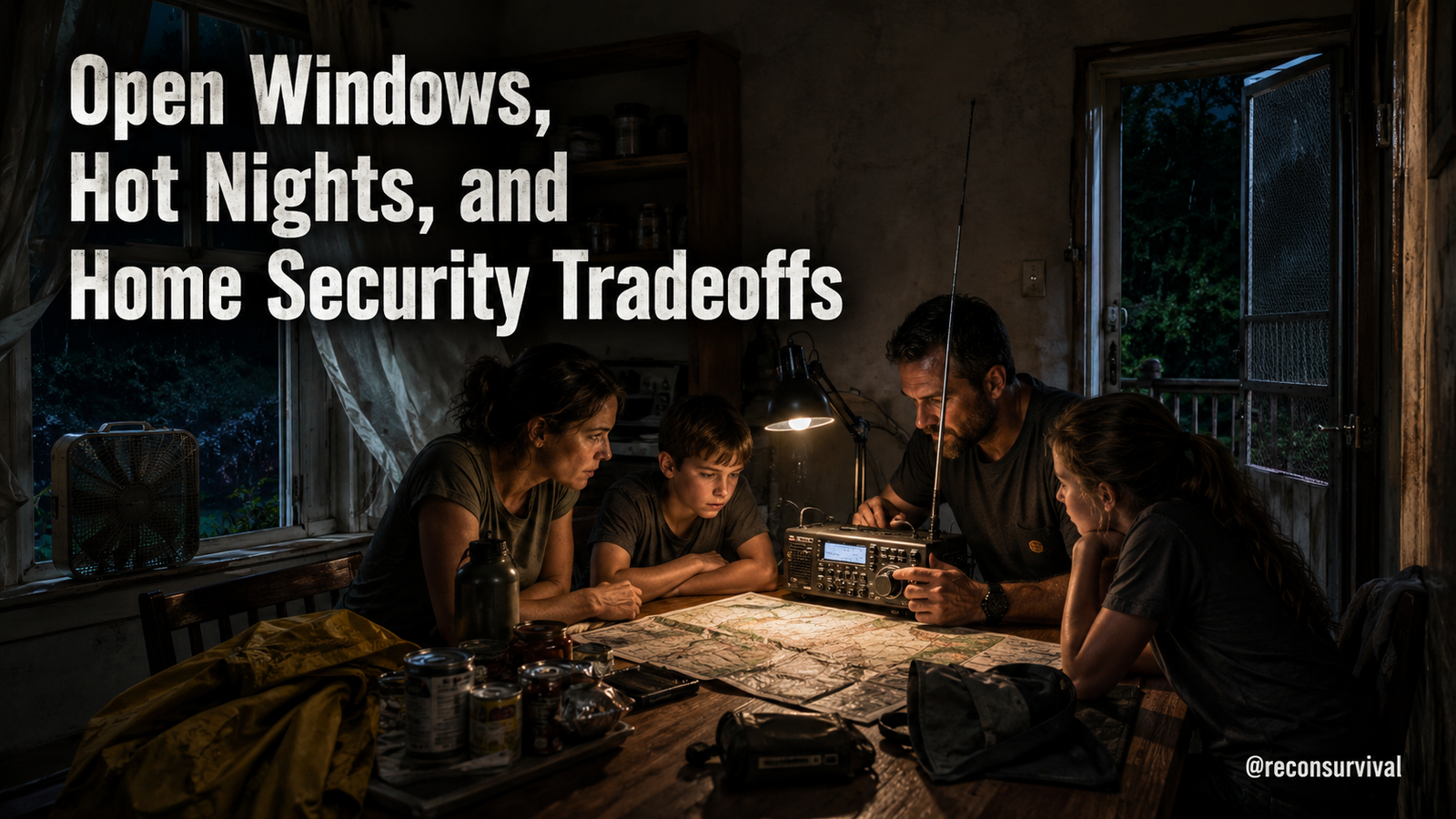
The air inside the living room feels thick, a humidity blanket that presses against the skin. Outside, the screen door slaps shut in the evening breeze, a rhythmic sound that signals the start of the cooling period. But as the sun dips below the horizon and the ambient temperature drops just enough to make the house bearable, the temptation hits. To keep the room cool without turning on the electric fan that needs power, you must open the windows. You must crack the casements wide to let the hot, stagnant air out.
As an Amazon Associate, I earn from qualifying purchases.
This simple act of opening a window introduces a vulnerability that most households ignore until an emergency strikes. The heat forces doors and windows open, but doing so without a plan creates an immediate tradeoff between comfort and safety. Most advice on this topic is either too generic, telling you to lock up tight, or too late, suggested after the heat has already made the house feel like an oven. The useful part is simple: balance ventilation and security when heat forces doors and windows open before stress makes the decisions harder. This is where the house is calm, which is when you can actually execute the necessary steps to protect yourself and your family without compromising the ability to breathe easy.
The Living Room and Window Mechanics
Begin the inspection in the largest room of the house. Walk to the primary window facing the prevailing breeze. Check the window screen for tears that allow insects but not air; a torn mesh reduces cooling efficiency. Look at the frame. Is it warped from the summer sun? Does it stick? If you force the window open, the latch may not engage fully. Test the lock mechanism. Pull the handle and try to rattle it. If the window opens more than a foot without a secondary latch or a specific security bar, you are creating a gap that allows an intruder direct access.
Move to the secondary window in the room. This one often stays closed during the day to block the sun, then opens at dusk. Examine the sash lock. Is it rusted? Does it require significant force to turn? If the lock is stiff, it might fail when heat expands the metal. Check the window seat. Is there a chair placed directly in front of it? A chair in front of an open window acts as a barrier, but if it is light and can be pushed, it is ineffective. Consider the screen door. Does it have a magnetic catch? A strong magnetic catch can hold the door closed against a breeze, but if the latch fails, the door swings open completely. Ensure the magnetic latch has a secondary latch that can be engaged from the inside.
Why This Matters for Off-Grid Living
In a standard power grid, air conditioning handles the heat load. In an off-grid scenario, the heat load is removed by convection and evaporation. This process requires open pathways. If you seal the house tight to prevent intrusion, the temperature inside will rise to dangerous levels quickly. Conversely, if you leave the house fully open to cool down, you provide a direct invitation for unauthorized entry. The stakes are high because, without electricity, a broken window means a loss of cooling and a loss of security simultaneously.
The Common Mistake of Gear Obsession
The most common mistake people make with this topic is assuming that buying expensive locks or security bars solves the problem. While high-quality deadbolts are essential, they do not stop someone from opening a window that is unlatched. A security bar installed on a sliding window might be sturdy, but if the window is designed to lift out of its track, the bar is useless. People wait too long to balance ventilation and security when heat forces doors and windows open. They run to the home improvement store to buy a new lock, install it, and then immediately open the window to cool down, forgetting that the new lock might be stiff and require a key to open in an emergency.
The mistake is also assuming that visibility is a simple matter of lighting up the exterior. Lighting a porch does not stop someone from climbing a ladder. Lighting a window does not stop someone from crawling through a gap. The mistake is treating security as a static state rather than a dynamic process that requires constant adjustment. The house is calm now, but the heat wave will change the conditions tomorrow. You need a system that adapts to the changing environment, not a piece of hardware that remains unchanged.
Recon Survival Principle: Visibility, Prevention, and Habit Formation
Security is not a product; it is a series of habits that must be reinforced daily. The Recon Survival practical system for how to balance ventilation and security when heat forces doors and windows open relies on three pillars: visibility, communication, and prevention. These pillars are built on actions you can take in your own space.
First, prioritize visibility. This does not mean buying expensive motion-sensor lights. It means ensuring that the immediate approach to the window is well-lit from the inside. If you are outside, an open window is easier to see if the interior is dark. Turn on a nightlight in the room where the window is open. Use a battery-powered lantern if the power is out. Second, prioritize communication. Who knows the status of the windows? If you live alone, you do not need to communicate, but you must communicate with your own plan. Know the failure points of your home. Third, prioritize prevention. This involves checking the mechanical integrity of the window before you open it. If the window is loose, secure it temporarily with a tension rod or a specific security device that is easily removable.
These steps form the foundation of a security system that works in the real world. They are not about fear; they are about maintaining control over your environment. By focusing on these habits, you create a buffer against the risks of summer heat.
The Bedroom and Entry Points
Move to the bedroom. This is where you and your family spend the night, making it the most critical room for ventilation and security. Check the window lock. If the window is in a first-floor bedroom, the lock must be robust. Install a security bar if the window is sliding. Test the bar with weight to ensure it holds. Check the bed placement. Is the bed positioned close enough to the window to block a direct climb? If the bed is against the wall, you have blocked a climbing route. Move the bed away from the window if necessary, but ensure the bed can be moved quickly if an emergency occurs.
Next, check the entry door. If the bedroom door opens to the outside, or if there is a window leading to a porch that connects to the outside, treat these as additional entry points. A window leading to a porch is a weak point. Ensure that the window leading to the porch has a lock and that the porch is not easily accessible from the ground. Check the light switches. Are they accessible from the bed? If a power outage occurs, you need to be able to turn on a light without leaving the safety of your room. Check the nightstand. Is a flashlight there? Is a phone charger there? Ensure you have a backup power source for communication devices.
The Kitchen and Utility Areas
In the kitchen, the ventilation needs are often higher due to cooking. However, the security risks are also higher if the house is open. Check the windows in the kitchen. These windows are often larger and may have screens that are less secure. Install security bars or tension rods if necessary. Check the exhaust fan. If the fan is broken, the kitchen will become hot and smelly. If the fan is working, ensure it does not require electricity to operate, or have a backup. Check the refrigerator. If the power is out, the food will spoil. Ensure you have a way to keep the refrigerator cool without electricity, such as frozen water bottles or dry ice.
In the utility area, check the water storage. If the water supply is disrupted, you need to have enough stored water for drinking and hygiene. Check the filtration system. Ensure the filter is clean and the system is functioning. If the water supply is out, you need to have a way to purify water from other sources. Check the waste disposal. If the garbage is not collected, it will attract pests. Ensure the garbage cans are sealed and placed away from the windows.
Do Today
The best time to check your security is when the house is calm, which is when you can actually execute the necessary steps to protect yourself and your family without compromising the ability to breathe easy. Start by identifying the windows that are most likely to be opened during a heat wave. Test the locks on these windows. If a window is loose, secure it with a tension rod or a specific security device. If a window is high on the wall, consider installing a security bar. If a window is low on the wall, consider installing a mesh screen.
Next, assess the entry points. Check the doors. Ensure they have working deadbolts. If a door is loose, secure it with a strike plate or a door reinforcement kit. Check the locks on the outside. Ensure they are not rusted or broken. If a lock is broken, replace it immediately. Check the windows on the ground floor. Ensure they are not easily accessible from the outside. If they are, install a security bar or a specific security device.
Finally, establish a routine for balancing ventilation and security. Every time you open a window, check the lock. Every time you open a door, check the deadbolt. Make this a habit. By doing so, you create a security system that works in the real world. You do not need to fear the heat or the summer nights. You just need to take the steps to protect yourself and your family. The goal is to maintain that regulation while keeping the home secure. This balance is achieved through specific mechanical advantages and behavioral habits, not by buying more gear.
- Check every exterior door for full latch contact and smooth deadbolt travel.
- Replace loose or short strike-plate screws where the frame and hardware allow it.
- Open, close, and lock each ground-level window, then note any stuck latch or broken screen.
- Test motion lights at doors, walkways, driveway edges, and dark corners after sunset.
- Trim one visibility problem near a door, window, gate, or walkway.
- Put a working flashlight and charged battery bank where people sleep.
- Write the household contact plan on paper and place it with the radio or main flashlight.
- Assign one person to recheck the list after the next storm, outage, or heat alert.